
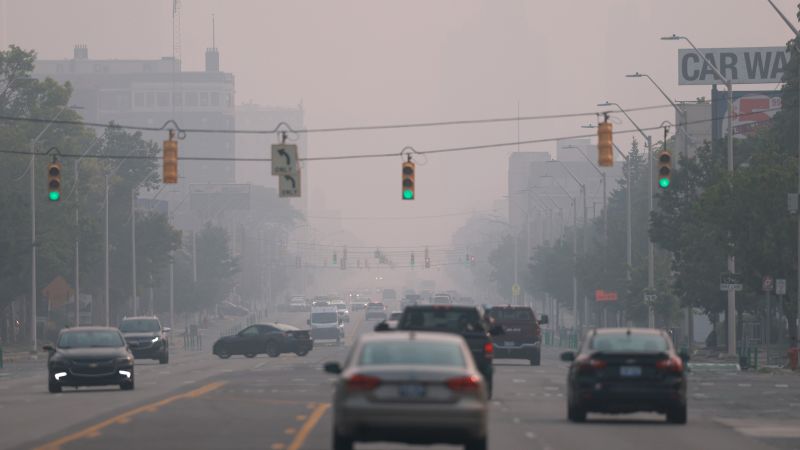
Why air quality can still be bad even if the sky doesn’t look smoky
Qwenews.com – Over 120 million people will face deteriorating air conditions this weekend due to wildfires, yet the presence of harmful smoke may not be immediately obvious. While some regions show clear signs of pollution—like an orange hue and a faint scent of burning—others could have no visible clues. This doesn’t guarantee the air is safe, as toxic particles might still be present without altering the sky’s appearance.
“Just because it does look a little bit less brown and orange today doesn’t necessarily mean that the smoke’s not there,” said Dan Westervelt, an atmospheric scientist at Columbia University.
Visibility of smoke depends on various elements: the composition of pollutants, the duration the plume has lingered, atmospheric conditions, and sunlight angles. Even when smoke appears to dissipate, its chemical makeup could still pose risks. As a result, relying solely on visual cues isn’t enough to assess air safety.
Understanding the Chemistry of Smoke
When trees ignite, heat decomposes plant matter, releasing flammable gases. These gases can combine with oxygen to form carbon dioxide and water vapor. However, if the fire lacks sufficient oxygen, more dense smoke and harmful chemicals are produced. This smoke often carries a distinct yellow, orange, or brown tint, attributed to “brown carbon”—a term for thousands of complex compounds.
Brown carbon contributes to the sky’s color by absorbing shorter wavelengths of light (like blue and ultraviolet) and allowing longer wavelengths (reds, yellows, oranges) to pass through. It falls under particulate matter 2.5 (PM 2.5), which measures roughly 2.5 micrometers in size—about 30 times smaller than a human hair. These microscopic particles can bypass the body’s defenses, infiltrating lungs and triggering respiratory or cardiovascular problems.
PM 2.5 is a critical concern, prompting widespread safety advisories to stay indoors and use air filters. These particles travel vast distances and stay airborne for days, sometimes weeks. Meanwhile, particulate matter 10 (PM 10), slightly larger at around seven times the width of a human hair, also causes health issues but tends to settle faster due to gravity or rainfall.
How to Minimize Health Risks
Wildfire smoke not only affects air quality but can also intensify over time. Even when it loses its visible color, the chemical composition might become more hazardous. For instance, brown carbon can undergo oxidation, where sunlight breaks down its molecular structure, altering both its appearance and toxicity. This process may make the smoke seem clearer, yet it can generate additional harmful pollutants like ozone.
Ozone, a toxic gas, acts as a lung irritant, similar to sunburn. It doesn’t originate directly from burning vegetation but forms when nitrogen oxides and volatile organic compounds in smoke react under sunlight and heat. This chemical reaction creates ground-level ozone, which can inflame airways and cause breathing difficulties. Despite its invisible nature, ozone poses significant health risks, underscoring the need for vigilance even when skies appear clear.