
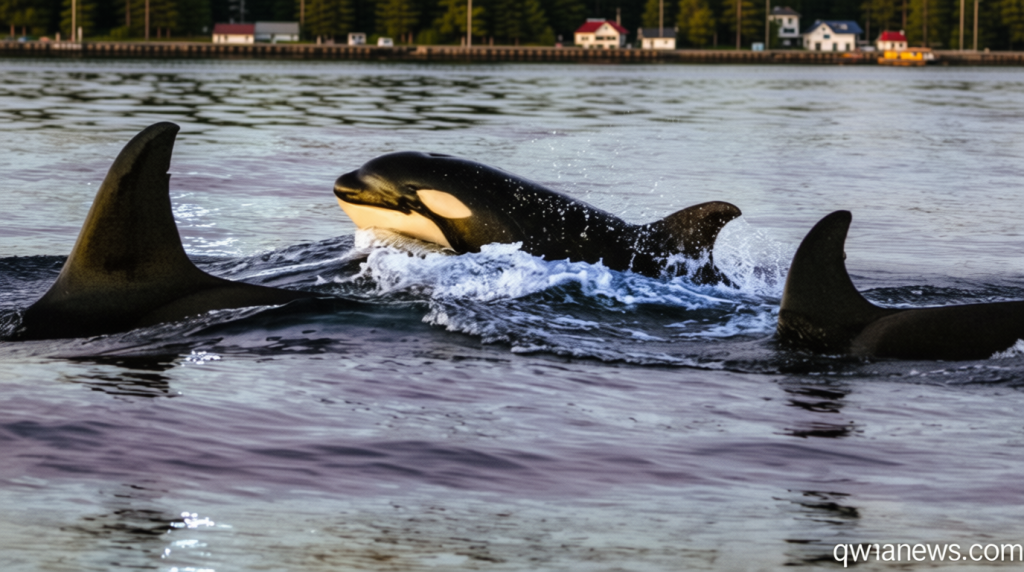
Qwenews.com – How hard do you have to ram a fish to make it explode? Ask an orca. Barreling into large, heavy fish with enough force to blast them into instant chum is a previously unknown collaborative feeding strategy among orcas, scientifically called Orcinus orca, also known as killer whales.
But in 2024 and 2025, divers captured underwater video of two such events in the Mexican Pacific Ocean and in the Gulf of California. The footage suggests that the brutal body slamming may be in service of a meal — or perhaps a form of play for the orcas, researchers reported Thursday in the journal Frontiers in Ethology. “I filmed the first event several years ago and couldn’t believe what I was witnessing,” said lead study author Kathryn Ayres, a research scientist for the marine conservation nonprofit Beneath the Waves and the first to capture orcas’ high-speed ramming on video.
Ayres studies sharks but observing orcas that preyed on sharks in the Gulf of California sparked her interest in killer whale behavior. She filmed the encounter on July 29, 2024, while diving as an ocean safari tour guide with the group Latitude Encounters, near the coast of San José del Cabo in the Mexican state of Baja California Sur. “The cooperative ramming behaviour itself wasn’t entirely new to me, as I had previously observed similar coordinated ramming during a hunt involving a whale shark,” she told CNN in an email.
Some dolphins appear to have orca friends. Scientists think they have figured out what’s going on Orcas have also made headlines in recent years for teaming up to ram and sink yachts in waters near Spain and Portugal. “What was unique in this case was the outcome,” Ayres said.
“Seeing the sunfish fragment into countless pieces was unlike anything I had encountered before.” Her astonishment was audible as she recorded the ramming episode. “Oh, god!” she repeatedly exclaimed. A second video of orcas holding and then ramming a sunfish was filmed by another tour operator in the Gulf of California in September.
Both incidents demonstrated teamwork; one orca held a sharptail sunfish, scientifically named Masturus lanceolatus, by its tail, while another orca swam toward the fish at high speed. Moments before impact, the restraining orca let go, and its partner slammed into the sunfish like a freight train hitting a watermelon. Young orcas then gobbled up fish fragments that drifted through the water as their elders tore into what was left of the sunfish’s corpse.
Sharptail sunfish, or molas, are among the heaviest fish in the world, weighing more than 4,000 pounds (1,800 kilograms) and measuring up to 10 feet (3 meters) long. Drone footage reveals orcas using tools in a stunning first Orcas often coordinate their attacks in pairs or groups when they target large prey. However, this torpedolike body slam and subsequent fish explosion had never been observed before and was “an incredible behavior to see,” said Monika Wieland Shields, director of the Orca Behavior Institute.
Shields was not involved in the new research. “I have never heard of anything similar to this occurring, so it is indeed a newly documented behavior as far as I know,” Shields told CNN in an email. Though all orcas belong to a single species, their diets vary widely depending on where they live.
Orcas’ prey may include fish, seals, belugas, narwhals, baleen whales or porpoises, and can require specialized feeding tactics — including, it seems, high-impact fragmentation. “I think that as we continue to observe orcas more closely around the world,” Shields added, “we will continue to discover novel hunting and feeding behaviors, especially among lesser-studied populations.” Ramming the sunfish and causing them to explode could help orca calves and juveniles get more of the remains, according to the study. What’s more, working together strengthens social bonds in orcas, as do shared meals.
An exploded sunfish spread out in the water in thousands of pieces is certainly easier to share, offering another possible explanation for this practice. But orcas are also known to play with newly dead food. Some orcas in Puget Sound off Washington state have worn dead salmon as hats.
Others drape seal intestines over their fins or take turns tossing sea lion pelts into the air, Shields said. Orcas seen hunting great white sharks to eat their livers in drone footage recorded in Mexico “We’ve also seen interactions with many other objects including bull kelp, driftwood, and crab pots,” she said, “In many of these cases there doesn’t seem to be a functional reason for these behaviors other than play.” In other words, it’s possible that orcas body-slam sunfish purely for entertainment. Ayres noted a large wound on the fish’s body before the impact, which hinted that the orcas feasted on the creature before slamming it to pieces.
“They had already consumed the sunfish’s internal organs, which are the most nutrient-rich parts of the prey,” Ayres told CNN in an email. “This suggests that causing the sunfish to explode may not have served an immediate feeding purpose and could have just been for fun.” Scientists capture rare footage of endangered orca pod The sunfish’s flattened body structure is unusual in large fish and could make them more likely to fly apart after a high-speed orca impact compared with other types of fish, Ayres added. “Their bodies are laterally compressed,” she explained.
“Once the nutrient-rich internal organs have been removed, the remaining tissues may be more accessible to rupture under high-impact ramming.” But for now, she cautioned, this is only a hypothesis. “We haven’t seen this type of prey fragmentation described in other sunfish species,” she said, “so it’s difficult to know whether it reflects something unique about the anatomy of Masturus lanceolatus, the specific behaviour of these orcas, or a combination of both.” Mindy Weisberger is a science writer and media producer whose work has appeared in Live Science, Scientific American and How It Works magazine. She is the author of “Rise of the Zombie Bugs: The Surprising Science of Parasitic Mind-Control” (Hopkins Press).
Sign up for CNN’s Wonder Theory science newsletter. Explore the universe with news on fascinating discoveries, scientific advancements and more.