
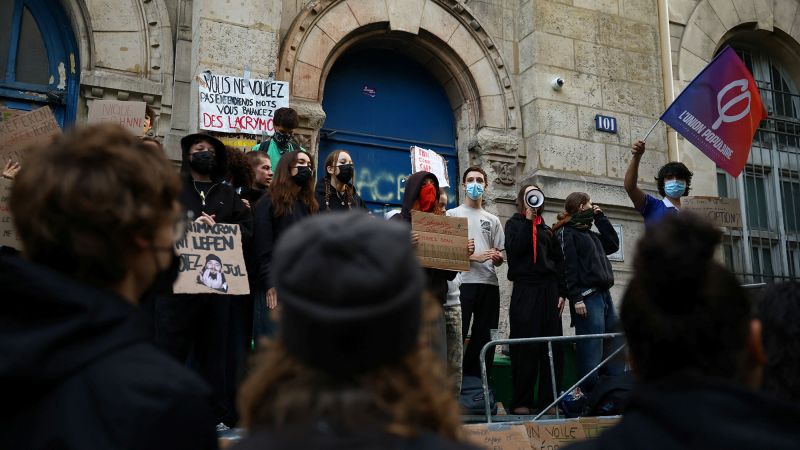
France’s School Protests Escalate Into a National Crisis
Qwenews.com – France is facing its most significant wave of student unrest in decades, with demonstrations that began at a single suburban school now disrupting communities across the country. Schools have closed, thousands of people have been taken into custody, and confrontations between protesters and police have left students, teachers and officers injured.
The movement has exposed long-running anger over crowded classrooms, staff shortages and resources that many students believe have failed to keep pace with growing enrollment. While the protests began over conditions inside schools, their rapid expansion and episodes of violence have turned them into a major political and public-order challenge.
A local dispute that spread nationwide
The first protest took place on September 21 at Saint-Exupéry high school in a suburb north of Paris. Students joined striking teachers who were demanding more staff and better resources. The school received additional personnel, ending the immediate strike, but the wider frustration did not disappear.
Student leader Manès Nadel said the movement quickly moved far beyond its starting point.
“It’s an unprecedented number of schools that are now involved.”
He said the Education Ministry had been “totally overwhelmed by the crisis.” Students at lycées in Paris and nearby areas began blocking entrances, and similar actions soon appeared throughout France, from Lille in the north to Marseille in the south.
Authorities estimate that hundreds of thousands of people joined protests on Tuesday, including students, teachers and trade union representatives. More than 100 high schools have sustained damage since the movement started.
Injuries, arrests and clashes with police
The protests have frequently moved beyond peaceful school blockades. In Paris, tear gas drifted through streets where rubbish bins, desks and chairs were set on fire. Riot police carrying shields and batons confronted some demonstrators.
More than 5,000 people have been detained, with minors who had no prior criminal record making up most of those held. A sharp increase in violence late last week brought roughly 2,000 detentions in one day alone. The interior minister said the unrest had shifted from student-led demonstrations toward broader urban violence.
Serious injuries have intensified concern about the tactics used by both protesters and police. In Lens, in northeastern France, a student lost a hand after allegedly picking up a grenade. Another student, in Tours, lost the use of an eye. Students, teachers and police officers have all been hurt during the unrest.
Police conduct has also come under scrutiny. Footage from Alençon showed an officer using a headlock on a girl, despite that restraint technique being prohibited by law. Critics have argued that the response has been excessively forceful, while authorities have emphasized the need to contain vandalism, arson and attacks linked to the demonstrations.
Why students say the system is failing them
Behind the dramatic scenes is a deeper dispute over the condition of France’s public education system. For years, students have shared videos showing classrooms without enough desks or chairs, as well as lessons cancelled because absent teachers were not replaced.
A rise in births in France in 2010 has increased the number of students now reaching high school age. That growth has put added pressure on secondary schools that have experienced years of funding reductions in real terms. France has 250,000 more students enrolled than it did in 2008, yet secondary schools have fewer teachers than they had then.
Class size is a particular point of concern. In the public system, 70% of classrooms have more than 30 students. For protesters, that figure represents a daily reality: limited individual support, stretched teachers and learning conditions they say are no longer adequate.
The grievances therefore extend beyond one school or one academic year. The protests have become a public expression of dissatisfaction among students who feel their concerns have repeatedly been sidelined.
Political pressure grows on the government
The government’s initial reaction drew criticism from those who felt officials focused too heavily on the involvement of the far-left La France Insoumise party, known as LFI, and its presence at barricades. Jean-Luc Mélenchon, the party’s leader and a figure expected to perform strongly in next spring’s presidential election, has defended students’ right to protest as well as his party’s participation.
Attention has also centered on the financial cost of the destruction. Damage to schools in the greater Paris region is estimated at 7 million euros, or $7.84 million.
Officials made an early concession involving fees planned for technological high schools in 2027. The proposal has since been removed from the government’s budget, but that step has not ended the broader mobilization.
“The government’s response has been irresponsible and it confirms exactly why the students are angry, because they are never heard.”
Manès added:
“They are responding only with repression.”
After the escalation in violence, Education Minister Edouard Geffray met student representatives on Friday. The discussion ended without an agreement, leaving the government under pressure to address both the immediate disorder and the structural problems that drove students into the streets.
A protest movement with wider consequences
International commentary has added another layer to the crisis. US President Donald Trump wrote on Truth Social that events in France represented “out of control mass migration” and claimed the protests were not about schools. Those remarks contrast with the demands voiced by students and teachers, which center on staffing, class sizes, funding and school conditions.
France now faces a difficult balancing act. Authorities must protect students, staff and public property while responding to a generation of pupils who see the education system as increasingly unable to meet their needs. Whether talks can produce meaningful changes may determine if the demonstrations begin to subside or become a defining issue in the months ahead.
Related Reading
Frequently Asked Questions
What is Unprecedented student protests are rocking France?
Unprecedented student protests are rocking France is the main topic of this guide. The article explains the context, practical details, and next steps readers should understand.
Why does Unprecedented student protests are rocking France matter?
Unprecedented student protests are rocking France matters because readers are looking for a useful answer, not just a short summary. Good content should match search intent and help them decide what to do next.