
Iran Signals Readiness for a Prolonged New Phase of Conflict
Qwenews.com – Iranian military leaders are openly preparing the country for the possibility of renewed fighting with the United States, pairing threats against Washington and its partners with claims that new weapons and targets are ready for use.
The messaging comes nearly nine months after the United States and Israel began their war against Iran in February. The conflict has since settled into a tense impasse: Tehran cites its survival as proof of success, while Washington points to the damage inflicted on Iranian state and military capabilities. Neither side has shown signs of accepting the other’s definition of victory.
Iran’s leaders have used recent public statements to suggest that any fresh military campaign could spread beyond the immediate region. Officials have raised the prospect of targeting undersea internet cables, artificial-intelligence data centers and oil and gas facilities across the region. The apparent aim is to make clear that a resumption of hostilities could carry consequences far beyond direct strikes on Iranian territory.
“The world will be amazed.”
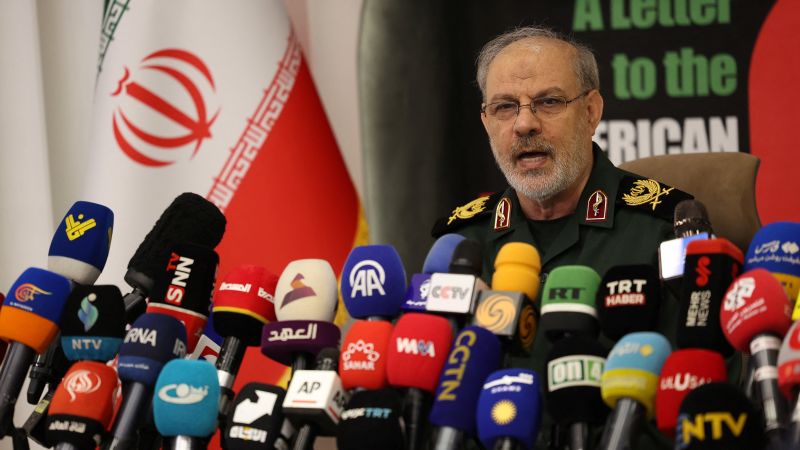
Hossein Mohebbi, a spokesperson for Iran’s Revolutionary Guards, made that declaration late last month while asserting that Iran had selected targets that had not previously been struck.
“We have new targets that have not yet been attacked.”
Mohebbi has also argued that the confrontation remains unfinished and that the Revolutionary Guards are positioned for an extended struggle.
“The war is not over.”
“The Islamic Revolutionary Guard Corps has prepared itself for a long-term war.”
Military threats and a more aggressive posture
Over the past month, Iranian commanders have increasingly emphasized what they describe as substantial new weapons stockpiles. Their statements have portrayed those capabilities as available for attacks outside the region if Washington restarts combat operations.
Iran is also signaling a doctrine that appears more offensive than purely defensive. Rather than waiting for another strike, its military leadership has indicated that pre-emptive action could be considered. Revolutionary Guards social-media accounts said last week that nationwide exercises included the launch of 30 ballistic missiles at once.
The exercises and public threats serve several purposes. They project military confidence abroad, reinforce deterrence at home and warn that a new round of fighting could affect international infrastructure, energy markets and military bases used by the United States and its allies.
Farzin Nadimi, a senior fellow at The Washington Institute who focuses on US policy in the region, said that a decision by Tehran to employ long-range missiles against Europe could place US forces at air bases in England at risk. Potential targets could also include Ramstein in Germany, the largest US military installation in Europe and a major logistics hub.
Washington weighs its options
Inside the White House, advisers have recently met to examine possible approaches to Iran. President Donald Trump has said publicly that he would not pursue new action before the midterm elections. But advisers have privately expressed uncertainty over whether that position is final or could change before voting day on November 3.
The US military has prepared additional strike options for use if Trump orders a return to combat, either before or after the election. Those plans could include the GBU-43/B Massive Ordnance Air Blast Bomb, widely known as the MOAB, against Iranian energy infrastructure and nuclear locations.
The MOAB is the largest non-nuclear weapon in the US arsenal. Its use would represent a major escalation, particularly if directed at infrastructure central to Iran’s energy sector or sites tied to its nuclear program.
Alireza Sheikh, an Iranian army commander, dismissed such threats as an effort to frighten the population.
“These are propaganda tools intended to intimidate the Iranian people.”
“The Iranian people are the father of all bombs.”
Life under the expectation of renewed attacks
For many residents of Tehran, official claims of preparedness offer little comfort. The possibility of another bombing campaign has added to years of economic pressure and uncertainty, leaving people to make practical preparations while wondering whether fighting will resume without warning.
A 70-year-old Tehran resident described keeping power banks charged, storing water and preparing essential supplies in case attacks begin again.
“Every single day and every night, we’re waiting for the bombing to start again.”
“I’ve charged all my power banks, stocked up on water, and got everything ready, because the attacks could start again at any moment, any day.”
A mother of two spoke of the anxiety that accompanies sending her children to school through streets where Revolutionary Guards personnel remain visible and military facilities continue operating. She questioned what another US campaign could accomplish after earlier operations failed to remove Iran’s leadership or produce a negotiated settlement.
“I would like to know exactly what else the US is planning to bomb?”
“They couldn’t even take (the Iranian leadership) out. You couldn’t negotiate either. So, what’s the point of starting another war?”
Another Tehran resident said the expectation of war’s return has become a constant subject of conversation. The uncertainty itself, the resident said, has made daily life more difficult because people cannot stop anticipating the next possible attack.
“It’s all anyone can talk about…you just have it in the back of your head, is tonight the night? Is it tomorrow?”
The residents spoke anonymously so they could discuss their concerns freely. Their accounts underline the divide between military rhetoric and civilian reality. While commanders speak of missiles, deterrence and new targets, ordinary people are left to weigh school runs, household supplies, electricity and the possibility that a fragile stalemate could suddenly collapse.
The central unanswered question is whether deterrent language from both sides will prevent a new confrontation or instead make it more likely. With military planning continuing, political uncertainty surrounding the US midterm election and Iran promising a broader response, the conflict’s pause remains far from a durable peace.
Related Reading
Frequently Asked Questions
What is The world will be amazed Iran?
The world will be amazed Iran is the main topic of this guide. The article explains the context, practical details, and next steps readers should understand.
Why does The world will be amazed Iran matter?
The world will be amazed Iran matters because readers are looking for a useful answer, not just a short summary. Good content should match search intent and help them decide what to do next.