
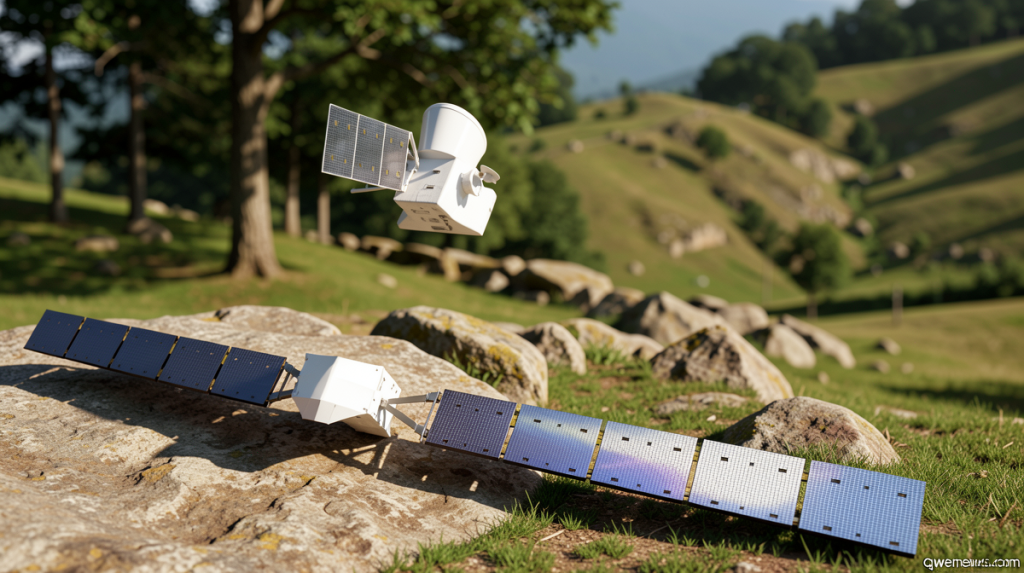
Nearly Eight Years After Launch, BepiColombo Reaches the Final Stretch Toward Mercury
Qwenews.com – At 8 a.m. Eastern Time on Thursday, a critical mechanical separation will unfold millions of miles from Earth: the Mercury Transfer Module — the propulsion backbone that carried the spacecraft across the inner solar system for years — will detach from the twin science orbiters stacked above it. The European Space Agency will stream the event live beginning at 7:45 a.m. ET, and a post-separation safety check is scheduled for 9:53 a.m. ET to confirm the spacecraft’s health after its marathon voyage.
The maneuver marks the end of the cruise phase of BepiColombo, a joint ESA–JAXA endeavor launched in October 2018 aboard an Ariane 5 rocket from Europe’s Spaceport at Kourou, French Guiana. Since liftoff, the vehicle has covered more than 6 billion miles (10 billion kilometers), threading a path through the inner solar system that no mission has attempted before.
Why the Journey Took So Long
Mercury sits roughly ten times closer to Earth than Jupiter does, yet BepiColombo has required more travel time than Galileo or Juno needed to reach the gas giant at the solar system’s outer edge. The reason is orbital mechanics, not distance.
“You can go faster to Mercury if you take a direct way to it,” explained Frank Budnik, flight dynamics manager for the mission at ESA. “But the problem is we want to insert into an orbit with respect to Mercury. You have to bring the spacecraft to the same velocity as Mercury has, and this is a very energy-demanding transfer.”
To shed enough kinetic energy for orbital capture, the spacecraft relied on a hybrid strategy: continuous electric propulsion supplemented by gravitational slingshots during a total of nine flybys involving Earth, Venus, and Mercury itself. Each encounter shaved velocity from the trajectory, gradually matching the spacecraft’s speed to that of the small planet it was meant to orbit.
A Name Carrying Scientific Heritage
The mission bears the name of Giuseppe “Bepi” Colombo, an Italian engineer and mathematician whose mid-twentieth-century analyses of Mercury’s unusual spin state reshaped planetary science. Colombo also devised the transfer trajectories that made NASA’s pioneering Mariner 10 flybys of 1974 possible. Naming the current mission after him underscores how much of today’s architecture rests on ideas first sketched decades ago.
What Awaits After Separation
The transfer module’s departure is not the finish line; it is the opening act of what mission operations describe as roughly six months of high-intensity activity. ESA’s Mercury Planetary Orbiter (MPO) and JAXA’s Mercury Magnetospheric Orbiter (MIO) will be captured by Mercury’s gravity on November 21. Between December 9 and 10 the two spacecraft will separate from each other. MPO will settle into its science orbit on December 16, while MIO will follow on March 10. Full science operations for both platforms are slated to commence in April.
“Unlike in other missions, BepiColombo’s arrival doesn’t mean a single event,” said Ignacio Tanco, head of Inner Solar System Mission Operations at ESA. “We have about half a year of intense operations ahead of us.”
“It will be the first time that a mission releases two fully independent, fully operational separate spacecrafts around a different planet,” Tanco added.
The operational risk is substantial. Tanco cautioned that the separation will occur under “exceedingly challenging” conditions and that the team must prepare for the possibility that things deviate from plan. He likened the post-separation phase to commissioning an entirely new spacecraft — one that has never been fully exercised in its target environment.
Two Orbiters, Two Complementary Views
Santa Martinez, BepiColombo mission manager at ESA, described the division of labor: MPO will image and characterize the planet’s surface, geology, and interior structure, while MIO will map the magnetic field, plasma environment, and exosphere surrounding Mercury. Together they will deliver the first comprehensive, simultaneous picture of both the solid body and its near-space environment.
Mercury: The Hardest Target in the Inner System
Average distance from the Sun: about 36 million miles (58 million kilometers). Orbital period: 88 Earth days. Peak daytime surface temperature: roughly 800 °F (430 °C). These figures, drawn from NASA planetary data, explain why Mercury has remained the least-visited rocky world in our neighborhood. Only two spacecraft have ever operated in its vicinity — Mariner 10 in 1974 and MESSENGER, which arrived in 2011 after a nearly seven-year cruise of its own.
The extreme thermal and radiation environment near the Sun forced engineers to design both orbiters to withstand conditions far beyond those encountered by typical deep-space probes. Every subsystem, from thermal control to communications, had to be validated for repeated exposure to temperatures that would melt ordinary spacecraft materials.
“The spacecraft in itself has been designed to operate within conditions which are extremely punishing,” Tanco noted.
If all goes according to plan, the data returned by MPO and MIO over the coming years will answer questions about Mercury’s formation, its iron-rich core, its thin exosphere, and the origin of its surprisingly strong magnetic field — questions that no single prior mission could address. The arrival sequence, for all its operational danger, is the gateway to the most ambitious planetary science campaign ever aimed at the Sun’s nearest neighbor.
Related Reading
Frequently Asked Questions
What is The BepiColombo mission begins its arrival?
The BepiColombo mission begins its arrival is the main topic of this guide. The article explains the context, practical details, and next steps readers should understand.
Why does The BepiColombo mission begins its arrival matter?
The BepiColombo mission begins its arrival matters because readers are looking for a useful answer, not just a short summary. Good content should match search intent and help them decide what to do next.