
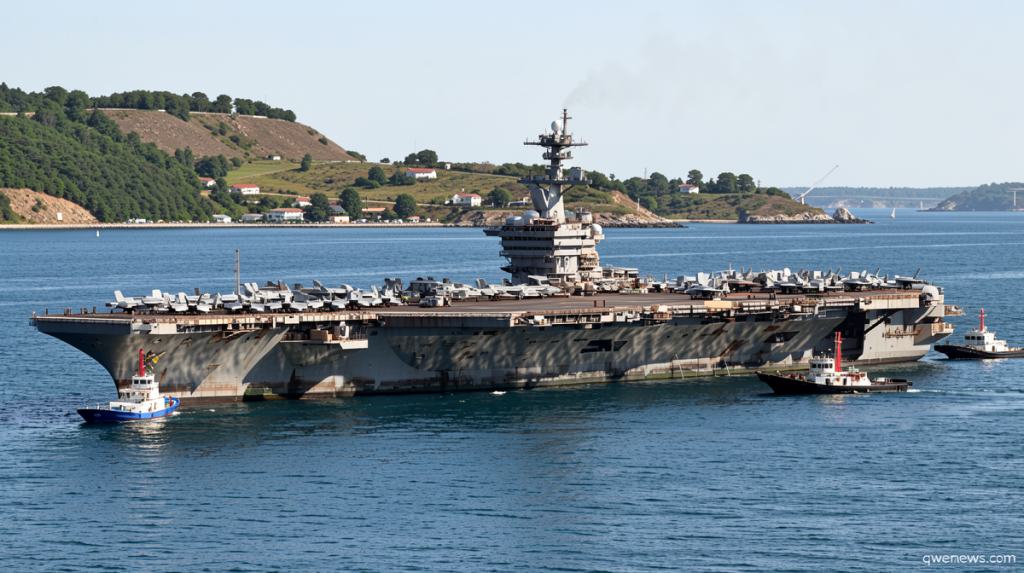
After Nearly Ten Months at Sea, USS Abraham Lincoln Returns to Port Covered in Rust
Qwenews.com – The Nimitz-class aircraft carrier USS Abraham Lincoln slipped into the commercial port of Laem Chabang, nestled along the Gulf of Thailand south of Bangkok, on Wednesday. What greeted dockside personnel was not the gleaming steel hull one might expect from a flagship of America’s naval power, but a vessel streaked in orange-brown corrosion from bow to stern. The roughly 1,100-foot warship had spent 286 days continuously deployed since departing its homeport of San Diego last November, a stretch that included months of active combat and blockade operations directed at Iran across the Middle East theater.
For those unfamiliar with the realities of prolonged maritime service, the sight was jarring. Yet naval veterans say the condition, while visually alarming, falls within the expected range for a ship that has endured such an extended operational tempo without access to dry-dock facilities.
Why the Rust Is Not a Surprise
Carl Schuster, a retired US Navy captain who completed three tours aboard Nimitz-class carriers of the same class as the Lincoln, explained that surface corrosion along the waterline becomes virtually inevitable once a vessel crosses the sixty-day threshold of uninterrupted sea operations. Saltwater immersion, constant wave impact, and the inability to perform routine maintenance while engaged in combat all conspire to accelerate the oxidation of unprotected steel.
“Rust along the waterline is 60 days or more of operations continuously at sea,” Schuster noted, emphasizing that the phenomenon is mechanical rather than a sign of systemic failure.
The practical implication is straightforward: the damage cannot be addressed while the ship is underway, particularly during active operations. Repair crews must be lowered alongside the hull, sand down the corroded areas, apply two coats of rust-preventative primer, and finish with two coats of standard naval gray paint. Schuster estimated that eliminating all visible corrosion on the Lincoln would require approximately thirty days of dedicated preservation work.
What Happens During the Thailand Port Call
The stop at Laem Chabang, expected to last several days, marks the crew’s first full rest-and-relaxation opportunity since the deployment began. Schuster cautioned that only high-priority tasks will be tackled during the brief visit. The bow and forward hull sections, which absorb the most kinetic and corrosive punishment as the ship plows through salt water—especially in choppy seas—will receive attention first.
“They will do only high-priority work during a seven-day port visit. The rust on the bow and forward hull areas will done first because they take the most abuse when the ship is moving, and they absorb the corrosive actions that accompany moving through salt waters, particularly choppy seas,” Schuster explained.
Corrosion on upper decks and superstructure can be treated while the vessel remains underway, provided conditions allow. Work along the waterline, however, demands that the ship be stationary and free from wave action so that painters and sanders can operate safely alongside the hull.
The Broader Maintenance Imperative
While the rust itself is cosmetic in the short term, naval engineers treat it as a structural threat if left unchecked. Oxidation progressively thins steel plates, compromising the integrity of decks, walkways, and lifelines—the very elements that keep sailors safe during rough weather or emergency abandon-ship scenarios.
“Rust is like a contagious disease. It spreads. So, it is better to deal with it early to contain it or deal with a much larger problem later,” Schuster warned. “It weakens any steel structure it attacks. So, you have to remove it before it has a decisive impact on your components.”
The Lincoln’s extended deployment has not produced only cosmetic problems. Crews have reported morale difficulties amid supply shortages, and at least one sailor went overboard during the operation. These incidents underscore the human cost of pushing a carrier beyond its planned maintenance window.
Political Pressure and the Rust Debate
US President Donald Trump, who has repeatedly pressed the Navy to shorten maintenance cycles and keep more hulls at sea, dismissed concerns about the Lincoln’s condition during the deployment, calling the assignment “not nearly long enough.” No further public comment from the White House has followed the carrier’s arrival in Thailand.
The president’s fixation on ship appearance is not new. Former Navy Secretary John Phelan recounted that Trump would telephone him in the middle of the night to press the rust issue. Speaking at a conference in Maryland, Phelan recalled the president’s repeated refrain:
“He has stated to me many times: ‘Shipbuilding, shipbuilding, shipbuilding. Get those ships out of maintenance yards. Fix the damn rust.’ He does not like it, and I don’t like getting calls in the middle of the night.”
The tension between political demands for maximum fleet availability and the engineering reality that steel hulls require periodic overhaul is now playing out in real time on the Lincoln’s corroded flanks. For the sailors who will spend the next several weeks sanding and repainting the waterline, the debate is academic.
“Fighting rust is one of the two most unpopular naval activities. The other being anything to do with plumbing. Hated both as a junior officer on a ship,” Schuster said, with the weary familiarity of someone who has spent decades watching the cycle repeat.
The Lincoln’s return to serviceable condition will ultimately require a full dry-dock visit back in the United States, where the hull can be inspected plate by plate. Until then, the orange streaks visible from Laem Chabang’s waterfront serve as a blunt reminder that even the most powerful warship in the world is, at bottom, a steel structure subject to the same chemistry that eats a ship’s railing or a harbor crane.
Related Reading
Frequently Asked Questions
What is Rusty state of USS Abraham Lincoln?
Rusty state of USS Abraham Lincoln is the main topic of this guide. The article explains the context, practical details, and next steps readers should understand.
Why does Rusty state of USS Abraham Lincoln matter?
Rusty state of USS Abraham Lincoln matters because readers are looking for a useful answer, not just a short summary. Good content should match search intent and help them decide what to do next.