
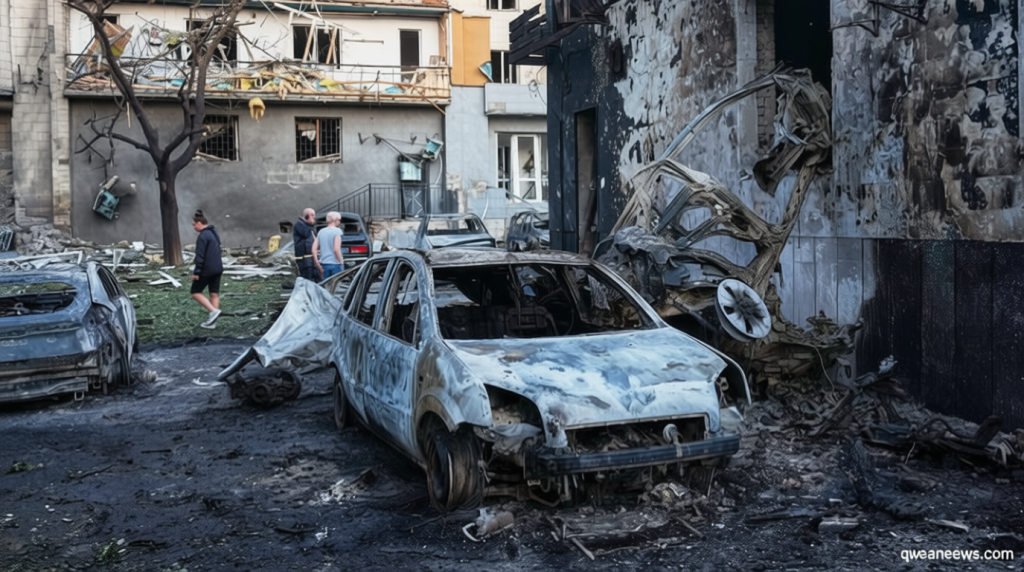
Russia Launches Largest Ballistic Missile Attack in Ukraine War: Kyiv Reports
Qwenews.com – Russia unleashes one of its biggest ballistic missile attacks of the Ukraine war, according to Kyiv. The assault, reported to have occurred overnight into Sunday, targeted the capital with a barrage of missiles and drones, marking a significant escalation in the conflict. Ukrainian officials confirmed the attack involved over 40 ballistic missiles and 120 attack UAVs, underscoring the scale of the operation. This strike comes amid ongoing efforts to disrupt Ukraine’s defenses and infrastructure, as the war enters its fifth year.
“The enemy launched more than 40 missiles of various types – most of them against the capital – and 120 attack drones,” said President Volodymyr Zelensky. He emphasized that Ukraine’s top priority remains defending against such strikes, stressing the urgency of acquiring advanced interceptors to counter the growing threat.
CNN reporters in Kyiv described the assault as one of the most intense in recent weeks. The majority of the missiles struck within a two-hour window, leaving the city in a state of alert and chaos. A strong smell of smoke lingered in the air, and residents reported widespread damage to buildings and infrastructure. Acting Foreign Minister Andriy Sybiha noted that the attack was the largest number of ballistic missiles since the war began, with around 40 launched on a ballistic trajectory to target key locations.
Interception Efforts and Global Supply Chain Pressures
Ukraine has repeatedly highlighted the need for more anti-ballistic missile interceptors to counter Russia’s increasing reliance on long-range weaponry. Zelensky reiterated this demand, stating that interceptors are essential to neutralize the threat posed by the attack. Despite production efforts in the U.S., the global demand for Patriot systems remains high, with allies also vying for access to the advanced technology. A proposed project to license Ukraine for local production of the system, championed by former President Donald Trump, could help ease supply pressures but would take months to implement.
France and Italy are collaborating with Ukraine to develop the SAMP/T missile system as an alternative, though analysts suggest its effectiveness may lag behind the Patriot. Fabian Hoffmann of the Norwegian Institute for Defense Studies noted that the market for ballistic missile interceptors is facing “limited suppliers, long lead times, and unresolved capability concerns.” The attack on Kyiv has intensified the need for a robust defense strategy, as the war continues to evolve with new military tactics.
Energy Infrastructure and Strategic Targets
While the focus of the attack was Kyiv, Ukraine’s military also targeted Russian energy infrastructure in a broader campaign. Early Sunday, a drone strike hit an oil export hub near the Black Sea, damaging two tankers and disrupting oil loading operations. The Caspian Pipeline Consortium confirmed the incident, noting the strategic importance of the site in Russia’s supply chain. The same location had been hit on Friday, with Ukrainian forces using a maritime drone to strike a Russian un-sanctioned vessel, the Avero, which entered the Black Sea on Thursday.
Experts suggest the attack on Kyiv and the energy infrastructure reflects a dual strategy: weakening Ukraine’s defenses while targeting its economic lifelines. The damage to the logistics warehouse and the oil hub highlights the potential for widespread disruption. As Russia continues its military campaign, the focus remains on maximizing the impact of its ballistic missile arsenal and forcing Ukraine into a defensive posture.
The Russian Defense Ministry confirmed the strike, describing it as a “massive attack” targeting “defense industry facilities and logistics centers in the city of Kyiv.” The statement added, “We’re loaded and carrying on,” indicating confidence in the operation’s success. This follows a pattern of aggressive strikes on critical infrastructure, with Kyiv reporting one fatality and 16 injuries in the recent assault. The event has raised concerns about the sustainability of Ukraine’s defenses and the potential for further escalation.
As the war intensifies, the scale of Russia’s ballistic missile attacks has become a defining feature of its military strategy. The attack on Kyiv is part of a series of large-scale strikes aimed at crippling Ukraine’s industrial and logistical capabilities. Analysts warn that such operations could force Ukraine to divert resources from frontline combat to infrastructure repair, altering the course of the conflict. The repeated use of ballistic missiles underscores the evolving nature of the war and the strategic importance of these weapons in Russia’s arsenal.
International observers have noted the significance of the attack in the context of the broader war. The focus keyword, “Russia unleashes one of biggest ballistic missile attacks,” has been used consistently to emphasize the event’s importance. With 23 missiles and 10 drones successfully striking Kyiv, the assault serves as a reminder of the destructive power of modern warfare. As Ukraine continues to resist, the nation’s resilience in the face of these attacks remains a key factor in shaping the conflict’s outcome.