
Heidenau Vote Triggers Anger Over Future of Holocaust Memorial Plaques
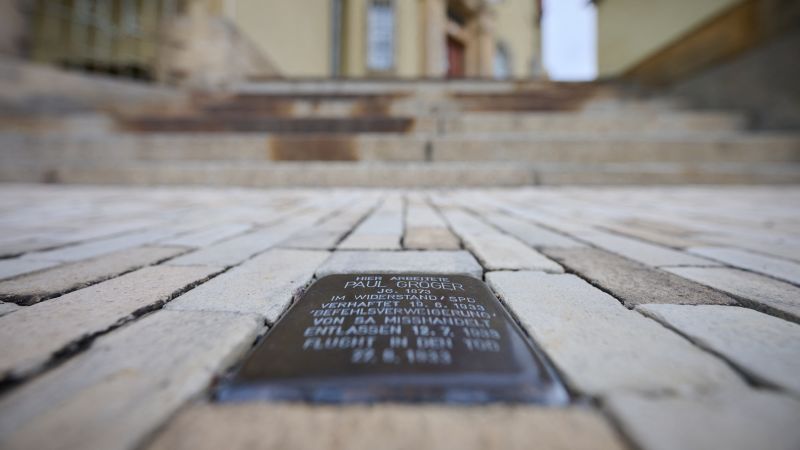
Qwenews.com – A decision by officials in the eastern German town of Heidenau to prevent additional Holocaust memorial plaques from being installed has prompted strong criticism from Jewish representatives, politicians and the artist behind the project. The dispute centers on Stolpersteine, or “stumbling blocks,” the small brass markers embedded in pavements to identify places connected to people persecuted by the Nazi regime.
Heidenau, near Dresden in Saxony, approved the measure in a city council vote on Thursday. The proposal came from the local branches of the far-right Alternative for Germany, known as AfD, and the center-right Christian Democratic Union, or CDU. Rather than allow new markers in streets, the parties suggested concentrating future Holocaust remembrance at the town’s memorial area in the northern cemetery.
The vote has become a flashpoint in a wider argument about how Germany remembers Nazi crimes, and about the political boundaries between mainstream parties and the far right.
Memorials placed in everyday life
Stolpersteine are generally 10-centimeter brass cubes set into sidewalks outside the homes or workplaces where victims of Nazi persecution last lived or worked freely. Each bears concise biographical details, commonly including a person’s name, deportation date and place of death. Their placement is central to the project’s purpose: remembrance is encountered in ordinary public spaces rather than confined to a distant monument.
German artist Gunter Demnig began the initiative during the 1990s. It has since grown into one of Europe’s most extensive decentralized memorial projects. Some 116,000 plaques have been placed across 31 countries, with Germany home to most of them.
Supporters view the stones as a quiet but persistent reminder that Nazi persecution affected individual neighbors, colleagues and families in familiar streets. Critics of the Heidenau decision argue that relocating commemoration to a cemetery would remove that direct connection between victims’ histories and the places where those lives unfolded.
AfD and CDU representatives in Heidenau argued that pedestrians may be walking over, or stepping onto, victims’ names. The explanation has been rejected by many defenders of the project, who say a passerby’s encounter with a plaque is meant to create a moment of reflection.
“They bring the names and fates of the victims into our everyday lives and prompt us to pause for a moment,”
Felix Banaszak, co-leader of Germany’s Green Party, called the decision a scandal and described the argument about people stepping on the markers as “absurd.”
Demnig rejects the ban
Demnig has also opposed the council’s action. He said the markers need to remain visible at the particular sites where people once lived or worked, and stressed their value in making history more tangible for younger generations.
He said the outcome did not surprise him in light of the AfD’s recent electoral gains. Addressing the CDU’s role, Demnig said the party “should perhaps drop its ‘C’. Because they’ve clearly left Christianity behind.”
Charlotte Knobloch, a Holocaust survivor and president of a Jewish association in Bavaria, described the council’s choice as the “completely wrong path.” Knobloch said she personally was not a supporter of the Stolpersteine concept, yet emphasized the importance of remembrance that remains visible in public life.
“decentralized commemoration that is not banished from public spaces”
Her response illustrates that the debate is not limited to whether every person favors one particular memorial design. The deeper concern for many critics is whether Germany’s culture of remembrance should be moved away from the streets, neighborhoods and daily routines where it can be encountered by people who may not otherwise visit a formal memorial site.
Pressure on Germany’s political firewall
The controversy also highlights growing strain around the Brandmauer, or “firewall,” an informal principle under which established German parties have sought to avoid cooperation with the AfD. The arrangement is intended to limit far-right influence over political decision-making and prevent its normalization within mainstream governance.
In Heidenau, the CDU’s support for a motion advanced with the AfD has brought criticism directed at the party’s leadership. It comes as Chancellor and CDU leader Friedrich Merz faces pressure after weak results in recent regional elections.
The AfD has repeatedly challenged established forms of German commemoration for atrocities committed under Adolf Hitler. In Saxony-Anhalt, where the party recently achieved its strongest state-election result, a prominent AfD official outlined a preferred shift in school history teaching with the phrase “more Bismark – less Hitler.”
At the federal level, Germany’s domestic intelligence service designated the party as a far-right extremist organization, though that classification is under review. Individual figures within the AfD have also faced accusations of extremism.
The International Auschwitz Committee condemned the CDU’s participation in the Heidenau vote. Its executive vice president characterized the move as an effort to exclude Nazi victims from the town’s public memory and send their remembrance to the cemetery.
“This is a transparent and despicable attempt to drive Nazi victims in Heidenau out of the city once again and dispose of them where, according to the AfD, their memory has belonged a long time ago — at the cemetery,”
For opponents of the decision, the issue reaches beyond a single town’s sidewalks. Stolpersteine are designed to preserve names where lives were interrupted, making historical responsibility part of the landscape of modern Germany. The Heidenau vote has therefore raised questions about whether local political choices can alter not only the location of memorials, but also the visibility of the history they are intended to keep alive.
Related Reading
Frequently Asked Questions
What is Outrage as East German town bans?
Outrage as East German town bans is the main topic of this guide. The article explains the context, practical details, and next steps readers should understand.
Why does Outrage as East German town bans matter?
Outrage as East German town bans matters because readers are looking for a useful answer, not just a short summary. Good content should match search intent and help them decide what to do next.