
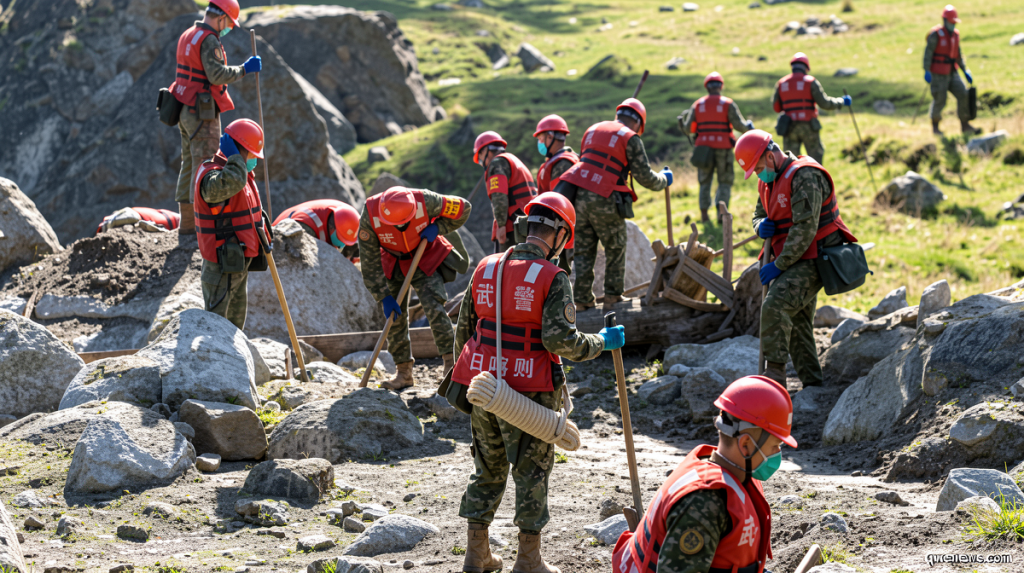
What Remains Where Gyirong Port Once Stood: A Moonscape of Stone and Silence
Qwenews.com – Where a five-story border checkpoint once towered over the surrounding valley, only the skeletal remains of concrete foundations jut from a field of shattered rock, packed gravel, and black sludge. Gyirong Port — the high-altitude gateway linking China’s Tibet Autonomous Region to Nepal’s Rasuwa district — no longer exists. An enormous landslide-triggered flood on August 26 erased the checkpoint, its adjacent travel agencies, a local supermarket, and the bridge spanning the river in a single catastrophic surge of water and mud. Emergency crews continue combing the debris field, searching for survivors among the rubble, while families on both sides of the Himalayan divide wait for answers that have yet to arrive.
The Moment of Impact
For decades, Gyirong Port functioned as one of the principal overland corridors between the two countries. Hundreds of travelers, traders, and logistics workers crossed the checkpoint daily, moving goods and people between the Tibetan plateau and the Nepali hills beyond. Surveillance cameras captured the instant everything changed: a wall of water and sediment, born from a mountain slope giving way above the valley, struck the port area with such force that it tore through the built environment and continued its destructive path into Nepal. Footage from the site shows figures sprinting for higher ground as the deluge arrived. No one at the port has been confirmed alive since.
A Scene of Utter Erasure
Those who have walked the disaster zone describe an environment of choking dust and low-hanging fog, with rescue vehicles parked along a road so badly damaged that crews had to lay down a gravel surface merely to make it drivable. Officials stationed at intervals direct the limited traffic through the area. Planted in a mound of wreckage, snapping in the cold high-altitude wind, a red-and-yellow Chinese flag marks the spot where the checkpoint’s main structure once stood. The building — a hulking, government-style facility that dominated the skyline of the crossing — has been reduced entirely to its buried base.
“All we could see afterward, once we started digging, was the foundation that remained. All of the structures above it had been swept away by the mudslide. It was really heartbreaking to see. So many of our fellow Chinese lost their precious lives in this disaster.”
Zhang Xiaojun, a rescue worker assigned to the site, spoke these words to journalists present during a government-arranged visit on Sunday. Reporters were issued hard hats and heavy boots to navigate the still-unstable, mud-saturated terrain and the persistent threat of secondary landslides on the surrounding slopes.
The Toll and the Silence
China’s most recent official tally, issued nearly two days before the journalist visit, placed confirmed deaths at 31 and missing persons at 531 on its side of the border. Local authorities in Tibet indicated that more than 250 of those missing are foreign nationals. Across both countries combined, authorities have confirmed over 1,000 fatalities, with thousands still unaccounted for. Nepal, by contrast, has been issuing frequent updates on rescue operations and confirmed deaths in its own affected districts, creating a stark asymmetry in the flow of information.
Beijing has not published a named list of individuals believed to have been at the port or missing on the Chinese side. Families — some in China, others scattered across continents — have pressed for specifics. The absence of a public roster has drawn criticism and fueled questions about transparency in a situation where every hour of silence deepens anxiety. The Chinese government has characterized its communications as open and timely, pointing to the invitation extended to roughly a dozen international journalists for the Sunday visit as evidence of that commitment. The trip was coordinated jointly by the Ministry of Foreign Affairs and the State Council Information Office. Journalists participating in the itinerary maintained independent editorial control over their reporting.
Distance as an Obstacle
The geography of the region compounds every challenge. Reaching the disaster site from Lhasa, the capital of the Tibet Autonomous Region, requires an approximately eight-hour drive through terrain climbing to altitudes near 13,000 feet (roughly four kilometers above sea level) before descending toward Dingri, the nearest city with an airport. From Dingri, another six hours of travel along a narrow, double-lane road threaded with hairpin bends through pine-forested mountains brings visitors down to the port’s lower elevation of about 6,000 feet. Those roads had only been cleared of debris on Wednesday, days after the initial catastrophe, underscoring how isolated the crossing had been and how long rescue teams faced before they could deploy at scale.
Why the Crossing Mattered
Gyirong Port sat at the intersection of two of Asia’s most significant overland trade and tourism routes. Before August 26, it processed a steady daily flow of commercial vehicles, backpackers, and diplomatic traffic. Its destruction — along with the bridge and adjacent infrastructure — effectively severs a critical artery of cross-border movement at precisely the time when both governments are coordinating a massive search-and-rescue operation. The long-term implications for trade logistics, tourism corridors, and bilateral infrastructure planning remain uncertain, though the immediate priority for every agency on the ground is finding those still buried beneath the stones and sludge where a functioning border post once operated.
Related Reading
Frequently Asked Questions
What is On the ground in China s wiped?
On the ground in China s wiped is the main topic of this guide. The article explains the context, practical details, and next steps readers should understand.
Why does On the ground in China s wiped matter?
On the ground in China s wiped matters because readers are looking for a useful answer, not just a short summary. Good content should match search intent and help them decide what to do next.