
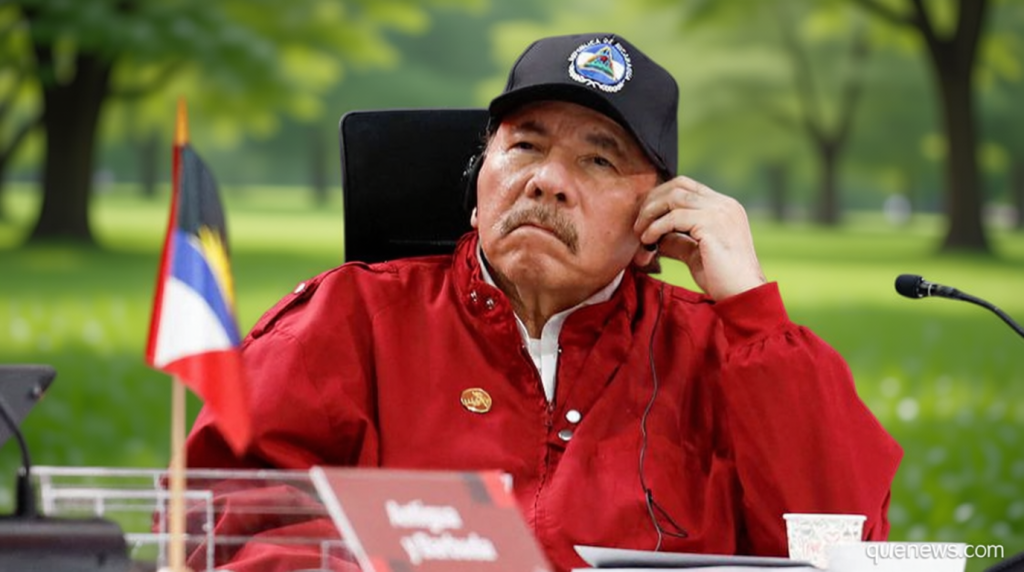
Nicaragua’s Ortega Vows ‘Never Again’ for Elections, Consolidating Power
Qwenews.com – Nicaragua’s president, Daniel Ortega, has declared that the nation will no longer hold elections, ensuring his continued control over the government and his wife’s co-presidential role. This bold statement, made during a speech commemorating the 1979 Sandinista revolution, signals a permanent end to the electoral process that once allowed for democratic competition. Ortega, who has led Nicaragua since 2007 and previously served as a revolutionary leader in the 1980s, aims to secure his regime’s dominance indefinitely, with his current term set to expire in 2027. By eliminating the possibility of electoral rivals, Ortega asserts that his rule will remain unchallenged, reflecting a shift toward centralized authority.
The decision to abolish elections follows years of political maneuvering designed to weaken opposition voices. Ortega’s administration has systematically detained critics, criminalized dissent, and manipulated electoral outcomes to maintain power. The 2021 election, for instance, was widely condemned as a farce, with over 2,350 officials and their families facing sanctions for alleged corruption and human rights abuses. In 2022, the government further entrenched its grip by amending the constitution to allow for extended presidential terms, enabling Ortega and his wife, Rosario Murillo, to govern with near-total authority. These measures have effectively removed the threat of democratic change, even as public sentiment against the regime continues to grow.
A New Era of Authoritarian Governance
“Ortega and Murillo are clearly determined to cement their control by eliminating the electoral process altogether,” stated Tiziano Breda, a senior analyst at Armed Conflict Location & Event Data. “Their actions reflect a fear that any political opening could lead to challenges against their power.” This sentiment aligns with recent developments in Nicaragua, where the ruling party has intensified its efforts to suppress opposition. The 2022 constitutional reforms not only extended Ortega’s tenure but also established a supermajority for the ruling party in legislative decisions, further entrenching their dominance. Critics argue that this marks the formalization of a one-party dictatorship, with the president now positioned to govern for life.
Ortega’s regime has faced mounting criticism for its human rights violations, including the violent crackdown on mass protests in 2018. Over 300 people were killed in that campaign, according to the UN Human Rights Council, which labeled the government an “authoritarian state.” The recent decision to abolish elections is seen as a direct response to these protests, aiming to prevent any future dissent. By eliminating the possibility of an electoral challenge, Ortega has positioned himself as the ultimate arbiter of Nicaragua’s political future, with his wife acting as a key ally in maintaining this structure. This has led to accusations that the pair has transformed the country into a consolidated autocracy.
International reactions to Ortega’s move have been mixed, with some nations expressing concern over the erosion of democratic norms. The U.S. State Department has yet to issue an official statement, but organizations like the UN have consistently criticized the regime’s actions. Meanwhile, regional allies such as Cuba and Venezuela have praised the decision, framing it as a necessary step to safeguard socialist governance. The global implications of this shift are significant, as Nicaragua’s example may inspire other countries to adopt similar models of centralized rule. For Ortega, the focus remains on maintaining stability through authoritarian means, even if it means sacrificing democratic institutions.
Historical Context and Long-Term Strategies
Ortega’s commitment to ending elections is not entirely new. Since taking power in 2007, he has implemented measures to control the political landscape, ensuring that his party, the Sandinista National Liberation Front (FSLN), remains the dominant force. The 2021 election, which Ortega won with a landslide, was followed by widespread arrests of opposition figures, effectively silencing dissent. This pattern has repeated in previous elections, including 2011 and 2016, where opponents were either marginalized or eliminated. The latest constitutional changes, however, represent a more permanent solution to this problem, allowing Ortega to govern indefinitely and ensuring that his wife Murillo holds equal power in the executive branch.
Nicaragua s Ortega says never again to elections as a strategic move to align the country with a centralized political model. By removing the electoral process, he eliminates the need for regular democratic checks, allowing the government to act with impunity. This strategy has already paid off, as the ruling party has consolidated control over key institutions, including the judiciary and media. The lack of electoral competition has enabled the regime to pass laws without opposition, further solidifying its grip on power. While some Nicaraguan citizens remain hopeful for change, the political climate suggests that Ortega’s vision of a unified state under his leadership is now the dominant narrative.
The decision to abolish elections has sparked debate about the future of Nicaragua’s democracy. Some analysts view it as a calculated step to ensure long-term stability, while others argue it represents a complete abandonment of democratic principles. The ruling party has framed the move as a way to protect Nicaragua from external interference, emphasizing national sovereignty. However, the absence of elections has also led to accusations of a lack of transparency and accountability, with critics pointing to the regime’s control over information as a key factor in maintaining power. As the nation moves toward a new political era, the question remains whether Ortega’s vision of stability will be seen as a triumph or a tragedy by future generations.