
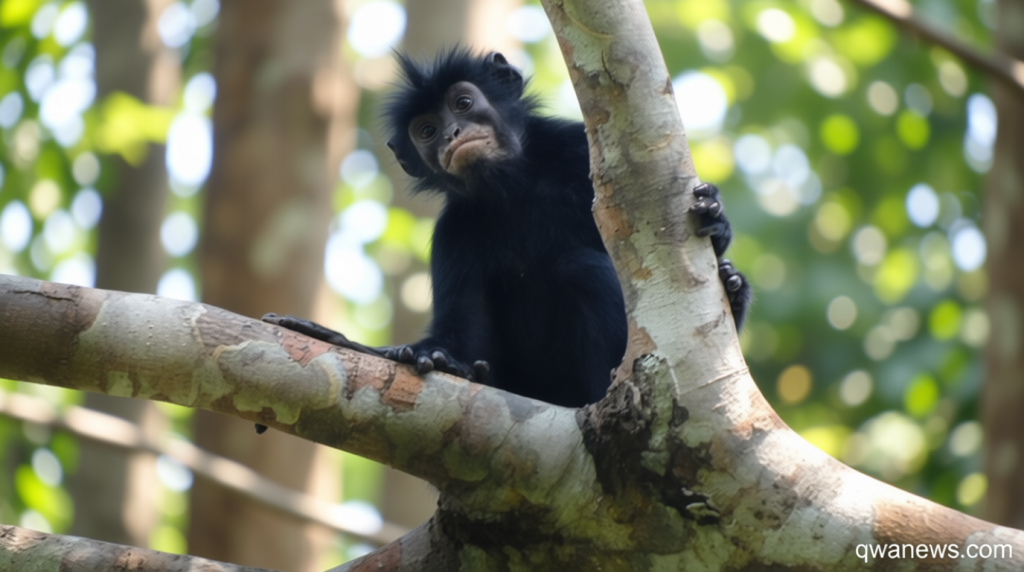
Monkey with Orange Lips Classified as New Species
Qwenews.com – A newly discovered monkey species, Colobus congoensis, has been recognized in the Democratic Republic of Congo. Known locally as Likweli, this primate boasts unique orange lips and a deep, resonant call that sets it apart from others. The findings, published in PLOS ONE, mark the fifth new monkey species identified in Africa over the past 75 years.
Physical Traits and Distinctive Features
Researchers from Florida Atlantic University and the City University of New York Graduate Center describe the species as having a glossy black coat, long fur, and a sweeping tail. Its most notable appearance includes orange-cream facial markings and dramatic facial features, enhanced by long black hairs and large folded ears. These traits, combined with its smaller size compared to related colobus monkeys—weighing approximately 15 pounds (6.8 kilograms)—help define its uniqueness.
Evolutionary Insights
According to the study, the species exhibits cranial, dental, and skeletal features that differentiate it from all other African colobus monkeys. Senior author Kate Detwiler, an associate professor at FAU’s Charles E. Schmidt College of Science, highlighted that its closest relative, Colobus satanas, is found over 1,200 kilometers away in west-central Africa. Genetic data suggests the two species diverged around 4 to 5 million years ago, indicating one of the earliest splits within the colobus lineage.
Discovery Timeline
The journey to confirm this species began in 2008 when researchers captured an unusual primate in east-central DRC. Over the next decade, they observed it more closely, culminating in 114 documented sightings between 2018 and 2022. To solidify its status as a new species, scientists analyzed museum specimens, compared anatomical data, and incorporated local ecological knowledge from communities near its habitat.
Conservation Challenges
Despite its recent identification, Likweli faces significant threats. Its habitat spans roughly 1,700 square kilometers, primarily within Lomami National Park. The study recommends classifying it as Endangered due to habitat loss and hunting pressures. Protecting this region is deemed essential to ensure the survival of the species.
Expert Commentary
“The analysis is very thorough and convincing,” remarked Alexander Georgiev, a primatology lecturer at Bangor University. He noted that the species remains largely unknown to both scientists and the local communities. “Only eight out of 52 villages bordering its range could provide information about this primate,” he explained. “This scarcity of knowledge explains why it took so long to document.”