
UK Airports Struggle to Recover After Air Traffic Control Failure
Qwenews.com – Passengers travelling through major UK airports continued to face cancellations and long delays on Wednesday after an air traffic control failure disrupted services across the country. Heathrow, Gatwick, Stansted and Manchester were among the airports affected, with airlines still working to restore schedules after the earlier outage.
National Air Traffic Services, the body responsible for UK air traffic control, said the underlying issue had been resolved on Tuesday. Even so, the disruption did not end immediately. Aircraft and crews had been left out of position, leaving airlines with a difficult task of rebuilding normal operations while thousands of travellers tried to rearrange plans.
Heathrow advised customers on Wednesday morning that flights were running, while warning that disruption could persist as carriers moved planes and staff back into place. Gatwick and Stansted issued similar guidance, urging passengers to confirm their flight status with airlines before setting out for the airport.
Thousands of flights affected
The scale of the interruption was substantial. Aviation analytics company Cirium recorded more than 1,750 cancelled arrivals and departures at UK airports on Tuesday. At least 291 flights were cancelled on Wednesday, showing that the consequences of the outage extended well beyond the period in which the technical problem was active.
A number of regional carriers cancelled hundreds of flights connected to London airports, including Heathrow, Gatwick and Stansted. British Airways said it had been forced to cancel more than 190 flights. Ryanair said the incident had disrupted 65,000 of its passengers and resulted in the cancellation of more than 50 planned services.
For passengers, the effects were especially difficult because a cancelled flight can trigger wider problems: missed connections, unavailable hotel rooms, limited seats on replacement services and aircraft arriving far from their next scheduled departure point. Delays also affect crews, whose working-time limits may prevent them from operating later flights even after the original problem has been fixed.
Government raises concerns with NATS
UK Transport Secretary Heidi Alexander met NATS chief executive Martin Rolfe on Wednesday. A Downing Street spokesperson said Alexander raised serious concerns about the breadth of the disruption and requested an investigation into the cause.
NATS acknowledged the continuing difficulties for travellers and said recovery had proved slower than anticipated. The organisation said normal operations had resumed and that it was working to clear the accumulated backlog.
“We know this is hugely frustrating and apologise unreservedly.”
The event has renewed scrutiny of a key piece of national infrastructure. Air traffic control systems must coordinate large numbers of aircraft while maintaining strict safety margins, so even a temporary technical or operational problem can sharply reduce the number of flights permitted to take off or land. Once capacity is cut, the resulting queue can take many hours to unwind.
Airlines criticise the response
Several low-cost airlines publicly criticised NATS over the pace of recovery. Ryanair chief operating officer Neal McMahon called for Rolfe to resign, arguing that passengers had again been let down after a previous major disruption in 2023.
“Families travelling on holiday, people travelling for work and thousands of visitors to the UK have once again paid the price for NATS’ abhorrent failure.”
Ryanair said the immediate financial impact from Tuesday’s disruption could reach £3 million, or up to $4.06 million. Wizz Air also condemned the situation, saying a critical infrastructure provider should not repeatedly bring aviation to a halt.
“NATS is simply not fit for purpose in its current form.”
The outage also affected airlines operating from outside the UK. Air India said it had been compelled to divert, delay or cancel several flights planned to operate to and from UK airports. Qatar Airways warned passengers that UK services could face delays or be rerouted.
Travellers describe overcrowded terminals
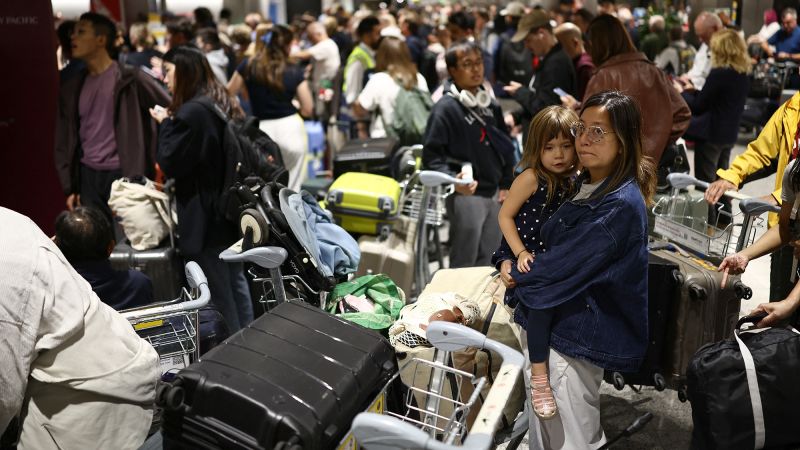
Airport terminals became crowded as passengers sought information, rebookings and assistance. Images shared online showed long lines through airport halls, while travellers described uncertainty over whether flights would depart, be delayed or be cancelled.
One passenger wrote that the disruption was the most stressful and disappointing transport experience they had encountered, saying British Airways had offered a replacement itinerary involving four flights and 24 hours of travel for a journey to Rome normally lasting about two and a half hours.
Josie Donoghue spent three hours on a Ryanair aircraft at Gatwick before her flight to Ireland was cancelled. She described the challenge of getting through the airport in stark terms.
“Getting through that airport was like trying to get out of Alcatraz.”
“It’s just an absolute nightmare down there. It’s the only word I can use to describe it.”
Amid the frustration, some passengers also praised airport and airline ground staff who were helping people navigate the rapidly changing situation.
A familiar problem for UK aviation
This is not the first recent air traffic control breakdown to disrupt Heathrow and other British airports. In August 2023, a major NATS systems problem during the final day of the summer public holiday weekend led to hundreds of cancelled departures and arrivals.
Heathrow remains particularly significant because of its scale and role in international travel. Airports Council International ranked it seventh globally for passenger traffic in 2025, after more than 84 million people passed through the airport during the year. Disruption at a hub of that size can quickly spread through airline networks in Europe and beyond.
Passengers with flights scheduled during the recovery period should check directly with their airline before travelling, monitor any rebooking notices and allow extra time at the airport. Even when a flight is listed as operating, late aircraft arrivals and crew repositioning can still alter departure times at short notice.
Related Reading
Frequently Asked Questions
What is Massive disruption hits UK airports after?
Massive disruption hits UK airports after is the main topic of this guide. The article explains the context, practical details, and next steps readers should understand.
Why does Massive disruption hits UK airports after matter?
Massive disruption hits UK airports after matters because readers are looking for a useful answer, not just a short summary. Good content should match search intent and help them decide what to do next.