
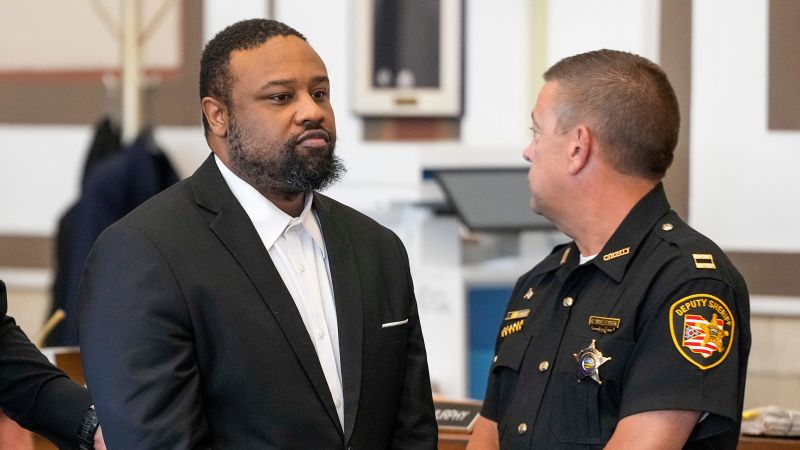
Ohio Jury Convicts Rodney Hinton Jr. in Death of Deputy Larry Ray Henderson Jr.
Qwenews.com – A Hamilton County jury has found Rodney Hinton Jr. guilty of murder after a crash that killed Deputy Larry Ray Henderson Jr., an off-duty sheriff’s deputy who was directing traffic near a college graduation in Cincinnati.
The verdict, delivered Friday, also included convictions for reckless homicide and felonious assault. Hinton had pleaded not guilty by reason of insanity, arguing that a severe mental-health crisis shaped his actions in the hours after his 18-year-old son, Ryan Hinton, was shot and killed by a Cincinnati police officer.
Hinton now faces a prison term of 15 years to life for the murder conviction, with the possibility of parole. His sentencing hearing is scheduled for November 16. Defense attorney Clyde Bennett II said an appeal will follow.
Crash followed family’s viewing of police video
The fatal collision occurred in May 2025, shortly after Hinton and relatives watched body-camera footage connected to the shooting of his son. Ryan Hinton had been killed during a police chase after an officer fired twice.
Cincinnati’s police chief said the officer told investigators that Ryan Hinton pointed a gun at him. The officer was not charged. Hamilton County Prosecutor Connie Pillich said a review concluded that the officer’s use of force was legally justified.
“Legally justified in his use of force.”
Pillich said Ryan Hinton had a fully loaded gun and pointed it at officers when they confronted him. The police shooting and the later death of Henderson placed two devastating events at the center of a case that became closely tied to grief, accountability and questions about mental illness.
Jurors considered Hinton’s mental state
The trial centered heavily on whether Hinton could understand the nature and consequences of what he was doing when he drove into the intersection where Henderson was working. Hinton had been diagnosed with schizoaffective disorder as well as other mental-health conditions.
His lawyer argued that Hinton was experiencing a psychotic episode and was attempting to end his own life, rather than deliberately seeking to kill Henderson. Bennett told jurors that the crash came amid overwhelming grief following the death of Hinton’s son.
Prosecutors took a different view, saying Hinton’s anguish did not eliminate his ability to distinguish right from wrong. They argued that he intentionally directed his vehicle toward the deputy and made a conscious decision that led to Henderson’s death.
The jury’s verdict rejected the insanity defense. Under that defense, the central legal question was not simply whether Hinton had mental illnesses or was deeply distressed, but whether those conditions prevented him from understanding the wrongfulness of his conduct at the time of the crash.
A veteran deputy remembered for public service
Henderson had spent decades with the Hamilton County Sheriff’s Office before retiring a few months before the collision. Even after retirement, he continued accepting off-duty assignments, including traffic-control work.
He was directing vehicles connected to a college graduation when he was struck and killed. His death brought renewed attention to the risks faced by law-enforcement personnel working traffic details and other assignments outside their regular shifts.
At his funeral in 2025, Henderson was remembered as a selfless colleague and devoted public servant. Those who spoke about him also described a person willing to take on dangerous work and volunteer for assignments that others might avoid.
Hamilton County Sheriff Charmaine McGuffey said the conviction offered a measure of resolution for Henderson’s family, colleagues and the sheriff’s office.
“The jury’s verdict brought some closure and helped provide justice for Henderson.”
What happens next
Hinton remains subject to sentencing on November 16. The murder conviction carries a potential sentence of 15 years to life, and he could eventually be considered for parole under Ohio law.
His planned appeal means the case may continue beyond sentencing. Appeals can challenge issues that arose during trial, including legal rulings, jury instructions or the handling of evidence, though the conviction remains in place unless a court overturns it.
The case has left Hamilton County confronting the aftermath of two deaths within a short period: the police shooting of Ryan Hinton and the death of Henderson the following day. The criminal verdict addresses Hinton’s responsibility for the deputy’s killing, while the official review of Ryan Hinton’s shooting found that the officer who fired acted within the law.
For Henderson’s loved ones and the sheriff’s office, the verdict closes one stage of a painful case. Sentencing will determine the punishment Hinton receives, while the appeal process is expected to shape the next legal chapter.
Related Reading
Frequently Asked Questions
What is Man who fatally struck deputy after?
Man who fatally struck deputy after is the main topic of this guide. The article explains the context, practical details, and next steps readers should understand.
Why does Man who fatally struck deputy after matter?
Man who fatally struck deputy after matters because readers are looking for a useful answer, not just a short summary. Good content should match search intent and help them decide what to do next.