
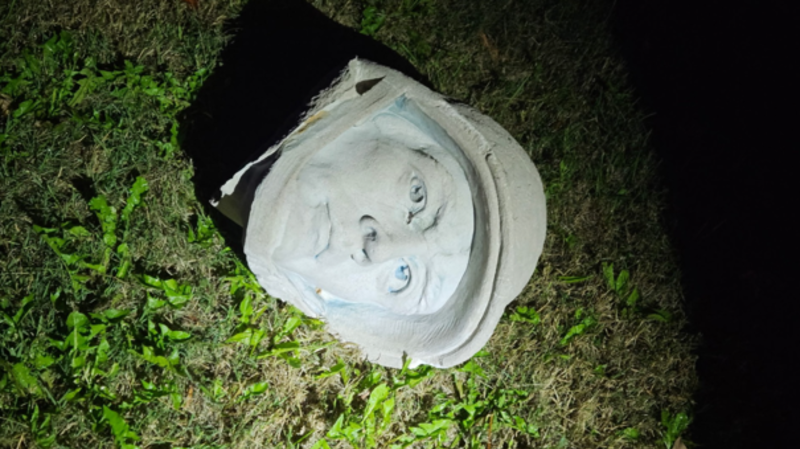
Virginia’s Iwo Jima Memorial Damaged in Late-Night Sledgehammer Attack
Qwenews.com – A limestone monument at Marine Corps Base Quantico in Virginia sustained extensive damage Wednesday night after a man allegedly used a sledgehammer to destroy part of the memorial. Police said the suspected vandal was stopped while the damage was still taking place, with the monument’s losses estimated in the hundreds of thousands of dollars.
The memorial is a smaller version of the Marine Corps War Memorial in Arlington, Virginia, one of the country’s most recognizable military monuments. Its damage has drawn attention to both the historic meaning of the sculpture and the vulnerability of public memorials that preserve important moments in American military history.
Police Detain Suspect at Quantico
Prince William County Police were called to Marine Corps Base Quantico at about 10:31 p.m. after receiving a report of property destruction. When officers arrived, they found a man allegedly striking the statue with a sledgehammer.
“Actively damaging the statue with a sledgehammer”
Officers detained the suspect without incident. Authorities identified him as Maldonado Soriano, of Stafford, Virginia. He faces charges of felony destruction of property, trespass with intent to damage, and felony injury to a monument.
Soriano remains held without bond while awaiting a court appearance. A lawyer listed for him in court records has been contacted for comment. Police have not publicly explained what may have motivated the alleged attack, and additional details about the incident have not yet been released.
A Replica of an Iconic World War II Image
The damaged sculpture stands roughly 36 miles south of Washington, DC, at Quantico. It recreates the celebrated scene of six US Marines raising the American flag on Iwo Jima during World War II.
That moment was photographed by Joe Rosenthal on February 23, 1945, during the Battle of Iwo Jima in Japan. The image became one of the defining photographs of the war and later inspired the design of the larger Marine Corps War Memorial in Arlington.
At Quantico, the limestone version captures the same flag-raising scene in a more compact form. It is described by the Marine Corps as a “non-heroic-size” counterpart to the Arlington memorial, whose bronze figures rise 60 feet. Though smaller, the Quantico monument carries the same symbolic connection to the Marines who fought in the Pacific theater and to those who served throughout the conflict.
The alleged attack specifically damaged one of the statue’s figures, leaving the monument with the loss of its head. The scale of the estimated financial damage reflects not only the physical harm to the sculpture, but also the specialized work likely needed to restore a historic limestone memorial.
Felix de Weldon’s Early Work on the Monument
Sculptor Felix de Weldon created the Quantico memorial after seeing Rosenthal’s photograph in 1945. De Weldon, who was serving in the Navy at the time, began work on the concept shortly after the flag-raising image appeared.
He completed the limestone sculpture for Quantico before the end of 1945. The better-known Arlington memorial took considerably longer to finish, opening in 1954 after years of work. Together, the two monuments show how a wartime photograph was transformed into a lasting public symbol.
The Quantico replica also has a direct connection to the Marine Corps community because of its location on the base. Marine Corps Base Quantico is closely associated with training, education, and the service’s institutional history, making the monument more than a roadside landmark. It serves as a visual reminder of the sacrifice represented by the Battle of Iwo Jima and by the generations of Marines commemorated through the image.
Why the Memorial Carries Lasting Significance
The flag-raising on Iwo Jima has long held a central place in American remembrance of World War II. Rosenthal’s photograph captured a moment of collective effort rather than an individual portrait, with six Marines working together to raise the flag. That composition helped give the image a powerful and enduring meaning.
For visitors and military personnel, memorials such as the Quantico statue offer a physical connection to events that can otherwise seem distant in time. The damage to the sculpture underscores the challenge of protecting historic monuments while preserving public access to sites of remembrance.
Investigators continue to examine the incident, while the base and law enforcement officials assess the monument’s condition. The criminal case against Soriano will move forward separately from any future restoration work. For now, the damaged replica remains a stark reminder that even well-known symbols of national service and wartime history can be subject to sudden and serious harm.
Related Reading
Frequently Asked Questions
What is Man arrested after beheading Iwo Jima?
Man arrested after beheading Iwo Jima is the main topic of this guide. The article explains the context, practical details, and next steps readers should understand.
Why does Man arrested after beheading Iwo Jima matter?
Man arrested after beheading Iwo Jima matters because readers are looking for a useful answer, not just a short summary. Good content should match search intent and help them decide what to do next.