
Trump’s Comments Put Fresh Focus on Fed Independence
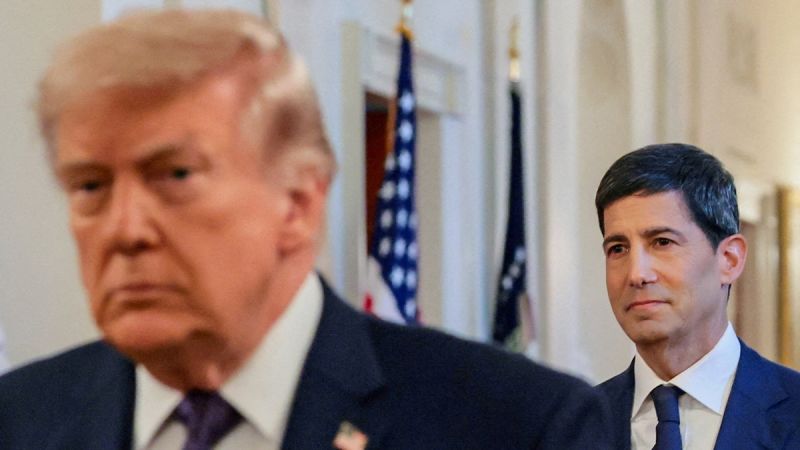
Qwenews.com – The Federal Reserve’s first interest-rate increase in three years has intensified scrutiny of the relationship between President Donald Trump and Kevin Warsh, the Fed chairman chosen by Trump. What might otherwise have been viewed as a straightforward monetary-policy decision became more politically charged after the president suggested that Warsh had been given room to support a move Trump himself considered mistaken.
Speaking with reporters Wednesday evening, Trump said Warsh was constrained by the Federal Open Market Committee, the rate-setting body he leads. The president characterized the committee as hostile and said Warsh lacked the support needed to prevent an increase.
“I talked to Kevin and I said you might as well vote with the board because it’s not going to matter…I said, ‘Do what you want because it doesn’t matter’ because he doesn’t have the votes,” Trump told reporters.
The comments immediately raised a central question for investors, economists and consumers: how closely is the Fed chairman communicating with a president who has repeatedly pushed for sharply lower borrowing costs? The answer matters because the Federal Reserve is intended to make its decisions independently of the White House.
Fed officials set interest rates with an eye toward inflation, employment and broader economic conditions. Their decisions influence everything from mortgage rates and car financing to business borrowing and savings returns. Although elected officials can publicly express views about the economy, the central bank’s credibility rests heavily on the expectation that political preferences do not dictate monetary policy.
Why the Appearance of Influence Matters
Even the perception that a president is directing the Fed can have consequences. If investors conclude that monetary policy is being shaped for political purposes rather than economic conditions, they may demand higher returns to hold government debt. That can feed through to market-based borrowing costs, making mortgages, auto loans and other forms of credit more expensive.
A weakening of confidence in the central bank can also complicate efforts to contain inflation. Consumers and businesses make spending, pricing and wage decisions partly on their expectations of future inflation. If those expectations become less anchored, the Fed may find it harder to achieve its policy goals.
Former Federal Reserve Bank of Boston President Eric Rosengren said Trump’s remarks were both unusual and troubling.
“It’s an unusual and unfortunate comment to make. Clearly, the Fed chair does not need the president’s permission to raise rates,” Eric Rosengren said. “The implication is that the chair got a hall pass. I have no idea how truthful the comment was.”
The Fed did not offer a public response to Trump’s statement. Warsh, meanwhile, avoided discussing his contacts with the president during his Wednesday press conference.
“I’m not a Wall Street newsletter. Part of the independence of the Federal Reserve is we stay in our lane. Independence is a two-way street,” Warsh said. “We’ll let people that do trade policy and fiscal policy stay in their lane, too. That’s how we can stand up here and call them the way we see them.”
When asked when he had last spoken with Trump, Warsh declined to provide details.
“I don’t have anything for you on discussions with the president.”
A Rate Decision That Looked Like a Test
For Warsh, the rate increase appeared to offer an opportunity to show that the Fed could act independently of the administration that selected him. The White House did not want higher rates, yet Warsh oversaw an increase that received unanimous backing from committee members, including former Fed Chair Jerome Powell.
Krishna Guha, vice chairman and head of economics and central bank strategy at Evercore ISI, argued that markets viewed the decision as Warsh’s own rather than as a concession to other policymakers.
“The market believes – and with good grounds – that Kevin Warsh owned this decision and that the committee was strongly united behind him,” Guha said. “There is no evidence here or to the market at large that Warsh was dragged into this by colleagues – or permissioned by the president.”
Guha said the meeting marked a stronger performance by the new chairman after what he had described as early missteps.
“It felt like the day the Fed became Warsh’s Fed,” Guha said. “He was a lot more assured, coherent and credible yesterday. What he’s saying basically adds up.”
Still, Trump’s description of the episode could create a different impression: that Warsh is unable to shape the committee’s direction. Tim Mahedy, chief executive and chief economist at Access/Macro, said that framing may undercut the chairman at a moment when he seemed to be establishing authority.
“It makes it seem like Warsh has no control over this committee, like he was completely ineffectual in convincing his colleagues,” Mahedy said.
Mahedy also questioned Warsh’s response about communications with the president, saying a clearer denial would have been preferable.
“The right answer is, ‘I didn’t talk to the president.’ I don’t think the president is talking to Warsh beforehand. That would be shocking,” Mahedy said.
The Next Decision May Bring More Questions
The immediate rate increase may have reassured some observers that the Federal Reserve remains willing to take an unpopular step when its officials believe economic conditions require it. But future decisions could prove more difficult to interpret.
If Warsh and a majority of the committee later decide against another increase, critics may ask whether White House pressure influenced the outcome. If the Fed raises rates again, the administration’s public criticism could further test the boundaries between political messaging and central-bank independence.
Historically, presidents have often sought to avoid even the appearance of directing the Federal Reserve. That restraint was rooted in a practical calculation: financial markets respond not only to rate decisions, but also to confidence that those choices are made by officials free to pursue the economy’s long-term interests.
Warsh now faces the challenge of maintaining that confidence while serving under a president who has made his own preferences unusually clear. The Fed’s next moves will be judged not only by their effect on inflation and growth, but also by whether they reinforce the institution’s ability to operate on its own terms.
Related Reading
Frequently Asked Questions
What is Kevin Warsh just defied Donald Trump?
Kevin Warsh just defied Donald Trump is the main topic of this guide. The article explains the context, practical details, and next steps readers should understand.
Why does Kevin Warsh just defied Donald Trump matter?
Kevin Warsh just defied Donald Trump matters because readers are looking for a useful answer, not just a short summary. Good content should match search intent and help them decide what to do next.