
Xi’s Anti-Corruption Campaign Tightens His Hold on China’s Elite
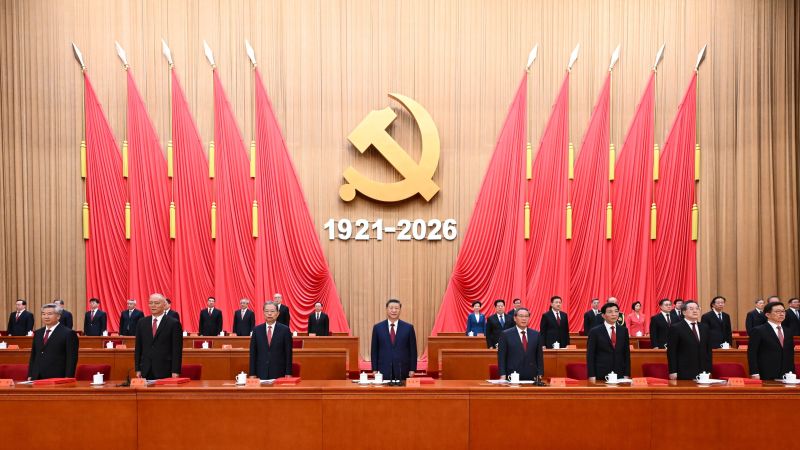
Qwenews.com – China’s political establishment is heading into a major closed-door gathering in Beijing with a conspicuous number of seats empty. More than 200 senior Communist Party figures are expected to convene this week, but attendance is set to hit a historic low as investigations continue to remove officials from the country’s most powerful institutions.
The immediate reason is President Xi Jinping’s sweeping campaign against corruption, a drive that has reached deep into the party, the military, the courts and the security apparatus. For many officials, the atmosphere is one of uncertainty: influential figures have been investigated, expelled or suddenly disappeared from public view. Xi, however, enters the meeting with his own position appearing stronger than ever.
That contrast is central to the current political moment. Xi, 73, has led China for more than 14 years and is expected next fall to seek an extraordinary fourth term at a still more consequential party leadership gathering. With potential rivals and independent power bases steadily weakened, there are few visible figures or factions capable of challenging him.
Institutions Once Seen as Secure Have Been Hit
The campaign has not been limited to local officials or lower-ranking party members. It has reached positions once regarded as exceptionally insulated from political pressure. China’s Central Military Commission, normally made up of seven members and responsible for the party’s highest military decision-making, now has only two members. Xi is one of them.
The Politburo, the party’s 24-member top leadership body, has also shrunk to 21 members. The unusually thin ranks highlight both the scale of the investigations and the degree to which the campaign has disrupted the normal circulation of elite power.
Since Xi took office, millions of rank-and-file officials have been caught up in disciplinary action. More than 500 ministerial-level officials were investigated, subsequently convicted, removed or expelled for corruption between 2012 and 2022. In the three years since, more than 410 additional officials have been purged.
Xi broadened the campaign in 2022 by calling for discipline enforcers themselves to be scrutinized.
“Turn the blade inward.”
Earlier this year, he told party cadres that corruption still posed a serious problem and warned of “two-faced people” within the party. He described the effort against graft as a struggle with no end point.
“Remains grave.”
“Never-ending struggle.”
A Climate of Sudden Disappearance
In recent weeks, the Central Commission of Discipline Inspection, the party’s main anti-corruption body, has issued nearly daily notices involving arrests, fresh inquiries and party expulsions. The pace has kept political circles focused not only on those already under investigation, but on who may be named next.
Huang Qifan’s investigation sent a particular jolt through those circles. A longtime mayor of Chongqing, Huang had built a reputation as an unusually resilient political operator. He served under six Communist Party secretaries in the megacity and outlasted dramatic upheaval, including the imprisonment of two former party chiefs. One of those jailed officials had been viewed as a rival of Xi.
After leaving office, Huang remained a familiar figure at conferences and on television, often discussing China’s economy. Following his downfall, people who had known or worked with him moved quickly to erase references to him from social-media accounts. Such online distancing is a familiar response when a politically connected figure comes under scrutiny.
Beijing deputy mayor Xia Linmao also illustrates how rapidly an official’s status can change. Shortly before he vanished from public life, state television showed him participating in a meeting with Walmart chief executive John Furner and other American business leaders. Xia took notes while Beijing’s mayor urged the executives to increase their investment and activity in the Chinese capital.
Other investigations become public only after months of silence. Ma Xingrui, an aerospace engineer who later became a senior party official and led the vast western region of Xinjiang, had not appeared publicly for five months before authorities announced in April that he was under investigation.
Why the Campaign Matters Beyond Individual Cases
An official investigation for corruption almost always ends a political career in China. Those affected are generally removed from the public eye, and former officials can remain absent from public life even after serving a sentence. The impact therefore extends beyond the individuals named in official notices: it reshapes the calculations of colleagues, subordinates and institutions across the party-state system.
China’s anti-corruption campaign has long been presented as an effort to enforce party discipline and confront misconduct. It has also transformed the balance of power at the top. Each removal reduces the number of established officials with their own networks, careers and influence. In a system where the Communist Party directs the state, military and major political institutions, that consolidation has broad consequences for policymaking and internal debate.
The upcoming Beijing meeting will be watched for signs of how Xi intends to fill vacancies and set the political direction ahead of next year’s leadership gathering. Yet the larger message is already apparent: seniority, past alliances and public prominence have offered little protection. The campaign has reached military commanders, judges, security officials and party disciplinary personnel, as well as local leaders and retired figures once considered well connected.
For China’s ruling elite, the immediate question is not simply who will take the vacant places. It is whether anyone can be confident that their position is secure. For Xi, the answer appears markedly different. As the party prepares for the prospect of a fourth term, the leader at the center of the system faces fewer visible constraints than at any point in his years in power.
Related Reading
Frequently Asked Questions
What is It can be lonely at the top?
It can be lonely at the top is the main topic of this guide. The article explains the context, practical details, and next steps readers should understand.
Why does It can be lonely at the top matter?
It can be lonely at the top matters because readers are looking for a useful answer, not just a short summary. Good content should match search intent and help them decide what to do next.