
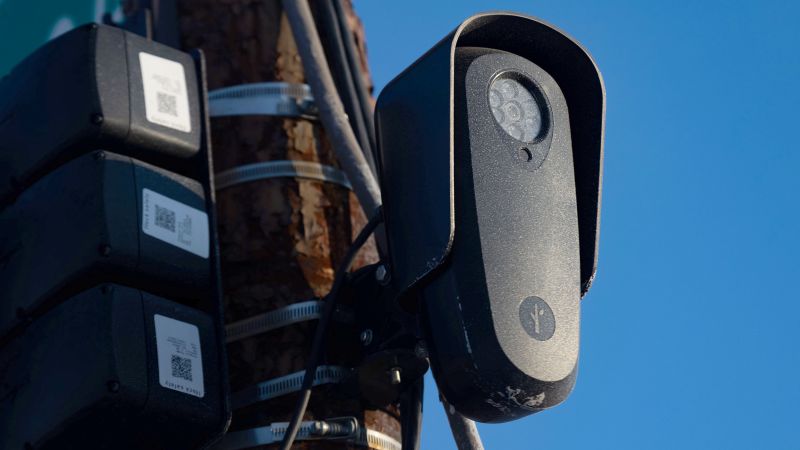
Inside the growing police use of Flock cameras: A closer look
Qwenews.com – Inside the growing police use of automated surveillance technology, Milwaukee Police Department internal affairs detectives launched an investigation last December. They were examining an officer accused of misusing Flock, the department’s automated license-plate reader system. The detectives investigating officer Josue Ayala discovered he secretly used Flock to learn the location of his romantic partner 124 times and that partner’s ex 55 times, according to a February criminal complaint. Ayala agreed to resign from the department and plead guilty to attempted misconduct in public office as part of a deal, according to court records.
Escalating concerns about surveillance abuse
Then earlier this month, one of the detectives who had investigated Ayala was himself arrested for misusing the Flock system. The detective, Tehrangi Chapman, admitted to using Flock to track two people and to secretly installing a GPS device on one person’s vehicle, according to a criminal complaint. The incidents are among at least two dozen cases in which officers resigned or were arrested for allegedly abusing Flock’s automated license-plate reader system to stalk romantic interests, according to a tally from the Institute for Justice, a nonprofit public interest law firm.
Just in the past month, five Albany police officers in Georgia were arrested and fired for allegedly misusing Flock, and police in Greer, South Carolina, fired two officers for misusing the product. The cases underscore the growing use – and misuse – of automated license-plate reader systems, known as ALPRs, that police departments across the country have adopted in recent years. The technology has its proponents who laud its investigative power, while opponents call it a mass surveillance system that violates privacy and civil liberties.
“This case represents an abuse of power and a misuse of power. It results in a lack of trust from our community,” Milwaukee County deputy district attorney Matthew Torbenson said at Ayala’s sentencing hearing Wednesday.
Inside the growing police use: Balancing benefits and concerns
“That’s the story that is going to end and be printed today is about police misuse of the Flock system, when the truth of the matter is the vast majority of law enforcement appropriately uses that tool to investigate crime.” In response to these concerns, Flock has taken steps to crack down on police abuse of its technology. Flock CEO and co-founder Garrett Langley told CNN in an interview the company last month launched an “audit assistance tool” that alerts an auditor to “abnormal” uses of its system. “This is such a powerful tool, we don’t want to reduce the efficacy of the 99.99% of officers who go to work every single day and want to do good for their community,” Langley said.
ALPRs are cameras – either mounted on vehicles or on fixed poles along public roads – that take images of a vehicle’s plates and other identifying characteristics and store that information in a database. The system alerts police when a vehicle on a “hotlist,” such as one associated with a crime or a missing person, drives by a camera. Police can also search for a specific license plate number to see the vehicle’s recent movements.
In addition, departments can share their information with neighboring agencies to better coordinate a response. Flock Safety, based in Atlanta, is the largest such ALPR company and works with over 5,000 law enforcement agencies. The company says its network includes more than 120,000 cameras across 49 states.
Founded in 2017, Flock announced last March it was valued at $7.5 billion after its latest $275 million funding round from major Silicon Valley investors, who include Andreessen Horowitz and the Peter Thiel-backed Founders Fund. Law enforcement officials have said the technology is helpful in solving crimes, particularly stolen vehicle cases. Notably, police used Flock cameras last year to track down the suspect in the mass shooting at Brown University.
The tech firm that helped police find the Brown shooting suspect has sparked privacy concerns. Its CEO responds The Milwaukee Police Department sent CNN a summary of 24 cases that used ALPRs in April and another 26 cases in May. In one instance, ALPRs helped police catch a suspect accused of domestic violence, vehicle robbery and possession of a firearm.
In another, the ALPR system helped officers locate and arrest a suspect with a warrant for strangulation. “These results are only a small sampling of the impact this tool has, but illustrate the effectiveness of this technology as it relates to some of the most serious crimes that occur within our community,” Milwaukee police said in a statement. Still, only a few studies have looked at the technology’s overall effectiveness.
One recent study looked at the Atlantic City, New Jersey, police department’s use of ALPRs from 2022 to 2024 and found mixed results that were hard to separate from the nationwide decline in crime over