
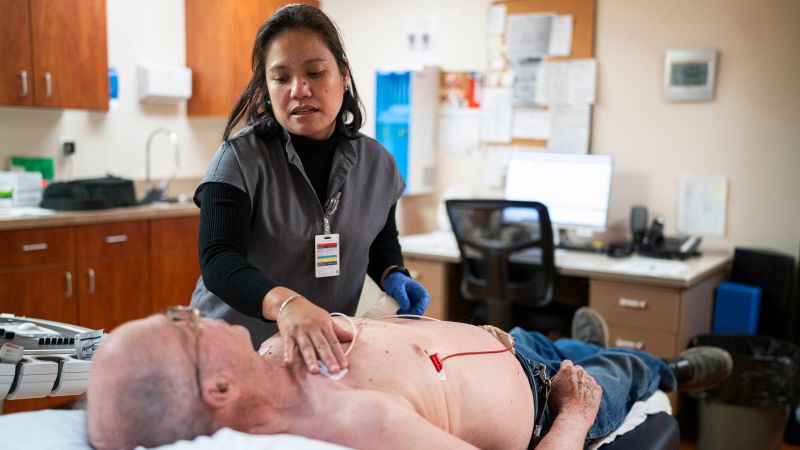
Immigrant Health Workers Help Sustain Care in a Remote North Dakota Community
Qwenews.com – In Hettinger, North Dakota, a prairie town of roughly 1,100 residents, keeping a hospital fully staffed has meant looking far beyond the region’s borders. West River Hospital relies on foreign-born medical professionals to provide care not only for local patients, but also for people arriving from nearby areas of Montana and South Dakota.
For ultrasound technician Marichu Castillo Villamiel, the path to Hettinger began with an unexpected interview question: whether she liked McDonald’s. The question was not really about fast food. It was meant to gauge whether the Filipina applicant could imagine living in a very small community with a single grocery store and little established immigrant population.
“Yes, I’m willing,”
Villamiel recalled saying when asked about moving to Hettinger. She added that she did not especially enjoy McDonald’s because she could prepare her own burgers.
She accepted the position and became one of 19 foreign workers at West River Hospital. The health system has recruited professionals from the Philippines for roles including nursing and laboratory technology, attempting to fill long-standing vacancies. One opening had remained unfilled for more than 10 years.
A workforce challenge shared by rural hospitals
The hospital’s recruitment needs reflect a broader pressure on rural medical providers: population loss and a limited pipeline of local workers. Hettinger sits about two and a half hours from Bismarck, the nearest major North Dakota city. New international hires typically arrive there by plane before hospital staff drive them south to their new community.
“All rural areas are experiencing population loss,”
said Dr. Cathy Houle, a family physician with West River Health Services.
“We’re seeing, increasingly, it’s difficult to recruit and retain people to work in the medical field.”
For smaller communities, staffing is not an abstract economic concern. A shortage of nurses, technologists, and other trained workers can affect whether patients can receive services close to home. Recruiting internationally has become part of West River’s effort to keep essential hospital roles covered.
Villamiel arrived through the H-1B program, which allows skilled foreign workers to fill qualifying jobs for three years and is generally renewable for another three-year period. Her decision to move was tied to a long-held ambition to work in the United States.
“Because this is my dream,”
she said.
“Yes, Hettinger is a home. If I got a chance to live in the United States, a good opportunity, why not?”
She said the opportunity to contribute to the town has strengthened her commitment to staying.
“I can help people here, yes, I can stay,”
Villamiel said.
Immigration uncertainty reaches small-town employers
Hospital leaders are watching immigration policy closely as the federal government pursues a tougher approach to legal immigration alongside enforcement actions involving undocumented migrants. A proposed $103,000 H-1B visa fee has raised fresh concerns, although many hospitals may qualify for an exemption.
Alyson Kornele, chief executive officer of West River Health Services, said the changing landscape makes planning difficult for employers that depend on skilled international recruits.
“It is something we expect to potentially affect us in the future as it continually changes,”
Kornele said.
“We never know what’s going to happen.”
That uncertainty matters in a place where replacement workers may be hard to find. International hires are not simply additions to an existing surplus of staff; they help cover positions that local recruiting has struggled to fill.
Building a home far from the Philippines
Villamiel shares her Hettinger home with her partner, Eric, and her three daughters. The children arrived from the Philippines six months earlier. She waited until the snow had melted after the severe prairie winter before bringing them to the United States, hoping the weather would be easier to adjust to.
The family’s experience also illustrates the personal side of international recruitment. A job offer can provide opportunity and stability, but it also involves a major separation from relatives, friends, and familiar surroundings.
New arrivals have recently become part of Hettinger’s schools as well. Three Filipino teachers came to town shortly before the school year began, adding to the growing number of immigrants serving in public-facing roles. They became emotional while discussing the family members they left behind. After classes, they spoke with loved ones by phone from the school cafeteria; on one call, chickens could be seen roosting in the background as the sun rose in the Philippines.
Zaira Chinte, a second-grade teacher in Hettinger, said a student’s recognition of that sacrifice left a lasting impression.
“One of my students (told) me, thank you for coming here, you left your daughter in the Philippines just for us,”
Chinte said.
“I’m so touched with that because they see our effort as a teacher coming here.”
A community learning to welcome new neighbors
Hettinger’s population is overwhelmingly White and native-born, yet the recruits described feeling accepted in the town. Everyday interactions, from greetings around town to gatherings with local families, helped make a remote destination feel more familiar.
At Pastime, a steakhouse bar operated by the same Hettinger family for more than four generations, the town’s longstanding local culture remains clearly visible. At the same time, its public institutions increasingly depend on people whose lives began thousands of miles away.
The school organized a gathering to introduce the new teachers to the community. Villamiel and other Filipino residents brought prepared dishes from home while parents met their children’s teachers and families shared a meal. Such moments do not remove the difficulties of distance, immigration paperwork, or adapting to a new climate. They do, however, create connections between newcomers and the residents who depend on their work.
For West River Hospital and the local schools, immigrant professionals are becoming an important part of how a small rural community maintains vital services. Their arrival brings technical training and experience, while their families, food, traditions, and relationships add new layers to town life. In Hettinger, the need for workers and the effort to build belonging are unfolding together.
Related Reading
Frequently Asked Questions
What is Inside a tiny prairie town relying?
Inside a tiny prairie town relying is the main topic of this guide. The article explains the context, practical details, and next steps readers should understand.
Why does Inside a tiny prairie town relying matter?
Inside a tiny prairie town relying matters because readers are looking for a useful answer, not just a short summary. Good content should match search intent and help them decide what to do next.