
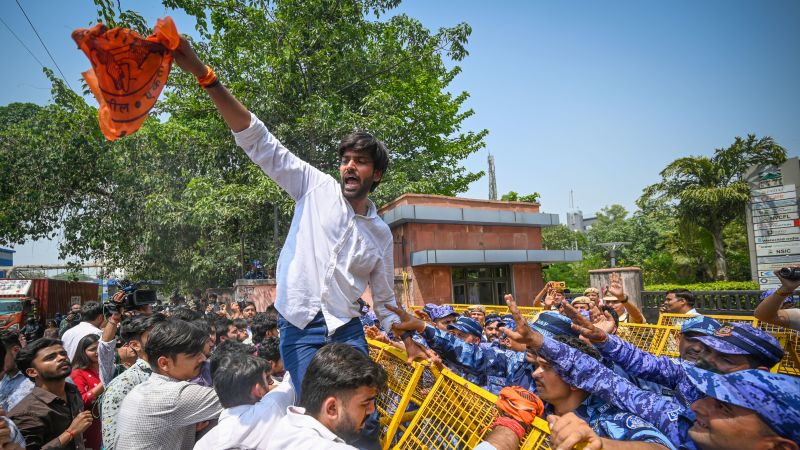
India’s Youth Are Fuming. A Boston University Graduate Seeks Change
Qwenews.com – India’s youth are fuming, driven by a combination of economic struggles, political disillusionment, and social pressures that have turned frustration into a powerful movement. Among the growing ranks of activists is Abhijeet Dipke, a 30-year-old Boston University graduate who has taken it upon himself to address the root causes of this unrest. Having witnessed the challenges faced by his peers back home, Dipke is now in New Delhi, determined to amplify their voices and push for systemic reforms that promise better opportunities for the next generation.
The Rise of the Cockroach Janta Party
Dipke is the driving force behind the satirical yet influential Cockroach Janta Party, a grassroots initiative that has captured the attention of millions across India. The group, which has amassed over 10 million Instagram followers, uses a unique blend of humor and sharp critique to spotlight the frustrations of young people. Its viral campaign gained momentum after Chief Justice Surya Kant made a controversial remark comparing unemployed graduates to “cockroaches,” a metaphor that resonated deeply with the disaffected youth. This moment sparked a nationwide conversation, with the party quickly evolving from a joke into a serious platform for change.
From Online Criticism to Physical Protests
What began as a digital movement has now transitioned into real-world action. The Cockroach Janta Party’s members, many of whom are university graduates, are leveraging social media to organize protests and demand accountability from leaders. Their strategy combines memes, viral videos, and AI-generated images of a virtual mascot to engage a tech-savvy audience. As Dipke explained in an Instagram post, the movement is not just about frustration—it’s about taking a stand. “Our future is getting ruined,” he said, highlighting the urgency of the situation and the need for tangible solutions.
India’s population exceeds 1.4 billion, with over 360 million aged 15 to 29. These young people are more educated and connected than ever before, yet they face an uphill battle in securing stable employment. A recent report from Azim Premji University revealed that nearly 40% of graduates under 25 are unemployed, while 20% of those aged 20 to 29 also struggle to find work. This staggering statistic underscores the growing divide between education and economic opportunity, a problem that has fueled the fire of youth anger across the country.
As inflation continues to rise, the economic pressures on young Indians have intensified. The Cockroach Janta Party has become a symbol of this struggle, with its members advocating for policies that prioritize job creation and educational reform. The movement has also highlighted the need for greater transparency in the government’s handling of education systems, particularly the medical school entrance test, which has been a source of immense stress for many. Veronica Madan, a 24-year-old who took the exam twice, described the relentless pressure to succeed: “The fear of disappointing myself and my family has made every exam a life-or-death event.” Her experience reflects the broader sentiment of the youth, who are no longer willing to accept the status quo.
India’s youth are fuming, and their anger is no longer confined to social media. With physical protests gaining traction, the movement is demanding immediate action from policymakers. The Cockroach Janta Party’s upcoming demonstration at the Jantar Mantar monument this weekend aims to put pressure on the education minister, Dharmendra Pradhan, to resign. The group’s ability to mobilize large crowds demonstrates the shift in power dynamics, as young people take the lead in shaping the nation’s future. Their message is clear: India’s youth are not just passive observers but active participants in the country’s transformation.
CNN has reached out to the Ministry of Education and the ruling Bharatiya Janata Party (BJP) for comment, but the movement’s momentum continues to grow. Young followers like Amrita Singh emphasize the importance of their role in driving progress. “I’m proud to be part of a generation that challenges the system and pushes for growth,” she said, echoing the sentiments of many. As the movement expands, it remains a powerful testament to the resilience and determination of India’s youth, who are refusing to let their frustration go unheard.