
How One Devastating Cyclone Threatened the Survival of Rare Great Apes
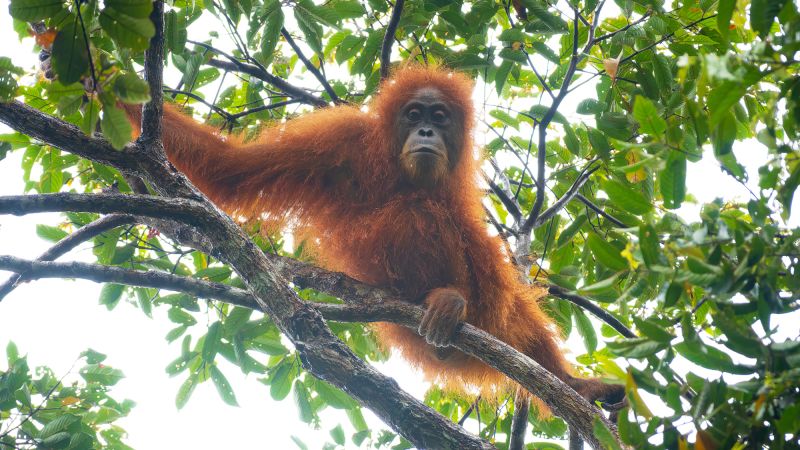
Qwenews.com – A groundbreaking study highlights the alarming toll of Cyclone Senyar on Indonesia’s Tapanuli orangutans, revealing that over 7% of the global population of these critically endangered apes perished in a single event. The storm, which struck Sumatra in November 2025, unleashed torrential rains and destructive landslides, devastating the region’s ecosystems. Researchers estimate that nearly 60 of the 800 remaining wild Tapanuli orangutans were lost, pushing the species closer to extinction.
The cyclone, classified as one of the region’s most intense in recent years, delivered more than 16 inches of rainfall, according to the Tsunami and Disaster Mitigation Research Center. Scientists suggest that climate change amplified the storm’s severity, increasing rain intensity by 9% to 50%. The resulting floods and landslides ravaged the West Block of the Batang Toru ecosystem, a vital habitat for the orangutans. Over 20,000 acres of forest were destroyed, with 12% of the area reduced to landslide scars.
“The sheer scale of destruction shows how climate-driven disasters can accelerate extinction risks,” said Erik Meijaard, lead author of the study and director of Borneo Futures. He noted that the loss of 58 orangutans may understate the true impact, as population density estimates could miss some casualties. Other threats, like food shortages and canopy damage, were not fully accounted for in the analysis.
Meijaard emphasized that Tapanuli orangutans are particularly vulnerable due to their slow reproductive rate—females give birth every six to nine years. This makes population recovery difficult, especially after events like Senyar. “Even a small rise in mortality could tip the species toward extinction,” he warned. The study underscores the urgent need for stronger conservation efforts to safeguard their dwindling habitats.
Experts Call for Action to Halt Deforestation
“Whether these orangutans can rebound depends on future conservation decisions,” said Friederike Otto, a climate science professor at Imperial College London. “Halting deforestation, reconnecting fragmented habitats, and uniting stakeholders will determine their fate.”
Adriano Lameira, a primatologist at the University of Warwick, urged the Indonesian government to enhance habitat protection. “Decades of conservation efforts have shown the current system is failing,” he stated. “The Tapanuli orangutan’s survival hinges on addressing both natural and human threats.”
The apes’ extinction would mark a significant loss for scientific understanding. As one of the last great ape species, they offer unique insights into human evolution. “Their existence helps us trace the origins of our own species,” Lameira added, highlighting the ecological and evolutionary importance of the Tapanuli orangutan. With climate change intensifying extreme weather, the urgency to act has never been greater.