
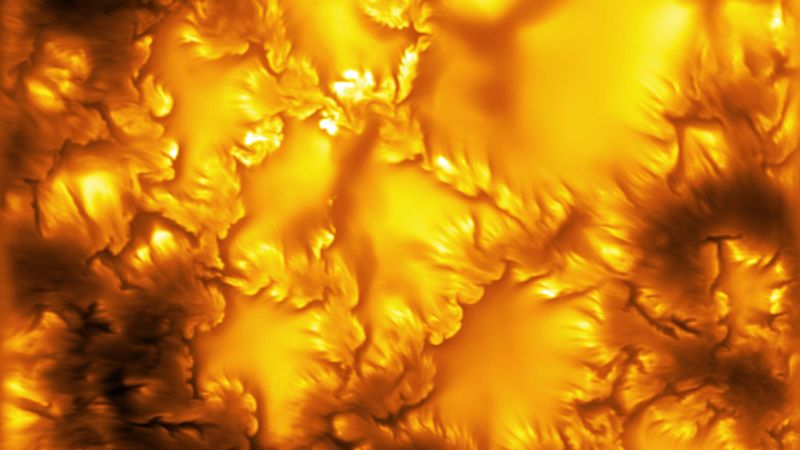
Unprecedented Solar Observations Reveal Hidden Magnetic Dynamics
Qwenews.com – The Daniel K. Inouye Solar Telescope, operated by the National Science Foundation and positioned atop Haleakalā volcano on Maui, has delivered the sharpest images ever captured of our star’s visible surface. These observations have unveiled a previously unknown mechanism responsible for driving solar activity. Researchers focused their instruments on a magnetically intense region adjacent to a sunspot—areas widely recognized as centers of heightened solar behavior.
Through detailed imagery and time-lapse sequences, scientists gained remarkable insight into the photosphere, the sun’s thin atmospheric layer composed of fluid plasma and shaped by magnetic forces. When combined with computational modeling, these observations led to a significant advancement in solar physics: the identification of miniature whirlpools on the solar surface that may directly influence conditions on Earth.
Understanding Kelvin-Helmholtz Instability
Known scientifically as Kelvin-Helmholtz instability, or KHI, these swirling formations could resolve long-standing questions about solar behavior. One such mystery involves the sun’s corona—the outer atmospheric layer—which maintains temperatures far exceeding those of the visible surface. Additionally, these rotational patterns may contribute to the accumulation of magnetic energy that powers solar flares and coronal mass ejections. When directed toward our planet, such phenomena emit particles capable of interfering with satellite operations, electrical networks, and communication systems.
The research, released Wednesday within the journal Nature, provides valuable insights into solar patterns that have proven challenging to forecast. Dr. David Kuridze, an assistant astronomer at the National Solar Observatory in Boulder, Colorado, served as the study’s lead author. He shared his perspective in an email correspondence:
Although theoretical models had suggested that the right conditions for Kelvin-Helmholtz Instability could exist in the photosphere, seeing these structures widespread across the surface was still a huge surprise. The vortex formation on the Sun has long been a central question in solar physics. For the first time, we have identified both their origin and their driving mechanism.
According to the published research, KHI develops when two fluid layers moving at varying speeds pass alongside each other, generating minor disturbances that evolve into spiraling vortices. This same instability pattern has been documented in oceanic and lake wave formations, atmospheric cloud development, and within the gaseous atmospheres of massive planets including Jupiter and Saturn.
Connecting Solar Phenomena Across the Cosmos
Dr. Maria Weber, associate professor of physics and planetarium director at Delta State University in Mississippi, offered additional context. She noted that she did not participate in the current investigation:
A beautiful example of KHIs happens at the boundaries of Jupiter’s cloud bands, leading to vortices along the edges. The granddaddy of them all is the Great Red Spot.
These Inouye telescope images represent the inaugural observation of KHI occurring on the sun. For decades, scientists hypothesized that magnetic energy accumulates through a process called flux braiding, wherein magnetic field lines intertwine. Eventually, this tension becomes unstable, causing the magnetic tangle to rupture and reconnect magnetically, thereby releasing substantial energy. However, the underlying cause of these twisting patterns remained unclear until now.
The new data suggests that rotational formations along magnetic region boundaries may be responsible for twisting field lines together. These structures also illuminate the pathway through which heat travels to the sun’s outer atmosphere. Dr. Kuridze explained the mechanism:
KHI is a really efficient way for the Sun to break big plasma flows down into smaller motions. When you have KHI in the system, it makes it much easier to trigger an energy cascade toward tiny, microscopic scales and once energy reaches those micro-scales, it can easily be released as heat. Therefore, finding KHI across the solar surface gives us a very important missing piece of the puzzle.
He further described how the magnetic vortices produced by Kelvin-Helmholtz instability function as miniature engines capable of generating, transporting, and releasing energy across the solar surface. Dr. Weber concluded:
We are still trying to piece together the full story about how the sun generates and sustains its magnetism, on all scales. This work helps.
The continuously shifting whirlpools serve as energy reservoirs for more substantial solar events, including flares and coronal mass ejections.
Related Reading
Frequently Asked Questions
What is Highest resolution view of the sun yet?
Highest resolution view of the sun yet is the main topic of this guide. The article explains the context, practical details, and next steps readers should understand.
Why does Highest resolution view of the sun yet matter?
Highest resolution view of the sun yet matters because readers are looking for a useful answer, not just a short summary. Good content should match search intent and help them decide what to do next.