
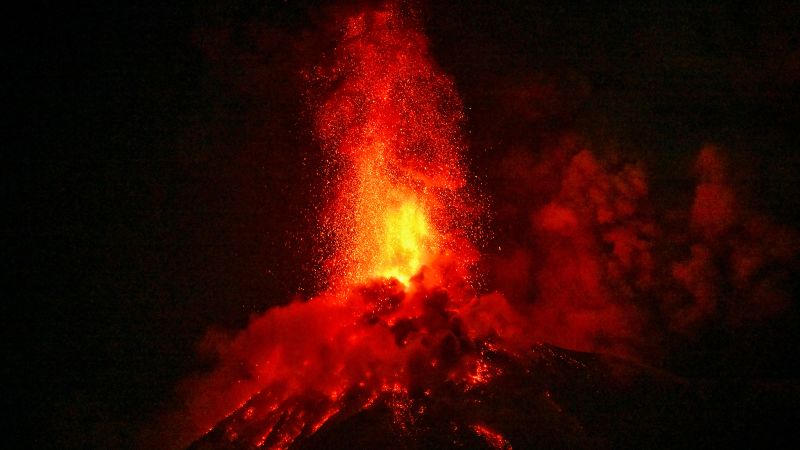
Guatemalan Volcano Reaches Critical Explosive Phase: Evacuations Underway
Qwenews.com – The Guatemalan volcano reaches critical explosive phase as authorities ordered the evacuation of hundreds of residents from communities near the Fuego volcano. The eruption, which began intensifying on Monday, has forced at least 1,699 people to leave their homes as pyroclastic flows cascade down the volcano’s surrounding ravines. Located approximately 50 kilometers (31 miles) southwest of Guatemala City, the Fuego volcano has been continuously spewing lava and massive plumes of ash into the atmosphere.
Edwin Rojas, director of the National Institute of Seismology, Volcanology, Meteorology and Hydrology, confirmed the severity of the situation during a Tuesday press conference. “Activity at the Fuego volcano continues in a critical explosive phase,” Rojas stated. The ash cloud has reached heights exceeding 5,000 meters (3 miles) above sea level and has spread as far as 120 kilometers from the eruption site. According to Conred, Guatemala’s disaster management agency, more than 29,000 people have been affected by the widespread ashfall.
Airspace and Transportation Disruptions
The volcanic activity has prompted significant disruptions to air travel and ground transportation. The Directorate General of Civil Aviation issued an alert to pilots warning that ash is contaminating airspace west and west-southwest of the volcano, extending to the Mexican border. Despite these concerns, Guatemala’s main international airport remains fully operational. At least three regions have declared red alerts—the highest possible level—to encourage additional evacuations and direct residents to shelters.
“Unfortunately, the Conred law is not coercive. It’s not like in other countries where they say, ‘We must evacuate’ and everyone evacuates. Here, it’s a recommendation, and that’s why we’re visiting house by house to encourage families to evacuate.”
Claudinne Ogaldes, executive secretary of Conred, explained the challenges of voluntary evacuation orders. Defense Minister Henry Saenz announced that security forces will patrol affected areas to prevent looting, which residents cite as a primary reason for refusing to leave their homes. So far, 18 communities have been impacted by smoke and ash emissions, though no lava flows or structural damage to homes have been detected.
Precautionary Measures and Historical Context
Educational institutions in municipalities near the volcano have suspended classes as a precaution. Conred has provided the Ministry of Education with detailed information to evaluate additional measures. Tourist access to both the Acatenango and Fuego volcanoes has been restricted until further notice. Additionally, Conred closed National Route 14, a major highway leading to Alotenango, to ensure safer evacuation routes.
The Fuego volcano ranks among the most active in Central America. A devastating eruption in 2018 claimed hundreds of lives and left many more missing, according to Conred records. Authorities have committed to monitoring the volcano’s activity for approximately 72 hours to assess whether conditions will stabilize or worsen.
Frequently Asked Questions
How many people have been evacuated so far? At least 1,699 people have been evacuated from communities near the Fuego volcano, with Conred visiting homes door-to-door to encourage voluntary evacuation.
Is Guatemala City affected by the eruption? While Guatemala City is approximately 50 kilometers from the volcano, ash has spread up to 120 kilometers, potentially affecting the capital region. The main international airport remains operational.
What is the risk of another major eruption? Authorities are monitoring the situation closely for 72 hours. Given the volcano’s history, including the deadly 2018 eruption, residents in affected areas are advised to remain vigilant and follow evacuation recommendations.
Are schools and roads closed? Classes have been suspended in some municipalities near the volcano. National Route 14, a major highway to Alotenango, has been closed as a precautionary measure.