
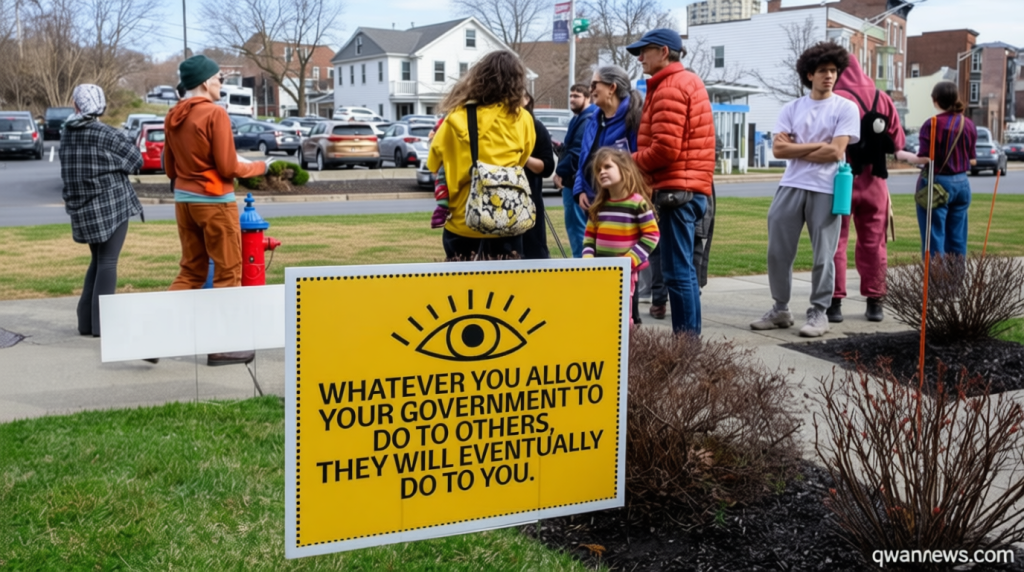
Nationwide Backlash Against Surveillance Technology
Qwenews.com – The phrase “Flock cameras are getting mobbed” perfectly captures what’s happening across America. Residents have organized coordinated efforts to disable the surveillance equipment. In upstate New York, people used electric saws to cut through the devices. Oakland residents covered the units with paint, while an Idaho driver smashed a car into one of the cameras. Meanwhile, a Florida man adopted a gentler strategy—sitting in a lawn chair with a cardboard shield on a pole to block the lens.
Cities Pulling Out
Municipal governments are responding to citizen concerns by ending contracts with the surveillance provider. Cities including Fort Collins, Colorado; Eugene, Oregon; Madison, Wisconsin; Knoxville, Tennessee; Syracuse, New York; and Walla Walla, Washington have either shut down their equipment or cancelled agreements.
How the System Works
The company describes its platform as a powerful crime-solving tool. Their network covers forty-nine states, constantly recording vehicle data and photographing pedestrians. Police departments use this massive database to track suspects and reconstruct criminal events. According to the company, their infrastructure handles tens of billions of data points monthly.
The firm currently runs about 120,000 automated license plate readers plus pan, tilt, and zoom cameras throughout the country. The automated readers continuously scan passing cars, while the directional cameras capture live footage for later review. This connected system allows cross-state alerts, enabling officers to get notifications when target vehicles show up in faraway areas.
Privacy Concerns Grow
While the company claims they only watch automobiles, recent reports suggest the cameras can track people too. Several cases have surfaced involving police officers who allegedly used the system to monitor romantic partners and coworkers. These stories have fueled a grassroots resistance movement.
Flock’s executives maintain that their equipment solves roughly 700,000 criminal cases each year. The company says it has addressed earlier technological issues and continues expanding its deployment.
Unlikely Political Alliance
What makes this movement special is its wide political coalition. Critics span the ideological spectrum, united by worries about personal freedoms and government overreach.
“It’s a violation of people’s privacy,” explained Caleb Williams, a twenty-four-year-old political independent from rural South Carolina.
“Rational people know it comes down to violating personal liberties,” stated Adrien Kaiser, a constitutional conservative residing northwest of Houston.
“I firmly believe the government can do things to make life better for people, but a surveillance state is the first step towards a police state,” added Jon Dendy, a Massachusetts progressive.
Community Support for Protesters
Neighbors have rallied behind those who physically disable the cameras. In West Virginia, a man faced arrest for destroying multiple units, yet dozens of neighbors volunteered to provide alibi testimony. One resident commented on a local news station’s Facebook page: “He was out fishing with me that day, you got the wrong guy.”
Another observer noted the unifying nature of the protest: “The one thing that’s bringing all of us together, which is exactly what they don’t want.”
A third voice captured the sentiment perfectly: “The two biggest signs that we can indeed get along are 1) the world cup & 2) our collective middle finger to flock cameras.”
Company Leadership Responds
Flock CEO Garrett Langley defended the company’s position during a recent interview with CNN’s Eric Levenson.
“Oftentimes our critics will say we need to make a choice between safety or privacy. And I think that’s I think that’s wrong,” Langley stated. “As a country, as a society, as a species, we have proven over and over and over again that we can have safety and privacy.”
Houston, where Kaiser resides, hosts nearly 4,000 Flock units, representing one of the company’s most extensive installations. Despite the mounting opposition, local supporters continue to defend the technology’s value for community safety.