
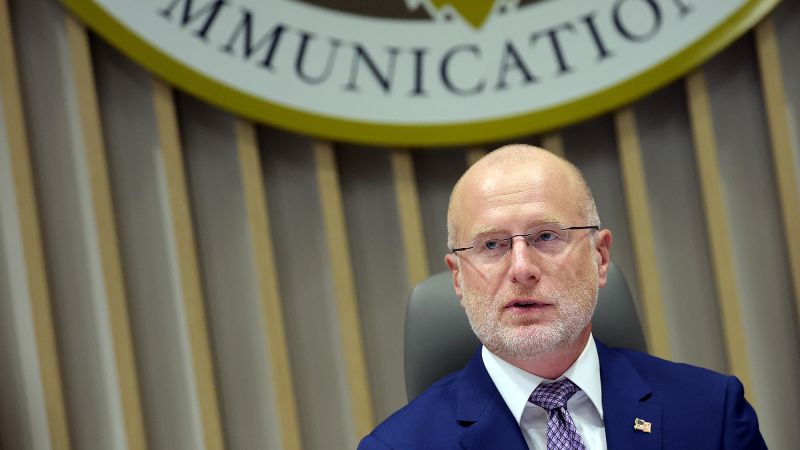
FCC Eliminates National Television Ownership Limit in Party-Line Decision
Qwenews.com – On Thursday, the Federal Communications Commission cast aside restrictions limiting how many television stations a single entity can control across the United States. This regulatory shift represents a significant victory for media organizations connected to President Donald Trump and Republican leadership. Those advocating for the existing limit have already announced plans to contest the commission’s decision through litigation, contending that legislative bodies alone possess the power to enact such modifications.
During the ongoing legal proceedings, the modified regulation is expected to enable major broadcasting networks like Sinclair to acquire additional stations, accelerating the transition toward centralized national control rather than local management.
Historical Context and New Framework
The Thursday vote, conducted along party lines, eliminated the national broadcast ownership restriction preventing any one corporation from controlling more than 39 percent of American television households through public airwaves. FCC Chair Brendan Carr explained that the eliminated rule will be substituted with a “case-by-case review” mechanism, which grants him greater influence over transactions concerning local television stations nationwide.
Carr said his intent is to support the local TV ecosystem and “stop hamstringing this one segment of the broader market with outdated restrictions.”
Opponents of Carr’s approach argue this rationale serves merely as a pretext. Matt Wood, who serves as general counsel for Free Press—a public interest organization promising legal action—stated: “His goal is to spur more media consolidation involving companies Donald Trump views as ideological allies and corporate cronies.”
The commission’s vote reached 2-1 in favor of repeal. Carr and Republican commissioner Olivia Trusty cast affirmative ballots, while Anna Gomez, the only Democratic commissioner, opposed the measure.
Critics Raise Concerns About Media Consolidation
Gomez championed the longstanding limitation as “a structural safeguard to preserve localism, viewpoint diversity, and competition.” Since the invention of broadcast television, American authorities have sought to advance these principles by restricting how many stations any single corporation may possess.
For nearly as many decades, ambitious broadcasting executives have pursued government relaxation of these constraints. During the 1980s, the FCC established a ceiling of twelve stations with coverage extending to no more than 25 percent of television households. The 1990s witnessed congressional intervention following aggressive lobbying from station proprietors, resulting in the removal of the twelve-station restriction and an increase to 35 percent.
Sen. Ted Cruz said, “I am skeptical a change can be made absent an act of Congress.”
The executive and legislative branches have debated this matter for generations. When Carr revealed last month that he was arranging Thursday’s vote, Senator Ted Cruz expressed doubt about the commission’s authority.
Democratic lawmakers adopted a more forceful stance. Senator Elizabeth Warren declared in a statement after Thursday’s decision: “Trump’s FCC Chair is trying to illegally rewrite the rules to make it easier for billionaires to line their own pockets while jacking up costs and controlling what Americans watch.” She added that “This looks like the Trump administration’s latest attempt to roll out the red carpet for more antitrust disasters.”
Local vs. National Control Debate Continues
At Thursday’s FCC gathering, Carr reiterated his position that the ownership limitation has become obsolete in the era of major technology corporations. Addressing supporters of Trump, he characterized the change as a method to “restore balance to the broadcast airwaves.”
Gomez said in a statement that “eliminating the cap does not free local broadcasters from economic pressure, it just changes who is doing the squeezing.”
The Democratic commissioner continued her critique: “The large station groups positioned to grow even larger under this decision are not local broadcasters, they are national companies that own local stations and increasingly dictate what airs on them.” She concluded by noting that “Trading a squeeze from Big Tech for a squeeze from Big Media does nothing to protect the communities this cap was designed to serve.”
Related Reading
Frequently Asked Questions
What is FCC repeals national TV ownership cap?
FCC repeals national TV ownership cap is the main topic of this guide. The article explains the context, practical details, and next steps readers should understand.
Why does FCC repeals national TV ownership cap matter?
FCC repeals national TV ownership cap matters because readers are looking for a useful answer, not just a short summary. Good content should match search intent and help them decide what to do next.