
Extreme Weather Is Drying Up Europe: A Crisis Visible from Space
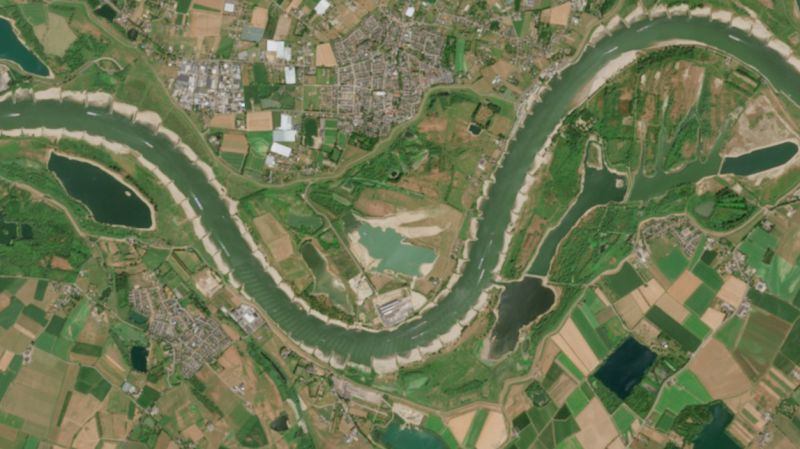
Qwenews.com – Extreme weather is drying up Europe at an alarming rate, with satellite imagery capturing unprecedented changes across the continent. Relentless heat combined with insufficient rainfall has pushed major European rivers to historic low levels. The crisis is so severe that it can now be seen from space, where dramatic photographs reveal waterways dramatically contracted amid parched landscapes. Extensive riverbanks and sandbars, normally submerged beneath flowing water, now lie exposed as levels plummet. Compared to 2023, when most European rivers maintained near-average flows, the current depletion is striking. As the world’s most rapidly warming landmass, Europe experiences increasingly severe summers driven by anthropogenic climate change.
Record-Breaking River Levels
The Danube and Rhine—two of the continent’s most essential arteries—have suffered particularly devastating impacts. The Danube, spanning ten nations from Germany to the Black Sea, has recorded its lowest levels in Hungary. Budapest experienced water depths of merely four inches on Monday, demolishing the previous 2018 benchmark of thirteen inches. With temperatures expected to exceed 100 degrees Fahrenheit, officials fear further declines. At Kaub, a critical navigation point near Koblenz in western Germany, Rhine water depth measured nine inches Wednesday. The prior record of 9.3 inches, established in 2018, has now been surpassed. Massimiliano Zappa, a hydrologist at the Swiss Federal Institute for Forest, Snow and Landscape Research, attributed the crisis to diminished Alpine snowfall, inadequate precipitation, and five separate heat waves impacting the Rhine basin.
Energy and Economy Under Pressure
These waterways serve as crucial infrastructure for commerce, industrial cooling, renewable energy production, tourism, and biodiversity. Their contraction creates cascading effects across human societies and natural systems alike. Hungary’s energy sector faces immediate threats. The Paks nuclear facility, responsible for nearly half the nation’s electricity and utilizing Danube water for cooling systems, operates at approximately ten percent capacity after nearly all reactors were forced offline. Complete shutdown looms if water levels continue falling. Prime Minister Péter Magyar acknowledged voluntary electricity conservation efforts from residential and commercial consumers during evening peak periods. Romania confronts similar challenges. Naval personnel deployed explosives Monday to fracture rock formations, attempting to channel additional Danube water toward the Cernavodă nuclear plant’s only operational reactor. According to Reuters, state water authorities plan to position two barges filled with rock to construct a temporary barrier diverting more flow to the facility.
Commercial vessels must reduce cargo capacity by up to eighty percent to prevent grounding incidents. Supply chain disruptions and elevated shipping costs follow.
Shipments by barge are severely restricted, and vessels are operating with significantly reduced cargo loads. As some loading and unloading points can no longer be reached, we are switching to rail and road transport wherever possible.
— Lanxess spokesperson, speaking to Reuters on Monday
Tourism and Historical Discoveries
Tourism operations face mounting difficulties as reduced water depths force itinerary modifications and cancellations. A passenger vessel recently grounded on a Danube sandbank in Bulgaria. The receding waters also unearth historical remnants. Northern Bulgaria yielded what experts believe to be ancient mammoth remains last week, while Serbia’s Danube revealed a sunken German warship from World War II. The Rhine presents comparable concerns. Originating in the Swiss Alps and terminating in the North Sea, this waterway transports essential commodities including food, minerals, coal, and petroleum. While seasonal low water periods are common, this year’s measurements represent exceptional extremes.
Frequently Asked Questions
Which European rivers are experiencing the lowest levels on record? The Danube and Rhine are both recording historic minimums, with the Danube reaching four inches in Budapest and the Rhine dropping to nine inches at Kaub, Germany.
How is extreme weather is drying up Europe affecting nuclear power plants? Hungary’s Paks nuclear facility operates at ten percent capacity with nearly all reactors offline. Romania’s Cernavodă plant has only one reactor running and requires emergency water diversion measures.
What causes these extreme river level drops? Hydrologists attribute the crisis to diminished Alpine snowfall, inadequate precipitation, and five consecutive heat waves that have impacted both the Rhine and Danube basins.
How are shipping and commerce being disrupted? Commercial vessels must reduce cargo capacity by up to eighty percent to avoid grounding, leading to supply chain delays and increased transportation costs across Europe.