
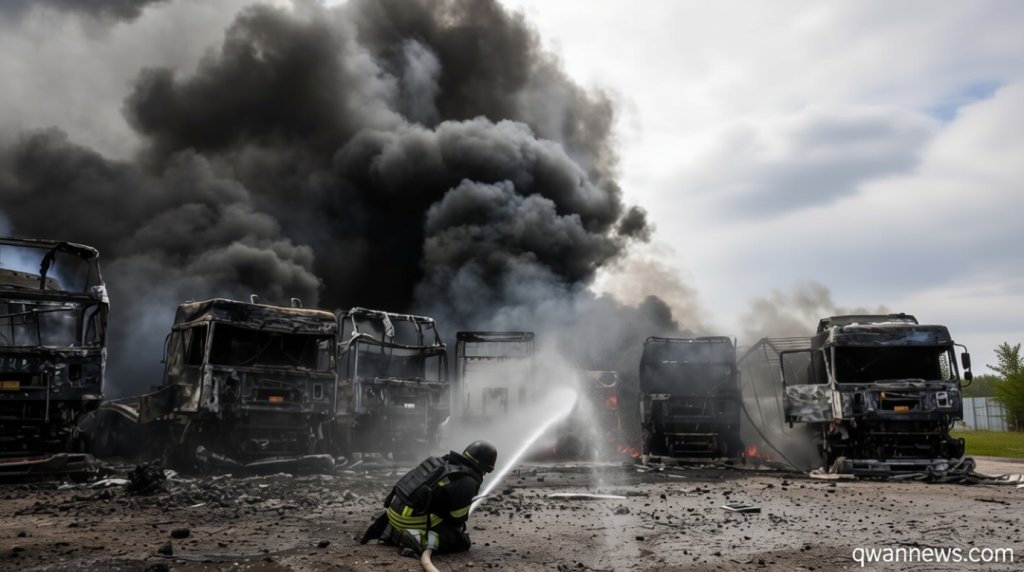
Drone and Artillery Strikes Kill Civilians on Russia-Ukraine Border
Qwenews.com – On Saturday, drone and artillery attacks near the Russia-Ukraine border resulted in civilian casualties on both sides, intensifying the already volatile conflict. The incidents, confirmed by local authorities, marked a new phase in the region’s warfare, with strikes targeting populated areas and civilian infrastructure. As the war enters its fifth year, the frequency of such attacks has raised concerns about the toll on non-combatants, despite the ongoing military stalemate between the two nations.
The Human Toll of Escalating Attacks
According to reports, a Ukrainian drone strike in the Bryansk region killed two civilians in a vehicle, as confirmed by the acting governor, Yegor Kovalchuk, who shared updates via Telegram. Meanwhile, in the Dnipropetrovsk Region, the governor, Oleksandr Ganzha, noted that over 40 combined drone and artillery attacks near Nikopol caused one fatality and one injury. These events underscore the growing threat to everyday life, with both sides deploying advanced weaponry to target strategic and symbolic locations.
“Ukrainian drones heading for the capital are being intercepted,” stated Moscow’s mayor, Sergei Sobyanin, during daily briefings. Russian news agencies recorded 24 drone encounters in a single day, while the Defense Ministry reported 124 drones downed over Russian territories between 8 a.m. and 8 p.m. local time. This discrepancy highlights the complexity of tracking aerial threats, as some drones may evade detection or be intercepted multiple times.
The attacks have intensified in recent weeks, with both nations using drone and artillery strikes to pressure each other. In Russian-held areas of Donetsk, Moscow-appointed leader Denis Pushilin confirmed casualties from drone strikes in Horlivka and Makiivka, two towns with significant strategic importance. The focus on these locations, including the Dnipro River’s opposite bank, reflects the broader goal of disrupting supply lines and forcing tactical concessions. The ongoing assault on Zaporizhzhia’s nuclear power plant, now under Russian control, has also drawn attention to the potential for catastrophic consequences if the plant is damaged.
Context and Strategic Implications
The recent strikes come amid a series of offensives that have shifted the frontlines closer to the border. Ukraine’s use of drones, which have become a cornerstone of its military strategy, has been particularly effective in targeting Russian positions and infrastructure. Meanwhile, Russia has relied on artillery to maintain its foothold in eastern Ukraine, often striking Ukrainian border villages in retaliation. Analysts suggest these attacks are not only tactical but also aimed at demonstrating resolve to the international community, especially as the conflict approaches its fifth anniversary.
Civilian casualties have become a persistent issue in the war, with both sides increasingly using precision strikes and area attacks to weaken the enemy. The drone and artillery attacks near the border have exacerbated the humanitarian crisis, displacing thousands of residents and damaging homes and schools. Human rights organizations have called for greater accountability, noting that the war has claimed over 10,000 civilian lives since 2022. The latest incidents, however, have drawn particular scrutiny due to their proximity to key population centers and the use of advanced technology to minimize collateral damage.
As the conflict drags on, the balance between military effectiveness and civilian safety remains precarious. The drone and artillery attacks near the border illustrate how modern warfare has evolved, with drones enabling rapid, long-range strikes while artillery provides sustained firepower. This combination has allowed both sides to inflict significant damage while reducing the need for large-scale ground advances. However, the human cost continues to mount, with families in border regions reporting sleepless nights and a constant fear of sudden attacks. The war has not only reshaped the battlefield but also deepened the personal tragedies of those caught in the crossfire.