
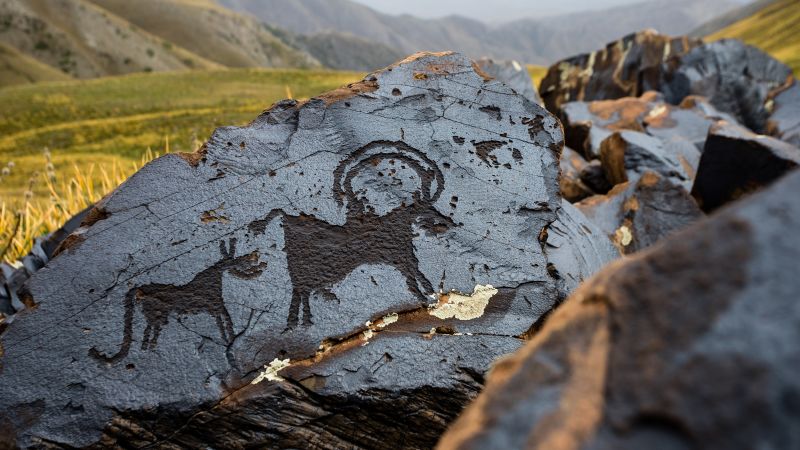
Qwenews.com – EDITOR’S NOTE: This CNN Travel series may have adjacent ads by the country it highlights. CNN retains full editorial control over subject matter, reporting and frequency of the articles and videos, in compliance with our policy. Under the dark canopy of night, the starry sky is reflected by the stones.
Ten thousand rocks, carved with nearly 90,000 petroglyphs, catch the beam of a headlamp, telling stories as ancient and vast as the constellations above. Near the top of the Saimaluu Tash valley, a small sacred pond brings land and sky together at a point that has been used for centuries of Tengrist religious rituals. Known in Kyrgyz as “Embroidered Stones,” or Saimaluu Tash, one of Central Asia’s most spectacular cultural sights is also one of the most difficult to reach.
Dating back about 4,000 years, and spanning three millennia of continuous worship, Saimaluu Tash is one of the largest and most remote high-altitude petroglyph sites in the world. Etched into dark, volcanic basalt by successive waves of Bronze Age nomadic tribes, Scythian warriors and early Turkic civilizations, this open-air gallery serves as a raw, unspoiled archive of ancient human belief — depicting everything from prehistoric hunts to sacred sun-worship rituals. Getting there involves climbing a path that winds up through the rocky terrain of the Tian-Shan mountains and crosses an impermanent snow bridge that is crucial to the entire journey.
Arrive too early in the season, and the petroglyphs remain buried under the wintry landscape; arrive too late, and the snow bridge will have melted beyond the point where it can be safely crossed. This delicate seasonal tightrope limits access to the petroglyphs to a fleeting six-week window, usually between July and September. During the slow trek upward, Bishkek-based tour guide Altynai Kudaibergenova explains the trials these long-forgotten artists would have faced to get here, and what makes the site so special as a place of worship.
“Ancient peoples would have to plan carefully and face all kinds of challenges as they made their way up here year after year for centuries,” she says. “They had to brave trails that climb along precipitous slopes and treacherous ice patches that linger in the shadows and refuse to melt under midsummer sun.” Just beyond 2,000 meters above sea level — about 6,600 feet — after nearly three hours of climbing, the first of the dark basalt rock faces start to appear. These carvings seem to depict scenes of hunting, warfare, sun worship and more — art created in thanksgiving for blessings already received or to beseech a higher power for some much-needed good fortune.
Tengrism, an animist tradition in which the spirits of nature are mediated by shamanic practitioners, dominated the religious beliefs of Central Asia before the arrival of Islam in the eighth century. While many of the spiritual sites of the belief system still exist in some form, it is the rare few like Saimaluu Tash that have remained in their original state without being affected by the advent of modern religion. This, according to Kudaibergenova, is a cultural heritage site unlike any other.
“Saimaluu Tash nests in the mountain pass that connects the Ferghana valley to inner Tian-Shan and the southern, historically more settled, Kyrgyzstan to its northern regions that remained heavily nomadic all the way into the 20th century,” Kudaibergenova says. “It is the largest petroglyph site in Central Asia, left by different people groups over the span of four millennia. “This makes the location most unique from a historical, archaeological and anthropological standpoint, and last but not least, a museum of the earliest art.” After hours of hiking, sore legs are forgotten as soon as the first few carvings appear.
Climbing the last moments into the center of the site, the feeling is as much treasure hunt as open-air museum. A day and night of wandering among the boulders is nothing compared to millennia spent carving these wonders. As the summer heat shines upon scenes of solar worship and hunters chase ibex to the next valley over, an internal war wages between the simple joy of exploration and the innate urge to find and see and document.
Stories reaching out from thousands of years past connect to a modern audience with a gravitas defined by their physical and temporal remoteness. The petroglyphs were lost to history until rediscovered by Imperial Russian military cartographer Nikolai Khludov in 1902. And archaeologists only began to truly study the site in the late 1940s.
Research dates the earliest petroglyphs on-site to the Bronze Age, continuing through the Iron Age into the early Turkic period, roughly 900 CE. That means this small glacial valley was a center of worship for roughly three millennia. The carvings tell of hunting parties and agricultural communities, of warring tribes and sun worship, offering important insights into the lives and lifestyles of Turkic, Scythian, and even earlier nomadic cultures in the region for which such significant finds are rare.
The same remoteness that has restricted study and tourist access, however, is also what has preserved the petroglyphs in such an incredible condition, with minimal looting and vandalism. Heavy winter snow cover has largely protected the basalt from rapid temperature fluctuations. While there are a few instances of modern graffiti alongside the ancient carvings, Altynai takes a long-term view.
“The ancient art of petroglyphs demonstrates what was of value to those who lived as far back as 3000 BC — food, hunting, war, worshiping, procreation. “Nowadays, next to these, one encounters carvings that say ‘Sasha was here 2012.’ We consider it vandalism now, but a millennium from today, scientists will probably remark upon these as well and note the difference about what mattered to people of different ages, from basic survival to self-identity.” With Kyrgyzstan’s travel industry experiencing a recent boom as long-planned infrastructure projects bring this region closer to major cities, there’s a lingering sense that the profound quiet that surrounds the petroglyphs cannot last much longer. For the few international tourists who make the trek, the sheer remoteness is the primary appeal.
Saimaluu Tash remains, for now, well off the beaten track. Moving further up the valley, past the sacred pond toward the windswept pass, the only signs of human activity are those carved into the rocks thousands of years ago. From the crest of the pass, looking down at 10,000 boulders scattered across the grassy slope, the scene feels far removed from the present day.
“As someone who’s done a few hikes all over the world this one truly has it all: challenging passes, lush valleys with snow-capped mountains, rushing rivers with tricky crossings, more horses than people, and the odd friendly shepherd who hasn’t seen a tourist in months and invites you into his yurt for some chai,” says American hiker Tara Fenwick-Smith, who recently visited the Saimaluu Tash valley. “Not only were we able to see some incredible scenes of Kyrgyz back country but also get a glimpse of the incredibly warm culture that is there.” From the base camp, the route is just a half-day walk to the waiting vehicle that, the following morning, will carry travelers back through nearby Kazarman and onward to the Kyrgyz capital of Bishkek. But tonight, as the moon rises behind the mountain ridge, the stars still shine brightly down upon the most extensive traces that remain of a tradition that has all but faded from the modern world.
Bishkek- and Osh-based tour operators can organize trips including all necessary guides, permits, gear and transfers to the site directly from those two cities’ international airports with connections to major hubs in Europe, the Middle East, and Asia. These include Bishkek Walks, Kyrgyzstan-Tourism and Nomad’s Land. Independent travelers can use public transport from either city to Kazarman, where visitors can pre-pay the entry fee (400som, or just under $5) for Saimaluu Tash and arrange hired horses (2,000som per day, or about $23), beyond which a private transfer will be required to the national park entrance.
CBT Kazarman can also arrange transfers, guides, and other logistics but it’s worth reaching out well in advance.
Related Reading
Frequently Asked Questions
What is The vast Bronze Age masterpiece that?
The vast Bronze Age masterpiece that is the main topic of this guide. The article explains the context, practical details, and next steps readers should understand.
Why does The vast Bronze Age masterpiece that matter?
The vast Bronze Age masterpiece that matters because readers are looking for a useful answer, not just a short summary. Good content should match search intent and help them decide what to do next.