
A Manila Museum Brings the Galleon Era to Life Inside Mall of Asia
Qwenews.com – In Manila, the story of the sea is inseparable from the country’s place in the modern world. Filipino sailors now account for roughly 25% to 30% of crews on vessels worldwide, serving aboard tankers, bulk carriers and cruise ships. Their prominence in international shipping reflects a maritime tradition that reaches back centuries, to the period when Manila stood at the center of a Pacific trade route connecting Asia, the Americas and Europe.
That history has found an unusual new setting: Museo del Galeon, located within the vast Mall of Asia complex beside the South China Sea. The museum offers visitors a focused, atmospheric journey through the Manila galleon trade, providing a sharp contrast to the noise and activity of one of the Philippines’ largest retail and entertainment destinations.
The mall contains more than 660 stores and restaurants in its main building, creating an environment that can feel intensely busy. Nearby, a mall marching band performs pop songs, including music by Taylor Swift. Yet a short walk from those crowds leads to a quieter space where the sounds diminish and the focus shifts to voyages made hundreds of years ago.
A Full-Scale Galleon at the Center
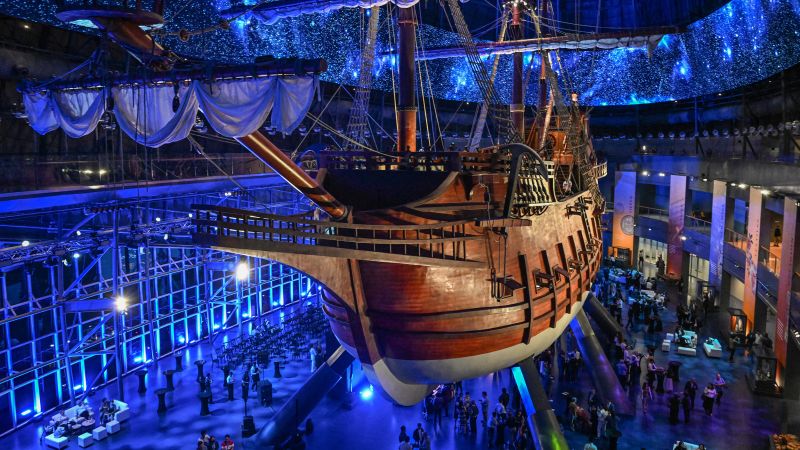
After entering on the ground floor and riding an escalator beyond the ticket area, visitors encounter the immense bow of the Galeon Espiritu Santo. The installation recreates at full scale a ship that crossed the Pacific between 1603 and 1618.
Nearly 100 feet high and extending more than 130 feet in length, the Espiritu Santo replica stands beneath a high ceiling illuminated with stars. The setting evokes the night sky observed by the approximately 200 people aboard the ship as it made 10 voyages across the Pacific.
Its route linked Manila with Acapulco, the major Spanish trading center on Mexico’s Pacific coast. Asian goods such as porcelain, silk and spices arrived in Acapulco, where they were exchanged for silver from the New World. The silver then traveled westward, while Asian cargo was taken by mule across Mexico to the Atlantic coast before continuing by sea to European markets and royal courts.
“It is considered one of the earliest global trade networks in history.”
Over 250 years, 181 galleons completed 798 voyages. Maps in the museum show that the paths used in that era bear a striking resemblance to routes followed by Filipino seafarers today. One major difference is the Panama Canal, which removed the need to transport goods overland across Mexico.
Navigation Before Modern Instruments
Museo del Galeon is designed as an experience rather than a collection of objects viewed from a distance. Visitors are invited to use touch, smell and interactive displays while learning how the Pacific crossing shaped life in Manila and far beyond it.
A spice installation invites guests to identify aromas from six stations. Each has a jar roughly the size of a fist, encouraging visitors to connect the scents with cuisines and regions across Asia. The exhibit gives a sensory reminder of why spices were among the valuable goods carried through the trading network.
On the ship itself, English-language touchscreens explain how crews navigated the enormous Pacific Ocean with the sun, stars and early instruments. The galleon trade was active more than a century before the creation of a dependable clock suitable for long ocean voyages. As a result, finding longitude was exceptionally difficult, and sailors could be hundreds of miles away from their intended position.
Digital imagery wraps around the upper portion of the museum, helping create the feeling of an open-water journey. There is no actual rolling deck or tropical heat, but the scale of the ship and the star-filled visual setting make the difficulties of a galleon passage easier to imagine.
Building Ships in Cavite
The original Espiritu Santo was built in Cavite, south of Manila, on a peninsula extending into Manila Bay. Builders used hardwoods from Luzon, including teak, molave and lanang. Studies indicate that constructing a single ship could require 2,000 trees, illustrating the immense resources required to sustain the galleon system.
Filipinos made up most of the shipyard workforce, just as they formed a large part of maritime crews. Historical records also show the presence of skilled specialists from Japan, China and other places, including carpenters and blacksmiths. The museum’s displays examine the layout of a Cavite shipyard, the work involved in constructing these vessels and the process used to launch them.
The exhibit’s Espiritu Santo is made from fiberglass rather than hardwood. It was built in Pampanga, north of Manila, then disassembled and transported by truck to the capital for reassembly inside the mall.
Depending on its size, a galleon could leave port carrying between 50 and 400 people. These ships carried merchants, sailors, workers, passengers and cargo across one of the world’s most demanding sea routes. Their journeys helped establish commercial links that reshaped economies on several continents.
For present-day visitors, the museum offers more than an account of historic trade. It places the Philippines’ current seafaring role in a much longer narrative, showing how Filipino labor, shipbuilding knowledge and maritime experience supported global connections long before modern container shipping and international cruise travel.
Related Reading
Frequently Asked Questions
What is Inside one of the largest malls?
Inside one of the largest malls is the main topic of this guide. The article explains the context, practical details, and next steps readers should understand.
Why does Inside one of the largest malls matter?
Inside one of the largest malls matters because readers are looking for a useful answer, not just a short summary. Good content should match search intent and help them decide what to do next.