
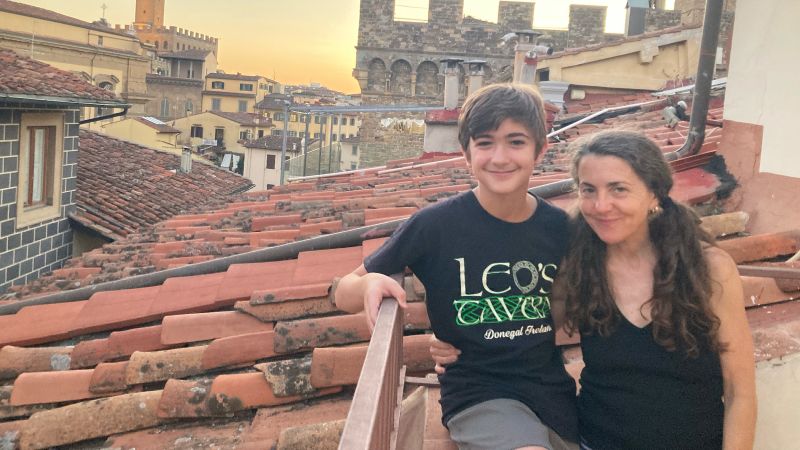
Learning to Share Italy With a Teenager
Qwenews.com – Italy held a defining place in one mother’s life long before her son Leo was old enough to travel. A semester abroad there eventually led to time living in the country after she studied Italian in college. Years later, she returned with her family hoping the places that had shaped her would captivate him too.
It has not always worked that way. By age 13, Leo had already made three trips to Italy and taken nearly 10 international trips in total. Rome and Florence, which can feel endlessly rich to an adult visitor, sometimes registered to him as repeat destinations, heat, long walks and museums standing between him and something more immediately entertaining.
“What? Again? We’ve already been to Rome and Florence!”
That reaction can be hard for any parent to hear, especially when a destination carries such personal meaning. Yet traveling internationally with children often requires accepting that a parent’s dream itinerary and a child’s version of a good day may be very different. In this family’s case, making Italy meaningful for Leo has increasingly depended on flexibility, pauses and a willingness to include experiences that were never part of the original plan.
Florence, Through Two Different Lenses
One summer evening last year in Florence made the contrast particularly clear. The mother met Chiara, an Italian friend she had not seen in years. Their reunion unfolded in the city where they first met: a walk through Piazza della Repubblica, time looking at novels in a bookstore, then a leisurely meal near the central market.
For the adults, it was an opportunity to reconnect in a Tuscan city full of memories. For Leo, it became an extended stretch of Italian conversation after a long day. Once Chiara left, he voiced his frustration.
“That was three hours of hearing you talk, talk, talk Italian!”
His impatience had appeared earlier at the Uffizi, Florence’s internationally known museum of Renaissance art. His parents had waited until he seemed old enough to appreciate it, but the visit became a speedy passage through galleries rather than the slow encounter with Botticelli and other masterpieces they had imagined. As Leo hurried toward the exit, his mother found herself trying to look back at works she had barely had time to absorb.
What did appeal to him? Not always the expected Italian treasures. Pokémon cards made an impression, as did an expensive Ferrari shirt, a tourist-oriented museum of illusions and the rooftop café at the Uffizi. A round of Uno No Mercy was also a success, even though it could just as easily have taken place at home.
Compromise Began in Rome
The pattern had started years earlier, on the family’s first Italy trip in 2018. Leo was five when they arrived in Rome after a 10-hour flight. He had spent much of the journey restless and stretched across his mother’s lap. The July heat was intense, and everyone was tired, but there was still an outing to Villa Borghese, the large park north of the historic center.
Its marble sculptures did little to hold Leo’s attention. Italian cars, however, did. Already fascinated by them, he was thrilled when the family rented a slightly shaky quadricycle, an open four-seat vehicle sometimes described locally as a rickshaw. He wanted to race around bends, laughing even when the ride felt as though it might tip.
The Forum, a nap and the park’s art museum were postponed. In that moment, the quadricycle was the compromise: not the cultural stop his mother might have selected, but a way for a young child to find joy in the setting on his own terms.
Pokémon Cards and the Roman Forum
A 2022 return to Rome brought another lesson. After an outdoor dinner began to test the patience of her fidgety 10-year-old, his mother went searching through the city for Pokémon cards. The search took her to Mondadori, one of Italy’s major booksellers, a familiar place because of her love of Italian novels. Only then did she discover that the bookstore sold the cards too.
Standing in line, she felt the friction between the trip she had pictured and the one actually taking place. Yet the purchase answered an immediate need, allowing room for a child’s interests within a journey otherwise designed around adult passions.
The Roman Forum also proved that even historic ambition has limits when a child is hot, tired or urgently needs a bathroom. A planned visit was shortened when Leo wanted to return to their accommodation. His mother managed to see inside the Temple of Venus before conceding that the day could not be rescued by pressing on.
That does not make the trip a failure. It underlines a practical truth for families: the most memorable travel does not necessarily come from completing every planned attraction. Sometimes it comes from recognizing when a child has reached capacity, then preserving the possibility that the next stop will be better.
Finding the Details That Spark Curiosity
Italy has still offered unexpected points of connection. In Florence, Leo responded differently to the museum that displays Galileo’s finger. Galileo died in 1642, and the unusual artifact gives history a startlingly concrete quality—far removed from the more abstract challenge of moving through room after room of paintings.
There is also a natural overlap between Leo’s interests and the country around him. He is a thoroughly American teenager, but he shares a first name with Leonardo da Vinci and dreams of owning a Ferrari. Cars, games, odd historical objects and the occasional rooftop treat may not be the traditional foundations of an Italian cultural education. They can nevertheless become the bridges that make a place feel personal.
For a parent attached to Italy, the goal has gradually shifted away from securing instant devotion to every museum, piazza and archaeological site. The more realistic hope is that Leo will gather his own set of memories: the exhilaration of steering through Villa Borghese, the hunt for cards in Rome, the Ferrari connection and the strange fascination of Galileo’s finger.
Those memories may not mirror his mother’s. They do, however, give him a relationship with Italy that belongs to him—and leave open the possibility that the art, language and history he once rushed past will mean something different later on.
Related Reading
Frequently Asked Questions
What is Compromises bribes and a 400 year?
Compromises bribes and a 400 year is the main topic of this guide. The article explains the context, practical details, and next steps readers should understand.
Why does Compromises bribes and a 400 year matter?
Compromises bribes and a 400 year matters because readers are looking for a useful answer, not just a short summary. Good content should match search intent and help them decide what to do next.