
China’s Homegrown Supercomputer Surpasses U.S. Rival in Global Rankings
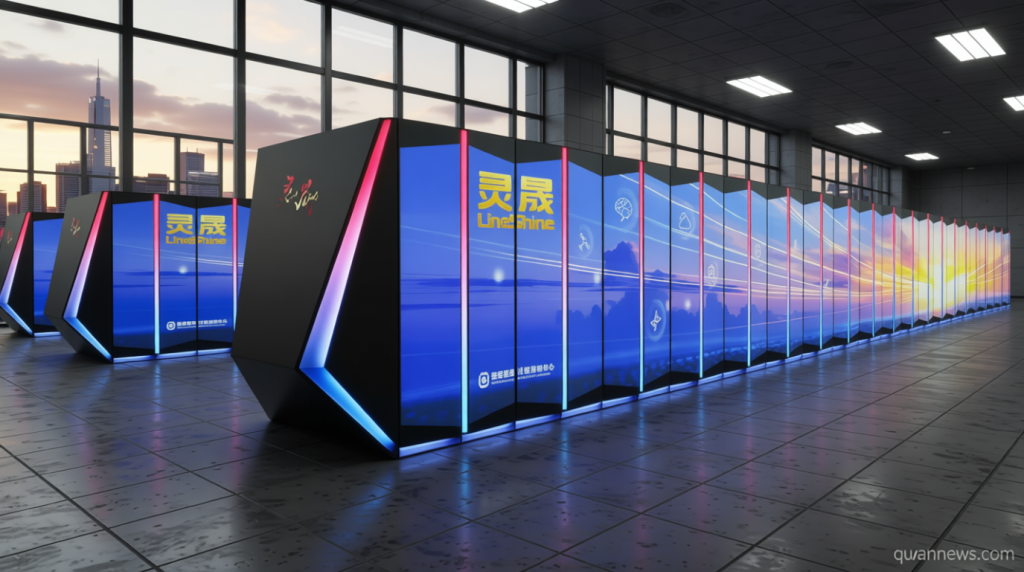
Qwenews.com – In a landmark development, China’s supercomputer powered by homegrown chips has reclaimed the top spot in the latest biannual TOP500 global rankings, marking its first lead over U.S. models since 2017. The LineShine supercomputer, which uses domestically developed processors, now ranks as the world’s fastest system, reflecting a major breakthrough in China’s high-performance computing capabilities. This achievement highlights the nation’s growing emphasis on technological self-reliance, particularly in critical sectors like artificial intelligence and scientific research.
Domestic Innovation Meets Global Competition
The LineShine system, located at the National Supercomputing Center in Shenzhen, demonstrates the power of China’s homegrown supercomputing technology. Its performance surpasses the previous leader, the American El Capitan, which was housed at the Lawrence Livermore National Laboratory in California. According to the latest TOP500 report, LineShine achieved a 20% higher computing speed, showcasing the effectiveness of China’s shift toward using native hardware. This milestone is part of a broader strategy to reduce dependency on foreign components, especially in light of escalating trade tensions.
Architectural Breakthroughs and Strategic Adaptation
LineShine’s success is not only a testament to its raw processing power but also to its unique architectural design. Unlike most supercomputers that rely on graphics processing units (GPUs) from U.S.-based companies like Nvidia, LineShine employs a fully domestic architecture, combining high-performance computing chips with optimized memory systems. This approach, which integrates both CPUs and high-bandwidth memory, allows the system to handle complex scientific simulations and AI training tasks with greater efficiency. The move underscores China’s commitment to building a self-sufficient tech ecosystem.
“LineShine broke through the conventional hybrid design of supercomputers, which combine CPUs and GPUs,” stated Lu Yutong, chief designer of the system, per the National Supercomputing Center. “It employs a complete stack of domestic components, including high-bandwidth memory, to handle scientific, engineering, and AI tasks.”
Global Rivalry and Technological Sovereignty
The rise of LineShine comes amid intensifying global competition in high-performance computing. Since Donald Trump’s administration imposed stricter export controls on advanced technologies, Chinese firms have accelerated efforts to develop independent solutions. The National Supercomputing Center emphasized that LineShine represents a “historic leap in overcoming foreign technology constraints,” as its components are now entirely sourced from within China. This strategic independence is seen as a critical advantage in the race for computational dominance, particularly in AI and data analytics.
Applications Across Science and Industry
China’s homegrown supercomputer is already making waves in diverse fields, from climate modeling to drug discovery. Its advanced processing capabilities enable researchers to analyze vast datasets more quickly, accelerating progress in areas like quantum computing and materials science. The system’s deployment also signals China’s intent to leverage its technological prowess for industrial applications, such as optimizing manufacturing processes and improving energy efficiency. However, experts note that while the TOP500 rankings highlight raw performance, they may not fully capture the nuanced demands of AI-driven innovation.
“While impressive, the TOP500 doesn’t directly reflect AI capabilities,” said Andrew Rohl, director at Australia’s National Computational Infrastructure. “The benchmark focuses on traditional computing tasks, not the specialized needs of modern AI systems.”
Future Implications and International Collaboration
The LineShine breakthrough could have far-reaching implications for global tech dynamics. With the top ten supercomputers now including nations like Italy, Switzerland, and Japan, China’s rise suggests a shifting balance in technological leadership. Analysts believe that this development will further solidify China’s position in AI research, as its homegrown infrastructure supports faster training of machine learning models. Meanwhile, international collaborations continue to play a role in refining domestic technologies, with Chinese researchers drawing insights from global advancements while maintaining a focus on sovereignty.
As the race for computational supremacy intensifies, LineShine stands as a symbol of China’s technological ambition. Its success not only challenges U.S. dominance in the field but also sets a precedent for other nations seeking to develop their own high-performance systems. With continued investment in R&D and a strategic push toward self-reliance, China is poised to maintain its edge in the global supercomputing landscape, reshaping the future of scientific and industrial innovation.