
Women’s Division Makes History at Red Bull District Ride in Groningen
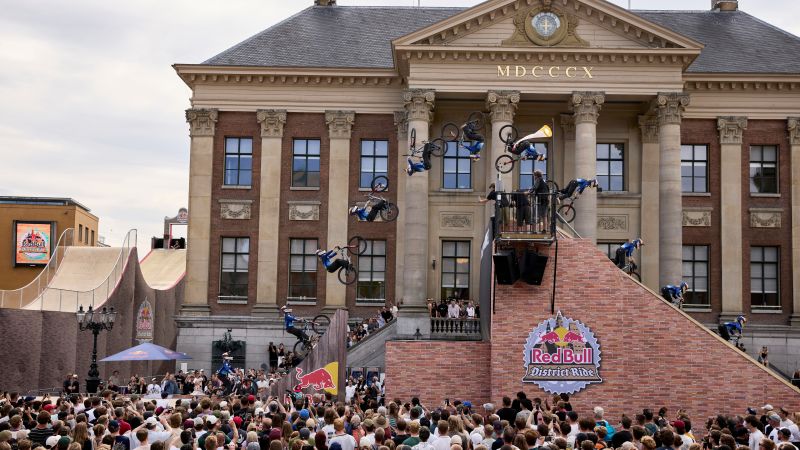
Qwenews.com – Amidst a roar from 20,000 spectators gathered in a Dutch market square, 23-year-old Swedish mountain biker Alma Wiggberg prepared for her moment. Positioned 50 feet above the crowd on a building rooftop in Groningen, she exhaled deeply, shook her head, and pedaled toward the edge before dropping into the competition course. That decisive run earned her the inaugural women’s championship at Red Bull District Ride, elevating slopestyle mountain biking to new heights of inclusivity.
A City Square Transformed
For one weekend in July, the historic Grote Markt in Groningen underwent a remarkable transformation. Centuries-old market stalls and café tables gave way to an elaborate wooden course featuring ramps, jumps, and wallrides constructed from scaffolding. The structure rose high alongside the square’s historic buildings, with riders performing flips and spins against the backdrop of the distinctive 500-year-old Martinitoren bell tower.
This concept defines Red Bull District Ride: transporting a sport traditionally rooted in mountains, dirt, and forests directly to urban audiences. Since its inception in 2005, six editions have taken place in Nuremberg, Germany, with one held in Sicily, Italy. This year marked the competition’s first appearance in the Netherlands.
Women’s Inclusion Marks Progress
The women’s division represents a significant milestone for the sport. Participants now receive equal prize money and equal audience exposure compared to their male counterparts—a division that simply did not exist four years prior. Riders, judges, and organizers all acknowledged the tremendous advancement since women’s slopestyle was incorporated into the FMB World Tour in 2022.
Despite this rapid growth, a noticeable gap remains. Groningen featured 15 male competitors against just six women. Most events with women’s divisions continue to show smaller female lineups and less advanced trick difficulty, a reality that has drawn social media criticism.
Championship Performances
Wiggberg secured her victory on the final crowd-pleasing 50-foot roof drop and “Big Air” jump, executing a backflip bar spin where she flipped once while spinning her handlebars. Her triumph followed a historic 2024 season in which she won the women’s inaugural Diamond titles in both Australia and Canada.
Seventeen-year-old German rider Johanna Nussbaumer finished close behind, performing the first tail-whip—where riders spin their bike’s body beneath them—in a women’s competition. Polish competitor Natalia Niedzwiedz, 22, completed the podium despite a difficult fall while attempting a front flip on the final jump.
Tim Bringer claimed the men’s division with a backflip double tail whip to bar spin, demonstrating a more complex maneuver where he flipped while spinning his bike’s body twice and his bars once.
The Subjective Art of Slopestyle
Slopestyle stands apart as one of mountain biking’s most subjective disciplines, operating without a clock or traditional racetrack. Riders complete a single run down the course, performing aerial tricks off jumps, and are evaluated on execution, difficulty, amplitude, and variety.
Thomas Genon, a former slopestyle champion who served as a judge at this year’s event, described the competition as featuring “360s to the right, to the left, backflips, front flips (and) big rotations” as competitors attempt to “pack the most different tricks in there.”
Griffin Paulson, a 29-year-old Canadian professional slopestyle rider, emphasized the discipline’s creative nature. “It’s an interesting style of mountain biking because of the individuality of each rider,” he explained. “You can bring in your own creativity.”
Voices from the Sport
Riders have witnessed remarkable evolution firsthand. Robin Goomes, a 30-year-old slopestyle and freeride competitor from New Zealand, reflected on the changes: “Only a few years ago, I did the first backflip in competition. Now backflips? Everyone can do it.”
Shealen Reno, a 30-year-old American slopestyle rider, added her perspective: “We just didn’t know of this sport and now it’s been four years, we’ve got the opportunity to ride courses this big and it’s just skyrocketed.”
Yet challenges persist. Reno, who has grown accustomed to negative feedback, noted: “There are so many men that think we shouldn’t be doing this and that we are a joke.” She mentioned encountering numerous online discussions where critics believe women must perform more advanced tricks to justify their presence in the sport.
“Only a few years ago, I did the first backflip in competition,” said Robin Goomes. “Now backflips? Everyone can do it.”
“We just didn’t know of this sport and now it’s been four years, we’ve got the opportunity to ride courses this big and it’s just skyrocketed,” added Shealen Reno.
Related Reading
Frequently Asked Questions
What is This Dutch city square became an extreme?
This Dutch city square became an extreme is the main topic of this guide. The article explains the context, practical details, and next steps readers should understand.
Why does This Dutch city square became an extreme matter?
This Dutch city square became an extreme matters because readers are looking for a useful answer, not just a short summary. Good content should match search intent and help them decide what to do next.