
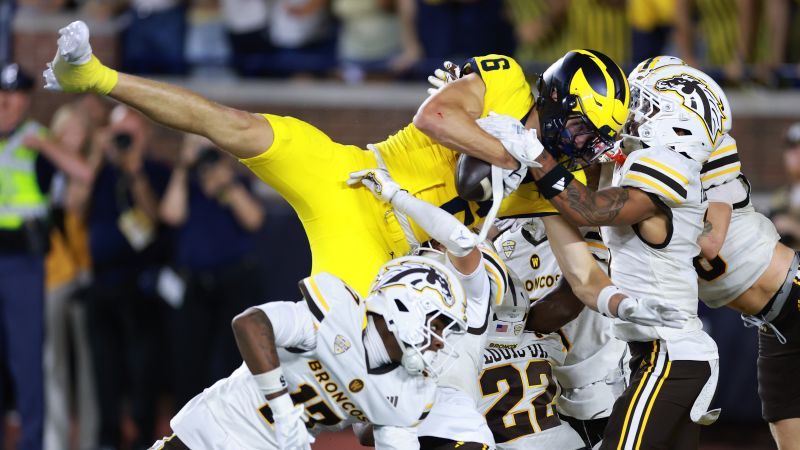
MAC Appeals Michigan Clock Controversy
Qwenews.com – The Michigan clock controversy escalates as MAC officials formally petitioned the NCAA and the College Football Playoff committee to overturn a last-second result in Ann Arbor. Western Michigan’s 12-7 lead over Michigan was erased when replay officials restored one second of game time, allowing quarterback Bryce Underwood to launch a second deep pass that landed in JJ Buchanan’s hands for a 13-12 Michigan win. The Mid-American Conference filed its appeal on Tuesday, arguing the replay crew violated established timing protocol.
How One Second Changed the Outcome
Michigan trailed by five points with the game clock appearing to expire. Underwood threw a deep pass that fell incomplete, and for a split second the stadium believed the contest was decided. Then the replay booth intervened. Officials determined that one second of clock time still existed and awarded Michigan an additional snap. Underwood used that snap to deliver a Hail Mary to Buchanan, flipping the score and handing the Wolverines a one-point victory.
The crux of the dispute is which clock reading governed that decision. Stadium displays and television broadcasts showed zero seconds remaining before the incomplete pass was resolved. The Big Ten, however, maintained that its internal replay-system clock — invisible to fans and broadcast feeds — still registered one second, and that reading was what authorized the extra play.
Commissioner Steinbrecher’s Procedural Charge
MAC commissioner Dr. Jon Steinbrecher issued a written statement on Tuesday framing the issue strictly as a protocol violation rather than a judgment call about how much time to restore.
“After further study and investigation, it is now evident that replay protocol was not properly followed in determining whether time remained on the game clock at the conclusion of the Western Michigan vs. Michigan football game.”
Steinbrecher explained that conference rules require officials to consult the program-feed clock — the same timing information shown to spectators and broadcasters — when adjudicating end-of-game timing. In this case, he stated, the replay crew instead referenced a clock feed embedded within the Big Ten’s proprietary replay system, a source outside the prescribed procedure.
“Had the protocol been properly followed and the program-feed clock been used, no additional play would have been awarded, and Western Michigan would have won the game, 12–7.”
The Michigan clock controversy escalates as MAC seeks to have the result reclassified for all purposes tied to rankings, playoff selection, and conference standings. The appeal is directed at both the NCAA Football Bowl Subdivision Oversight Committee and the College Football Playoff selection committee, asking each body to take corrective action within its authority.
Wider Timing-Protocol Debate
The episode lands in the middle of a years-long friction over how college football handles end-of-game clock situations. The NFL has codified replay-review thresholds with visible-clock requirements; college football has historically granted field officials broader discretion. The gap between the program-feed clock and internal replay-system timing has been a recurring point of contention, and this incident forces that tension into public view.
For Western Michigan, a program competing in the MAC, the stakes extend beyond a single box score. A corrected result would alter how the contest factors into postseason rankings and any committee deliberations that reference the outcome. The conference’s position is that procedural integrity, not competitive judgment, is at issue.
Frequently Asked Questions
What exactly did the MAC appeal request? The MAC asked the NCAA FBS Oversight Committee and the CFP selection committee to record the contest as a Western Michigan win for all ranking, evaluation, and selection purposes, and to take whatever corrective action falls within their respective authority.
Why did the replay crew restore one second? The Big Ten stated that its internal replay-system clock still showed one second remaining, even though the stadium and broadcast displays read zero. That internal reading was used to authorize an additional play.
What protocol did the MAC say was violated? Conference rules require the program-feed clock — the timing shown to fans and broadcasters — to be the authoritative source when determining whether time remained at the end of a half or game. The MAC alleges the replay crew used a separate, non-prescribed clock feed instead.
When was the appeal filed? The formal appeal was submitted on Tuesday following Saturday’s game in Ann Arbor.