
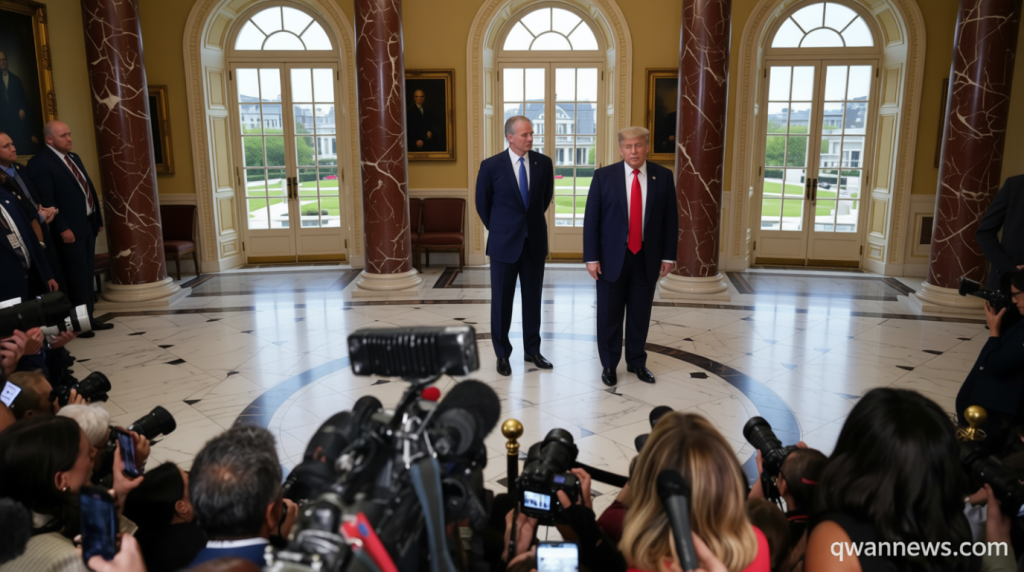
Trump’s Stunt on the Housing Bill Sparks Debate
Qwenews.com – President Donald Trump’s recent decision to delay the signing of a housing affordability bill has reignited discussions about his strategic moves in legislative affairs. The bill, which had already secured bipartisan support in both the House and Senate, was poised to address rising costs and improve access to affordable housing. However, Trump’s last-minute maneuver to tie its approval to the “SAVE America Act” has sparked concern among lawmakers and analysts. This move, dubbed a “stunt” by critics, appears to prioritize political theater over substantive policy outcomes, especially as the country faces mounting economic pressures.
Strategic Leverage and Congressional Backing
Trump’s cancellation of the housing bill signing came just as the White House was preparing to celebrate its passage. Republican officials had expressed confidence in the measure, with White House press secretary Karoline Leavitt previously calling it a “signature commitment” for his administration. The bill aimed to streamline the homebuilding process and provide relief to families struggling with mortgage rates and rent hikes. Yet, by linking its approval to the SAVE Act, Trump risks sidelining a key piece of legislation that had already gained traction among lawmakers.
“one of the most significant pieces of housing affordability legislation in American history”
The statement by Karoline Leavitt underscored the bill’s potential to reshape the housing market. However, Trump’s decision to hold it hostage for another cause has raised questions about its actual impact. The SAVE America Act, while focused on voter fraud prevention, lacks the immediate economic relevance that the housing bill offers. Critics argue that this shift could weaken the bill’s chances of becoming law, especially in a politically charged environment.
Public Backlash and Economic Concerns
Trump’s abrupt reversal has drawn sharp criticism from both opponents and allies. Many lawmakers, including some Republicans, view the stunt as a calculated move to divert attention from his declining approval ratings on economic issues. Recent polls indicate that Trump’s disapproval rating on the economy has reached 66%, with similar concerns about inflation. These figures highlight a growing frustration among voters, particularly in key battleground states where housing costs are a top priority.
Public opinion has also shifted significantly in the past year. A CBS survey conducted in March found that 66% of Americans supported stricter voter ID laws, but the SAVE America Act’s broader appeal remains unclear. Trump’s focus on this measure instead of the housing bill may alienate voters who are more concerned with immediate economic relief. Analysts suggest that this strategy could backfire, as it appears to prioritize political symbolism over tangible solutions.
Impact on Midterm Elections and Policy Momentum
With less than five months until the November midterm elections, Trump’s decision could have far-reaching implications. The housing bill’s cancellation may reduce its visibility, potentially allowing the SAVE America Act to dominate the political narrative. However, this move risks undermining the GOP’s credibility on economic issues. By delaying action on a widely supported measure, Trump may inadvertently reinforce perceptions that his party is out of touch with the American public’s needs.
Moreover, the housing bill’s provisions, which included measures to boost home construction and reduce barriers for first-time buyers, had already been endorsed by key stakeholders. Delaying its implementation could lead to further delays in addressing the housing crisis, which has affected millions of households. Trump’s stunt, while demonstrating his characteristic unpredictability, may also expose a lack of long-term economic planning, especially in an environment where voters are increasingly wary of partisan tactics.
Historical Precedents and Political Theater
Trump’s approach to legislation has often been described as theatrical, with a tendency to use surprise moves to capture media attention. This pattern is evident in his handling of the housing bill, which had already been finalized and ready for signing. By suddenly canceling the event, he not only disrupted the timeline but also sent a message that the bill’s success is conditional on other political goals. Such tactics, while effective in some contexts, may now be seen as a gamble with high stakes.
Supporters of the SAVE America Act argue that it addresses critical issues like voter fraud, which could influence the outcome of the upcoming elections. However, the act’s connection to the housing bill has drawn scrutiny. Experts suggest that the maneuver could weaken the bill’s chances of passing, as it introduces a new layer of complexity. With limited time before the elections, this delay might be more damaging than helpful, especially for a president whose economic policies are already under fire.
As the political landscape continues to evolve, Trump’s stunt on the housing bill serves as a reminder of the challenges faced by leaders navigating a divided Congress. While the move highlights his ability to reshape legislative agendas, it also underscores the risk of prioritizing short-term gains over long-term solutions. The upcoming weeks will be crucial in determining whether this strategy pays off or further erodes public confidence in his administration’s ability to address economic challenges effectively.