
Thwarted UFC Fight Attack Strengthens DOJ’s Case for White House Ballroom
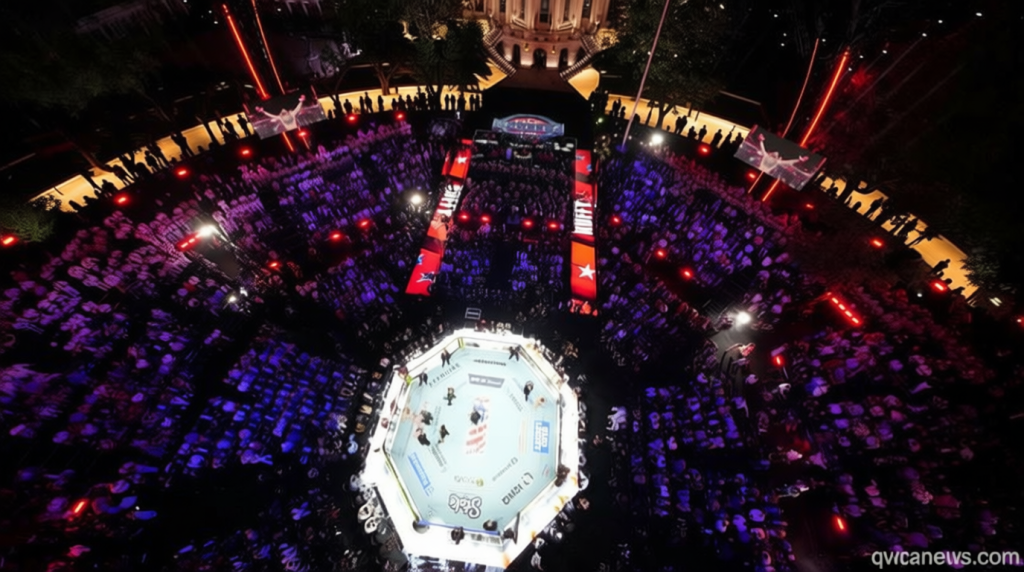
Qwenews.com – Following a thwarted attack on a UFC event held on the South Lawn of the White House last weekend, the Department of Justice has bolstered its argument for constructing a permanent ballroom on the premises. This incident, which occurred just days after the DOJ first proposed the project, has become a central point in its legal case. The legal team, led by the Trump administration, asserts that the new facility is a critical step in enhancing security for presidential activities. The attack, which targeted the event and left security personnel scrambling to respond, has been used to highlight the need for a more robust infrastructure to protect the executive branch from evolving threats.
DOJ’s Security Justification
According to the DOJ, the White House ballroom would serve as a multifunctional space that combines event hosting with advanced security features. The structure, designed to be both imposing and functional, is said to offer a layered defense against potential attacks. “The proposed ballroom will not only provide a secure venue for presidential functions but also act as a deterrent to adversaries seeking to compromise the White House,” stated a memo from DOJ officials. This argument comes as federal courts have been scrutinizing the project’s legality, with some questioning whether the administration has overstepped its authority in approving such a significant change to the presidential residence.
“The security threats have escalated to a point where permanent infrastructure is no longer optional,” the DOJ wrote in a May 24 filing, emphasizing the “imperative” of the ballroom as a proactive measure. The document references the recent attack as a pivotal moment, suggesting that the White House’s current layout is insufficient for modern challenges. The DOJ claims that the ballroom’s construction will create a “safe haven” for the president and key officials, ensuring that threats like the one that unfolded last weekend are mitigated before they escalate.
Legal Challenges and Judicial Doubts
The case has drawn attention from the DC Circuit Court of Appeals, where a three-judge panel is set to evaluate the DOJ’s rationale. While the administration argues that the ballroom is a necessary security upgrade, opponents contend that the project’s scale justifies deeper congressional oversight. During oral arguments, two of the judges expressed skepticism, pointing out that the president’s unilateral approval of the demolition of the East Wing for the new structure raises questions about the legal process. “If the White House can justify this project with security concerns, then we must assess whether those concerns are compelling enough to override existing legislative frameworks,” one judge remarked, signaling a potential hurdle for the DOJ’s case.
Historical Context of Security Incidents
The recent attack on the UFC event is not the first time the White House has faced security threats. In April, a gunman attempted to breach the grounds during the White House Correspondents’ Dinner, prompting a rapid response from Secret Service agents. Last month, a suspect was shot near the complex, underscoring the frequency of such incidents. The DOJ has leveraged these events to argue that temporary venues, such as the South Lawn, are inherently vulnerable. “The president’s ability to host events in these spaces has been tested repeatedly, and the need for a permanent solution is clear,” the memo states. However, critics note that the White House already has multiple facilities for official functions, including the Rose Garden and the West Wing, which could accommodate large gatherings without the need for a new ballroom.
Political Implications and Public Reaction
The debate over the ballroom has intensified as it reflects broader political tensions. Opponents argue that the administration’s timing is suspicious, with the decision to accelerate construction coinciding with a recent security incident. “This isn’t just about safety—it’s about shifting the narrative to justify a long-planned project,” said Democratic Rep. Alexandria Ocasio-Cortez in a recent interview. She criticized the DOJ for using the attack as a retroactive justification, suggesting the project was already in motion before the incident. Meanwhile, supporters of the ballroom highlight its potential to streamline presidential events and reduce the risk of future breaches. The facility’s design, which includes reinforced walls and integrated surveillance systems, is expected to offer a level of protection not currently available in temporary setups.
Broader Debate on Executive Authority
The White House ballroom project has sparked a wider discussion about executive power and the limits of presidential discretion. The National Trust for Historic Preservation has joined the legal challenge, asserting that the administration’s actions violate congressional oversight requirements. “The Constitution grants the president authority, but major structural changes to the White House should require approval from the legislative branch,” the trust argued in a statement. This sentiment resonates with lawmakers who worry about the concentration of power and the potential for the DOJ to act as a tool for executive agenda. The case may also influence future debates over infrastructure projects, as it sets a precedent for using security threats to justify large-scale developments.
Conclusion: A Landmark Decision
As the court prepares to render its decision, the case remains a focal point for both legal and political discourse. The DOJ’s reliance on the thwarted UFC attack to justify the ballroom highlights the administration’s strategic use of recent events to strengthen its argument. However, the challenge lies in proving that the security benefits outweigh the potential for executive overreach. With the project’s approval hinging on the judges’ interpretation of the law, the outcome could have far-reaching implications. Whether the ballroom is seen as a necessary defense or a symbol of expanding presidential control, its construction will be remembered as a pivotal moment in the ongoing debate over national security and democratic accountability.