
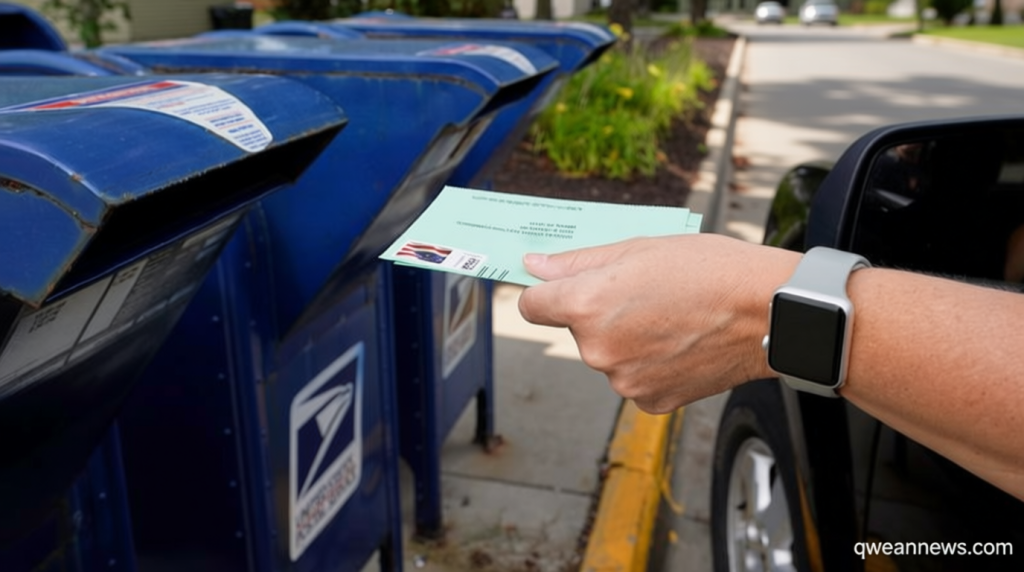
Judge Halts Trump Executive Order on Mail Voting
Qwenews.com – In a significant development, a federal judge has issued a ruling that partially halts President Donald Trump’s executive order targeting mail voting in 23 Democratic-led states and the District of Columbia. The decision, made by US District Judge Indira Talwani—a former Obama appointee—marks another hurdle in the administration’s effort to centralize election oversight under federal authority. The order, signed in March 2026, aimed to impose stricter rules on mail voting programs, including requirements for the US Postal Service to adopt new delivery standards and for the Department of Homeland Security to compile voter lists. However, the court found these measures to be overreaching, citing constitutional concerns.
Constitutional Challenges and Rulings
Talwani emphasized in her opinion that the president’s authority to dictate election procedures is limited, stating,
“The Constitution does not grant the President any specific powers over elections.”
This argument forms the crux of the ruling, which stops the implementation of key provisions in Trump’s March 2026 order. The measures included mandatory voter list submissions 30 days before elections and the introduction of individualized tracking barcodes on ballot envelopes. These changes were intended to enhance postal service oversight and detect discrepancies in voter eligibility. However, the court deemed them unconstitutional, highlighting the tension between federal intervention and state autonomy in election management.
The ruling comes as a critical moment for the 2026 midterm elections, which are already a focal point for debates over voting rights and election integrity. Critics, including legal experts and election officials, argue that the order’s provisions would allow federal agencies to scrutinize state-run voting systems without clear constitutional backing. This could set a precedent for future federal encroachment on state electoral processes, particularly in states that have historically opposed centralized oversight. The decision also prevents the administration from initiating legal actions against election officials in the affected states, further limiting its ability to enforce the directive.
Impact on Mail Voting Implementation
While the ruling blocks enforcement in states that challenged the directive, it does not entirely invalidate the executive order. The USPS remains under the requirement to implement new delivery standards, but only in jurisdictions that have not contested the order. This creates a patchwork application of the rules, with some states adhering to federal mandates and others resisting them. The Trump administration’s legal strategy now faces a setback, as it must navigate the complexities of state compliance and potential litigation in regions where the order is still in effect.
Separately, the Trump administration has been using federal immigration data to identify non-citizens, a practice that raised concerns about voter roll purges. In a related case in Washington, DC, a federal judge recently barred the use of this system to remove eligible voters from rolls. Although the March 2026 order did not explicitly link the Department of Homeland Security’s role in compiling citizenship lists to the USPS’s responsibilities, recent court filings suggest the administration is exploring data-sharing between the two agencies to identify possible instances of fraud or ballot misuse. This broader strategy underscores the administration’s intent to tighten election oversight through multiple avenues.
The ruling has sparked mixed reactions among political figures and stakeholders. Supporters of the order argue that it is necessary to prevent voter fraud and ensure election accuracy, while opponents view it as an overreach that undermines state authority and disenfranchises voters. The decision also raises questions about the balance of power between federal and state governments in the electoral process. As the 2026 elections approach, the legal battle over mail voting continues to shape the landscape of election administration across the United States.