
Punjabi Country Music Finds Common Ground Across North America
Qwenews.com – A new sound is taking shape in Canada’s Punjabi music community, joining Punjabi folk influences, hip-hop production and the familiar textures of contemporary country. Producer Amrit Singh, who performs as Assassyn, and Canadian Punjabi singer Jaggseer have begun calling it Punjabi country: music built around migration, farm life, trucks, long roads and the working routines shared across Punjab, Canada and the United States.
The genre’s emergence reflects an unexpected connection Singh noticed while working in customer support in Quebec. His job at a Canadian trail-camera company put him in regular contact with hunters, ranchers and farmers throughout rural North America. Images sent by callers in places such as Texas and Tennessee often showed vivid fields that reminded him of the agricultural landscape where he grew up in Punjab, India.
During pauses in technical-support conversations, callers would sometimes ask Singh about his own interests. Away from work, he had spent years producing within Canada’s active Punjabi music scene, where traditional sounds frequently meet trap rhythms and hip-hop melodies. Singh began telling customers he hoped to establish himself as a musician, then asked what they listened to. Country music came up repeatedly.
Exploring the artists his callers mentioned gave Singh a stronger sense of where his own songwriting could go. At 31, he saw a natural fit between country’s storytelling traditions and the experiences he wanted to put into songs.
“I got the sense that my story, what I want to say, the characters I wanted to create in different stories, resonated well with country music,” Singh said. “It felt like my lifestyle was always country.”
Country music is historically associated with the Appalachian region, while Punjab’s fertile plains sit far from that musical geography. Yet Singh sees the daily life beneath those different settings as closely related. Farming, machinery, land and labor all provide emotional and visual reference points that travel easily between the two cultures.
“We’ve also been singing on tractors and in the fields,” he said. “The work of the farmer is the same in Punjab as it is in America as it is in Canada.”
A Breakup Song With a Continental Map
Singh’s first country-focused release was simply called “Country Song,” a title chosen so he would remember its place in his creative development. He wrote it around a woman who leaves him for Tennessee, even though he had never visited the state. Its name had stayed with him after one of his conversations with a customer there.
For the recording, Singh worked with Montreal singer-songwriter Bobby John. John introduced him to basic country-guitar rhythms and chord movement, while also handling the English-language passages. Singh sang the Punjabi parts.
Released last September, “Country Song” combines electric guitar with a hip-hop-driven beat, placing it close to modern country-pop ballads. The central line, “Oh chad ke yaara nu chali oh Tennessee,” means, “She left me and went to Tennessee.”
The track moves beyond a conventional separation story by adopting the point of view of a Punjabi truck driver who knows the United States through its highways and freight routes. Its locations come from the places where Singh’s callers lived: Dallas is where the narrator proposed, Seattle’s changing weather becomes a metaphor for his former partner, and the Statue of Liberty represents the emotional hardening he has endured.
By the conclusion, the woman may be in Tennessee, but the narrator has loaded up and is traveling toward Kentucky. The possibility of meeting again remains unresolved. That open-ended journey gives the song another meaning as well: it is a portrait of a Punjabi immigrant’s relationship with the American landscape, built through work, distance and imagination.
“North America” Brings the Fusion Into Focus
Singh described “Country Song” as an experiment. He felt the sound fully came together with “North America,” a follow-up that uses banjo phrases and fiddle breaks alongside Punjabi vocals and modern production.
Jaggseer sings the hook, “Sikka chal da gabru da puray North America,” a phrase that roughly means, “Punjabi guys run North America.” The song celebrates Punjabi visibility and ambition across the continent, while grounding that confidence in dusty roads, Chevrolet trucks, difficult beginnings and hard work.
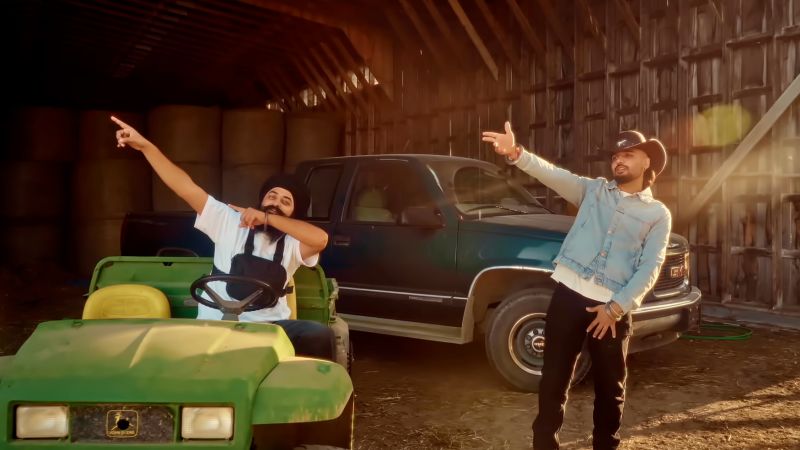
Its video was filmed at a friend’s Canadian farm. Jaggseer wears denim and a cowboy hat, while Singh appears in a black chest pack. They sit on hay bales, spend time with horses and drive tractors, presenting rural imagery with an upbeat, playful energy rather than treating it as borrowed costume.
The song also makes space for a more serious note. One lyric acknowledges Punjabi migrants who did not succeed in crossing the border, placing the celebratory mood beside the risks and barriers that have shaped many migration stories.
Both artists have found an audience online, with their videos drawing six-figure views across YouTube and Instagram. Their work shows how country’s themes can be adapted without abandoning Punjabi language or identity. Instead of treating the two traditions as opposites, Punjabi country turns their overlaps into the center of the music: agricultural roots, mobility, family histories, pride in labor and the search for belonging in a vast new landscape.
Related Reading
Frequently Asked Questions
What is The border busting birth of Punjabi?
The border busting birth of Punjabi is the main topic of this guide. The article explains the context, practical details, and next steps readers should understand.
Why does The border busting birth of Punjabi matter?
The border busting birth of Punjabi matters because readers are looking for a useful answer, not just a short summary. Good content should match search intent and help them decide what to do next.