
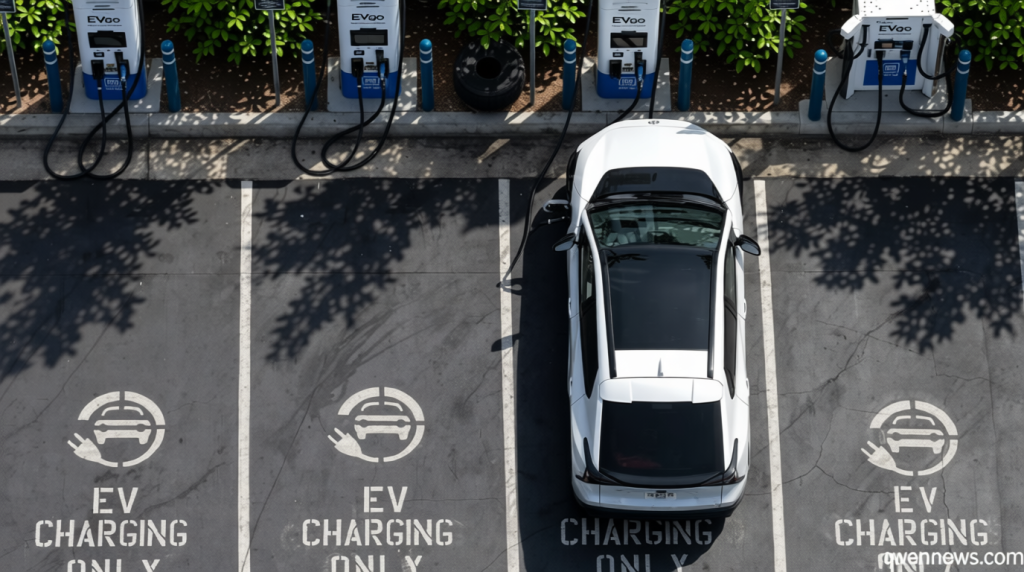
US EV Sales Dip, But Long-Term Outlook Remains Positive
Qwenews.com – US EV sales are down, yet the industry remains resilient as automakers continue to invest in electrification. A recent 20% decline in U.S. electric vehicle (EV) sales during the second quarter compared to the previous year has raised concerns, but experts argue this is a temporary setback rather than a sign of surrender. While factors like rising fuel costs and the expiration of certain tax incentives have dampened demand, automakers are adapting their strategies to align with evolving market conditions. Cox Automotive reports that the dip in sales is partly attributed to inflated figures from last year’s surge, which created a misleading benchmark for the current quarter.
Global EV Trends Outpace U.S. Slump
Despite the decline in U.S. EV sales, the global market continues to show robust growth. The International Energy Agency (IEA) estimates that pure battery electric vehicle (BEV) sales reached 14 million units last year, marking a significant increase from 11 million in 2024. This surge is driven by China, which now leads the world in EV production, with companies like BYD surpassing Tesla in market share. Over 55% of China’s auto sales last year were electric vehicles, highlighting the country’s dominance in the sector. Meanwhile, European, African, and South American markets have also seen strong adoption due to aggressive incentives and competitive pricing, creating a global momentum that U.S. automakers are still trying to catch up with.
“While US EV sales are down, the long-term trajectory of electrification is intact,” noted Stephanie Valdez Streaty, director of industry insights at Cox Automotive. “Automakers are recalibrating, not retreating, to meet the real needs of consumers.”
Strategic Shifts and Market Realignment
Legacy automakers are adjusting their approaches amid the current dip in US EV sales. Many have scaled back U.S. production targets or delayed new model launches, citing financial constraints and shifting consumer priorities. However, industry analysts emphasize that this is a strategic recalibration rather than a permanent exit from the EV market. The previous surge in sales was partly fueled by temporary incentives and regulatory pressures, which have since eased. Now, automakers are aligning their offerings with market demand, focusing on affordability, reliability, and charging infrastructure to retain customers.
Eric Straka, a Michigan physician, recently purchased a Chevrolet Equinox for $32,000. Although he faced delays due to a local rebate that expired quickly, he remained committed to the EV transition. “It’s smooth and quiet, and by far the best pickup acceleration I’ve ever had in a car,” he said. This anecdote reflects a broader trend: even as incentives fade, consumer interest in EVs persists. Many buyers are prioritizing long-term benefits like lower operating costs and environmental impact over short-term subsidies, signaling a maturing market.
Competition and Cost Challenges
Chinese EVs are playing a pivotal role in shaping the market, offering competitive pricing that outperforms U.S. and European models. Over 200 Chinese EVs are available for under $25,000, with some models priced as low as $10,000. In contrast, the average price for new U.S. EVs remains around $56,377, making them less accessible to budget-conscious buyers. While the Commerce Department recently imposed restrictions on Chinese car imports, these measures may not be sustainable in the long run. As global competition intensifies, automakers are expected to innovate further to counteract the price advantage of foreign EVs.
The decline in US EV sales is part of a broader shift in consumer behavior and market dynamics. With demand for EVs stabilizing, automakers are focusing on improving affordability and performance. For example, some U.S. brands are introducing more budget-friendly models or partnerships with battery suppliers to reduce costs. Additionally, the rise of used EV sales—reaching record levels in recent months—indicates sustained interest in the technology. This trend suggests that the market is adapting, and the decline in US EV sales may be temporary as consumers continue to evaluate long-term benefits.
Future Outlook and Industry Resilience
Analysts predict that the U.S. EV market will rebound as the industry matures and consumer preferences evolve. While the second quarter saw a dip in US EV sales, the first quarter’s 15% increase shows a gradual recovery. The combination of growing environmental awareness, falling battery costs, and expanding charging networks is expected to drive demand forward. Moreover, the transition to EVs is no longer a niche trend but a mainstream shift, with automakers across the globe investing heavily in research and development to secure their positions in this evolving landscape.
Although the current slowdown in US EV sales is notable, it underscores the importance of aligning production with actual consumer demand rather than relying on short-term incentives. As the market continues to grow, the U.S. will likely see a resurgence in EV adoption, particularly as newer models become more affordable and reliable. The resilience of automakers and the persistence of consumer interest indicate that the U.S. EV industry is not only surviving but also preparing for a more sustainable and competitive future. The key will be how well companies adapt to these changing conditions and continue to innovate in the face of challenges.