
Tear Your Eyes Away: Trump’s Federal Courthouse Shows the Real Face of His Architectural Vision
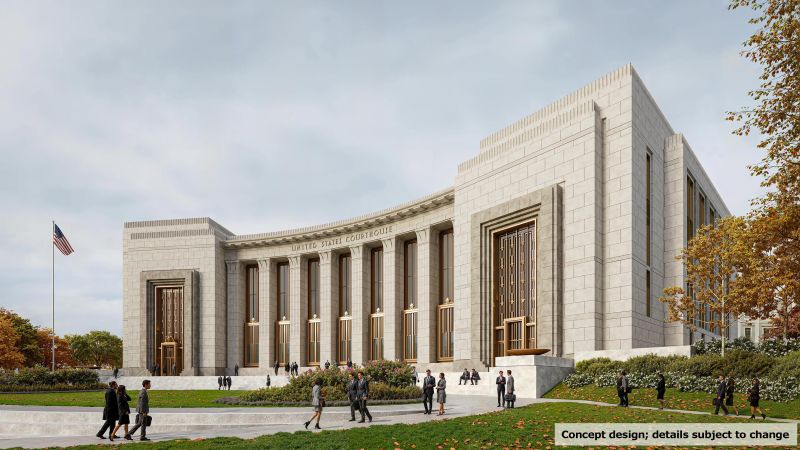
Qwenews.com – When the spotlight turns from Trump’s lavish White House ballroom and the proposed triumphal arch, a more revealing testament to his design philosophy emerges in Chattanooga, Tennessee. This new federal courthouse, set to open in 2030, is a striking example of “Tear your eyes away” from modern minimalism, embracing a bold Art Deco interpretation of a Greek temple. The project, guided by Trump’s executive directive, “Making Federal Architecture Beautiful Again,” aims to revive a sense of grandeur and tradition in public spaces, offering a tangible reflection of his political and aesthetic priorities.
Architects and critics have noted that the courthouse’s design, crafted by the contemporary firm HOK, blends classical symmetry with contemporary efficiency. Its imposing silhouette—two massive, mausoleum-like volumes flanking a row of square columns—evokes a sense of permanence and authority. While some praise the structure as a “showpiece” of Trump’s vision, others argue it signals a shift toward more decorative, historically inspired architecture. The National Civic Art Society (NCAS), which helped draft the directive, has called the project a milestone in reviving traditional styles for federal buildings, a move they believe resonates with public taste.
A Bold Reimagining of Federal Design
The courthouse’s design draws heavily from the Joel W. Solomon Federal Building, which it replaces. Yet, it introduces a muscular, more assertive form, with restrained ornamentation that balances historical references with modern functionality. This juxtaposition of classical elements—such as the Greek temple facade—with contemporary materials and engineering has sparked both admiration and debate. For some, the structure embodies a return to timeless elegance; for others, it raises questions about whether architecture should mirror political ideology or serve as a neutral backdrop for governance.
“Classicism is still alive, can be done well, and can be both traditional and original,” said NCAS president Justin Shubow, a strong advocate for classical styles. He pointed to the courthouse as proof that public architecture can align with cultural values while maintaining innovation. However, the project’s critics, including Kevin D. Murphy, a Vanderbilt University art history professor, argue that its aesthetic echoes the 1930s classicism associated with fascist regimes. “This design isn’t transparent,” Murphy remarked. “It’s very formidable and very solid—almost as if it’s trying to project strength and dominance, even in a judicial setting.”
Despite the controversies, the courthouse has become a symbol of Trump’s broader influence on American architecture. Its design underscores a desire to project power and historical continuity, aligning with his rhetoric about restoring American greatness. Supporters see it as a unifying statement, while detractors worry it might prioritize political symbolism over functional design. The debate is emblematic of a larger conversation about how public spaces should reflect the values of the time—and who gets to define them.
Tradition Meets Modernity in Chattanooga
The courthouse’s design also highlights a growing trend in federal construction, where classical elements are increasingly integrated into modern projects. This approach, while not new, has gained momentum under Trump’s directive, which emphasizes a “renewed commitment to traditional aesthetics.” The structure’s use of Art Deco motifs, such as geometric patterns and streamlined forms, suggests a deliberate effort to merge historical references with contemporary sensibilities. Critics argue that this blend could lead to a nostalgic, even retrograde, style, but proponents believe it creates a more welcoming and dignified environment for the public.
Christopher Hawthorne, a former Los Angeles Times architecture critic and Punch List contributor, offers a measured view. He calls the courthouse “handsome” and “competent,” acknowledging its visual appeal but questioning its deeper message. “Architecture has a responsibility to say something fundamental about contemporary society,” Hawthorne stated. “Does this design communicate anything beyond the current occupant of the White House?” The answer, he suggests, lies in how the building is perceived by those who use it daily and how it fits into the national architectural narrative.
Public sentiment may also play a role in shaping the courthouse’s legacy. A 2020 Harris Poll revealed that 70% of Americans prefer traditional designs for public buildings, regardless of political affiliation. This finding supports the argument that the courthouse appeals to a broad audience, blending familiarity with innovation. However, as architects and historians continue to dissect its meaning, the building’s role in reflecting Trump’s vision—and its impact on future design trends—remains a topic of discussion. Whether it’s seen as a bold statement or a nostalgic echo, the Chattanooga courthouse stands as a unique example of how “Tear your eyes away” from modern simplicity can shape the nation’s built environment.