
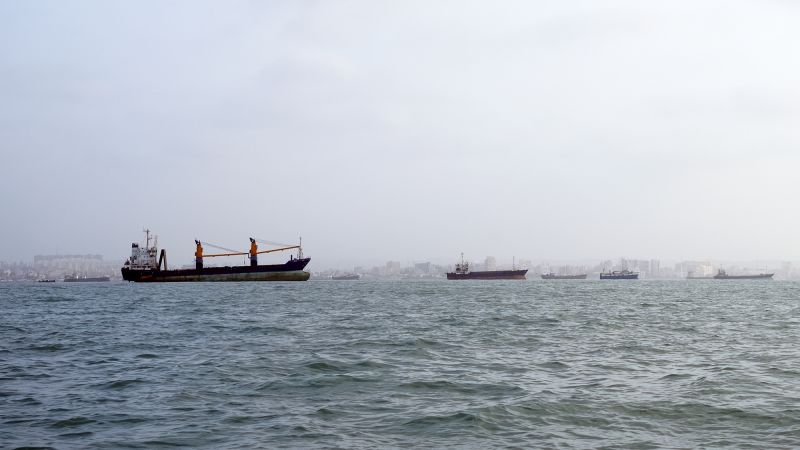
Qwenews.com – Energy Secretary Chris Wright said Tuesday that oil exports from the Middle East rose above pre-war levels on Sunday and have been right around normal for a week — a questionable claim that does not appear to be backed up by observable shipping traffic. Wright said in a post on X that the oil flows were restored to normal levels after the US military coordinated a plan with allied Gulf nations to get crude through the Strait of Hormuz and Middle Eastern countries bypassed the waterway via pipelines or other export facilities. The US military observes vessel traffic through the Strait of Hormuz and reports it to the Department of Energy on a daily basis.
“In theory, the US government with all its technology and all the military assets they have in the region should have the best number on the flow through the strait,” said Dan Pickering, founder and chief investment officer at Pickering Energy Partners. “But this is hard to verify.” Just 84 total vessels transited the Strait of Hormuz last week — including only nine on Sunday, according to Kpler, an oil market data service that uses satellite imagery and shipping transponders to provide up-to-date crude flow information. That’s down from more than 100 transits a day before the war and not nearly enough to carry the 9 million barrels per day through the strait that Wright claims has been traveling through the waterway.
Oil is getting out of the strait – but the number is closer to 4 million barrels per day, according to JPMorgan. “It is not possible to reconcile the disparity between what we see and what he is quoting,” said Matt Smith, director of commodity research at Kpler. Many ships turn off their transponders to move covertly through the Strait of Hormuz.
But Kpler uses a mix of satelite imagery and transponder data to account for shadow traffic. The Department of Energy said its data is superior to private tracking services. “In coordination with the US military, the US Department of Energy maintains the best available data related to oil and oil products leaving the Arabian gulf,” a DOE spokesperson said.
Wright’s claim that 5 to 7 million barrels per day are bypassing the Strait of Hormuz via pipelines appears to be accurate. Saudi Arabia’s East-West pipeline alone has rerouted upward of 5 million barrels of oil per day to the Red Sea. Despite threats of a blockade of the Red Sea’s Bab-al-Mandeb strait from Iran’s Houthi allies, ship traffic has been flowing at a close-to-normal clip through that waterway in recent weeks.
Wright has claimed that 15 million barrels per day left the Arabian Gulf region over the past week and that 20 million barrels of oil left on Sunday, which would be higher than the pre-war average. Middle Eastern countries have maxed out their pipeline capacity to reroute as much oil as possible around the Strait of Hormuz. So it’s hard to reconcile Wright’s bold claims with the physical limitations of the region’s infrastructure and the observable ship traffic through the Gulf’s waterways.
On Monday, a total of 6 vessels transited the strait: 4 inbound and 2 outbound, noted Andy Lipow, president of Lipow Oil Associates. None of those ships were crude oil tankers. “The administration is really trying to jawbone oil prices to the downside, as they have been doing for months,” Pickering said.
Wright’s claims follow numerous attempts from the Trump administration to spin the oil market in a positive light. President Donald Trump has routinely claimed that the United States controls the Strait of Hormuz, a claim belied by the notion that military escorts are needed to shuttle commercial vessels in and out of the Persian Gulf and Iran has attacked 64 vessels transiting the strait, resulting in 17 seafarer fatalities and 35 injuries. “We are nowhere near normal, but they have had six months of success selling this market narrative,” said Helima Croft, head of global commodity strategy at RBC Capital Markets.
Although the market has adapted and prices have remained relatively low considering the historic supply shock during the war, that’s in large part because demand for oil collapsed and China drew down its massive oil stockpiles. Traffic through the strait has ebbed and flowed. One day, weekend or week where traffic returns to normal is unsustainable if it takes a coordinated military effort to achieve.
Ships need to keep coming back into the strait to pick up oil and ship it out, and they have been reluctant to navigate the waterways while they’re under threat of attack. And a non-trivial amount of oil coming out of the Middle East is either on shadow tankers that are turning off their transponders or on vessels that are sailing under false flags to mask the fact that they are carrying sanctioned Iranian oil, according to Windward Intelligence, a shipping data service. Of the 84 vessels that passed through the Strait of Hormuz last week, 17 were shadow fleet crossings and 10 were carrying sanctioned cargo.
It’s not clear whether Wright was counting those in his calculations.
Related Reading
Frequently Asked Questions
What is The Trump administration claims oil is flowing?
The Trump administration claims oil is flowing is the main topic of this guide. The article explains the context, practical details, and next steps readers should understand.
Why does The Trump administration claims oil is flowing matter?
The Trump administration claims oil is flowing matters because readers are looking for a useful answer, not just a short summary. Good content should match search intent and help them decide what to do next.