
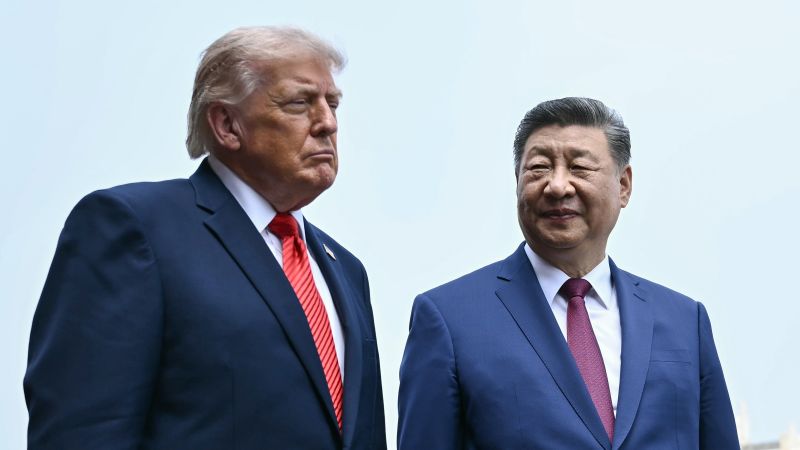
As US and China throw Up New Sanctions: Is Trump-Xi Meeting in Jeopardy?
Qwenews.com – As US and China throw up tit-for-tat sanctions, diplomatic tensions are reaching new heights just weeks before a crucial summit. Chinese President Xi Jinping’s planned visit to Washington next month faces mounting pressure as both nations escalate their reciprocal trade measures. The world’s two largest economies have reignited a cycle of retaliatory actions, with Beijing introducing fresh restrictions targeting American commercial interests while Washington responds with its own punitive steps.
Washington’s Multi-Faceted Sanctions Package
The United States has deployed several restrictions simultaneously, creating a complex web of trade barriers. American authorities banned the import of newly manufactured humanoid robots, predominantly sourced from Chinese production facilities. Washington also levied penalties against Chinese shipping firms accused of ferrying Iranian petroleum products. More than forty Chinese enterprises were added to an entity list citing human rights violations, while two major Chinese civilian universities received placement on a Pentagon blacklist. American officials additionally signaled plans to penalize Chinese artificial intelligence companies.
Beijing’s Measured Counterresponse
China’s Commerce Ministry announced it had “no choice but to take necessary countermeasures” when unveiling its Wednesday response package. The Chinese government sanctioned seven American corporations while tightening restrictions on drone and related technology exports to the United States. An investigation was launched regarding specific office equipment utilizing foreign software platforms. Separately, a fast-track certification process for American factories producing goods like electrical appliances for the Chinese market was suspended.
China values the hard-won stability of China-US economic and trade relations and hopes the United States will work with China in the same direction.
The ministry clarified that these actions specifically targeted recent American entity listings of Chinese companies, alongside robotics restrictions and prior technology-related bans introduced by the US Federal Communications Commission.
Historical Context and Summit Uncertainty
This renewed confrontation recalls the intense trade conflict between the two nations during the previous year. The situation raises concerns that continued escalation might force Beijing to postpone Xi’s forthcoming journey. Nevertheless, China’s current response—characterized by its own spokesperson as “restrained”—indicates that Chinese leadership remains committed to maintaining progress toward the September summit.
The upcoming meeting holds particular significance as an opportunity for Xi and Trump to address what has become their most intense competitive arena: artificial intelligence technology.
China has incentives to preserve diplomatic space and avoid an uncontrolled action–reaction cycle before the (expected) summit.
According to Sun Chenghao, a senior fellow at Tsinghua University’s Center for International Security and Strategy in Beijing, this diplomatic preservation is crucial. However, he cautioned that “restraint should therefore not be mistaken for acceptance.”
The AI Battleground Takes Center Stage
Future developments will likely hinge on American actions concerning Chinese-developed AI systems, a particularly sensitive topic for Beijing. Over eighteen months, China transformed from a distant follower to a serious competitor, developing multiple AI models that challenge Silicon Valley’s leading companies while attracting significant global user adoption.
Trump administration officials alongside major AI corporations have accused Chinese enterprises of “distilling” advanced American models, prompting Washington to threaten sanctions based on intellectual property theft allegations. Beijing has rejected these claims and urged the United States to “abandon its hegemonic mindset.”
If the US is going to ban Chinese models on the grounds of national security, it will not affect just American companies (using the tech). You’re basically talking about the US trying to ban Chinese AI models for business practice in the whole world, and you’re talking about a trillion-dollar market … China is not going to take this lightly.
Such potential sanctions could represent an active attempt to undermine the worldwide expansion of a major Chinese industry sector. For Beijing, this scenario recalls the bitter experience of the first Trump administration’s comprehensive campaign against Chinese technology leader Huawei.
Economic Leverage and Strategic Positioning
Beijing possesses various economic instruments for applying pressure while maintaining diplomatic channels. Chinese authorities control critical supply chains for rare earth minerals essential to American technology manufacturing. Additionally, China remains the largest trading partner for numerous American agricultural and industrial sectors. This economic interdependence provides both nations with tools to escalate or de-escalate tensions without causing catastrophic damage to their respective economies.
As US and China throw up increasingly complex sanctions packages, the outcome of Xi’s upcoming visit will depend on whether both sides can find common ground on AI regulation, trade practices, and mutual security concerns. The coming weeks will reveal whether diplomatic engagement can overcome the growing tide of economic nationalism.
Frequently Asked Questions
When is President Xi’s visit to Washington scheduled?
President Xi Jinping’s state visit to Washington is planned for September 2026, though the exact dates may shift depending on the evolution of trade tensions.
What are the main areas of US-China trade conflict?
The primary areas include artificial intelligence technology, robotics, shipping and maritime trade, human rights-related entity listings, and technology export controls.
How might AI sanctions affect global markets?
US sanctions on Chinese AI models could impact a trillion-dollar global market, potentially restricting American companies’ access to Chinese AI technology while limiting Chinese firms’ international expansion.
What economic tools does China have to respond to US sanctions?
China can leverage its control over rare earth mineral supplies, agricultural exports, and manufacturing supply chains, while also targeting American companies through entity listings and export restrictions.