
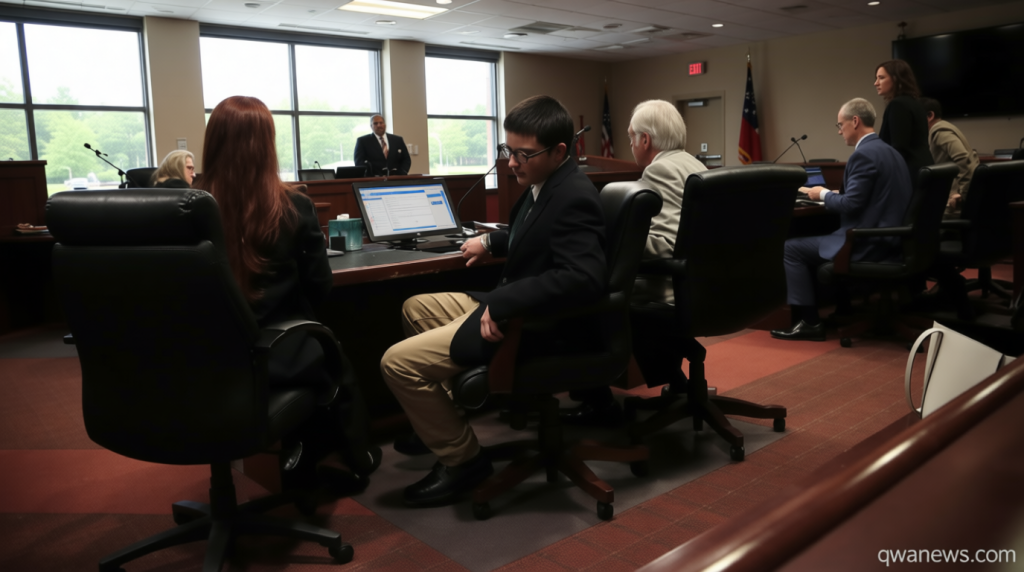
Confronting the Shooter: Apalachee High Victims Speak to Colt Gray
Qwenews.com – More than a hundred individuals navigated through rain-soaked parking spaces to reach the Barrow County Judicial Courthouse, where emotional weight hung heavy in both the air and the building itself. These attendees gathered to witness Colt Gray accepting accountability for the lives extinguished and forever altered by his actions during the 2024 tragedy at Georgia’s Apalachee High School. Family members and survivors arrived with determination, ensuring their voices joined the teenager’s guilty plea in bringing closure to Winder’s community.
The violent event claimed four lives—two adults and two students—while wounding seven additional people through bullets fired from an AR-style weapon that Gray’s father had purchased for him. Among those lost were fourteen-year-olds Christian Angulo and Mason Schermerhorn. Their relatives attended wearing shirts displaying the boys’ cheerful photographs, determined that September 4, 2024 would never be forgotten. Breanna Schermerhorn, Mason’s mother, wore a garment bearing the hashtag “#lovelikemason” across its back.
A Quiet Courtroom, Heavy Hearts
Thunder echoed through the dimly lit upper-level courtroom as Gray entered, his appearance noticeably transformed from his mug shot days. Where once stood long, bleached hair, now rested shorter, darker locks accompanied by a delicate mustache—one of the few traces of his former self. Chains from his leg restraints clinked with each step as he took his place before the court.
With a vacant expression, the teenager leaned toward the microphone repeatedly, responding “Yes, your honor” as he accepted responsibility for fifty-five charges, among them four murder counts. Twelve sheriff’s deputies positioned themselves along the walls while a bailiff in a dark blazer observed from the front. On hard wooden benches that resembled church pews, one hundred fifteen people sat in silence, searching for any sign of remorse in Gray’s demeanor or voice.
That day brought none. As Gray acknowledged his crimes without emotion, the corridor outside revealed how innocence had been stolen alongside lives. A queue of teenage girls—several who had been shot and all of whom witnessed the violence—prepared to share their experiences and request that Gray never experience freedom again.
Victims Find Their Voice
By Tuesday, these young women would witness the power of their words. Judge Nicholas Primm delivered a life sentence without parole to Gray, merely two days before his father, Colin Gray, faces his own sentencing for murder and manslaughter charges.
During the first day of the three-day proceedings, the teenagers stood mere feet from their classmate, addressing him directly for the very first time. Supported by family members, court advocates, law enforcement officers, and the Mystic Saints—a leather-clad motorcycle organization established in the days following the shooting—each teen was called forward individually to reveal emotions accumulated over nearly two years.
Taylor Jones entered the courtroom walking independently, a personal triumph in itself. The ninth-grader had been in Gray’s algebra class when bullets shattered her femur. Medical professionals initially warned she might never walk again. Through numerous surgeries and months of rehabilitation, Taylor defied expectations, yet the psychological wounds remained. Inside the courtroom, her floor-length pink dress and denim vest concealed physical scars, while her skirt’s considerable length nearly caused her to stumble. Her left foot nervously pressed into the carpeted floor as she spoke.
“After the shooting, I struggled with so much anxiety, and I felt like my life was completely over. I couldn’t do anything a normal 14-year-old should be able to do.”
Taylor looked toward the assistant district attorney who guided the victims’ testimonies, receiving gentle encouragement. She wanted her experience to resonate with the shooter.
“I hope my story makes Colt realize the horrible things that he has done and all the pain and suffering he has caused.”
Natalie Griffith’s testimony burst forth with rapid, nervous energy, prompting the judge to request she slow down—a moment that drew chuckles from the crowd and eased the day’s mounting tension. Leaning against the lectern, she took a breath before continuing.
“I never thought something like that would happen here. Those things happen in places where the sun doesn’t shine as bright,” Natalie explained, noting that like Taylor and others, she had been shot during the attack. Her school had been meant to serve as her sanctuary, a place of safety and normalcy.