
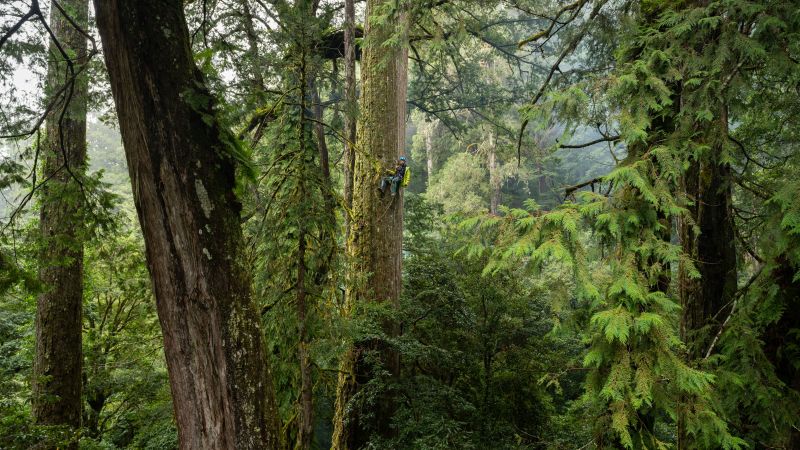
East Asia’s Tallest Tree Is the ‘Heaven Sword,’ an Environmental Guardian
Qwenews.com – East Asia s tallest tree, a towering Taiwania cryptomerioides known as the “Heaven Sword of the Da’an River,” has been identified by researchers after a dedicated effort spanning several years. Located in a remote, mist-shrouded valley near Taiwan’s longest river, this ancient specimen not only captivates with its extraordinary height but also symbolizes the resilience of natural ecosystems in the region. The discovery, celebrated as a milestone in botanical research, highlights the importance of preserving such rare and majestic flora, which play a crucial role in maintaining ecological balance.
The Quest for a Natural Giant
For over a decade, scientists have meticulously tracked the towering trees of Taiwan, a biodiversity hotspot with over 950 million trees in its forests. The identification of the Heaven Sword required a combination of cutting-edge technology and traditional fieldwork, including lidar scanning and collaboration with Indigenous communities. This approach was vital in overcoming the challenges posed by Taiwan’s rugged terrain and dense canopy, which often obscure remote-sensing data. The final confirmation of its height—84.1 meters (276 feet)—was achieved through manual measurements, a process that took months of careful planning and execution.
The tree’s age, estimated at approximately 1,000 years, adds to its significance as a living testament to the region’s natural history. While the world’s tallest tree, Hyperion, a coast redwood in California, measures 116 meters, the Heaven Sword stands as the tallest in East Asia, offering a unique perspective on the biodiversity of the region. Its discovery has sparked renewed interest in the study of ancient trees, particularly those in Taiwan’s remote mountainous regions, where they have thrived for centuries despite historical threats.
Industrial logging between 1912 and 1991 had previously disrupted many of Taiwan’s ecosystems, but the island’s steep topography has helped preserve some of its oldest trees in protected areas. The Heaven Sword’s survival is a reminder of the delicate interplay between human activity and natural preservation. Researchers note that its height and age are not just impressive in themselves but also indicative of the favorable environmental conditions that allow such species to flourish. These include Taiwan’s steady climate, abundant rainfall, and minimal human interference in certain regions.
Cultural Reverence and Ecological Impact
For the Rukai Indigenous community, the Heaven Sword holds profound cultural significance. They refer to it as “the tree that hits the moon,” a phrase that reflects its mythical status and the deep connection between the people and the land. This reverence underscores the importance of integrating local knowledge with scientific methods when studying such ecosystems. The tree’s role as an environmental guardian extends beyond its physical presence; it serves as a keystone species that supports a complex web of life, from microorganisms to larger fauna, in its surrounding forest.
Dr. Rebecca Chia-Chun Hsu, lead author of the study, emphasized the importance of combining advanced technology with human insight. “The common characteristics are probably that we are all tree lovers and like adventures,” she noted. This collaboration has not only led to the accurate identification of the Heaven Sword but also improved the overall understanding of Taiwan’s forest giants. The use of citizen scientists in 2020 revealed that algorithms had misclassified nearly 93% of trees, prompting a more nuanced approach to data collection and analysis.
The Heaven Sword’s discovery has implications for conservation efforts in East Asia. As the tallest tree in the region, it exemplifies the potential for natural habitats to sustain extraordinary life forms. Researchers hope that its recognition will inspire greater protection of such areas, ensuring that future generations can appreciate their ecological and cultural value. The tree’s survival also offers insights into the long-term effects of climate stability on plant growth, a critical consideration in the face of global environmental changes.
The journey to confirm the Heaven Sword’s status as East Asia s tallest tree was not without challenges. Initial studies focused on documenting “The Three Sisters,” three other giant Taiwania firs in the Cilan conservation area. However, the team’s work expanded after learning about the limitations of lidar technology. By combining digital data with on-the-ground verification, they were able to overcome previous inaccuracies and achieve a more precise classification of the region’s flora. This breakthrough underscores the importance of interdisciplinary collaboration in ecological research.
As the Heaven Sword continues to stand as a symbol of East Asia’s natural heritage, its story serves as a powerful reminder of the need to protect and study such ecosystems. The tree’s height and age are not just numbers but a testament to the enduring strength of nature when left undisturbed. With its discovery, scientists and conservationists have gained valuable knowledge that can inform future efforts to preserve the region’s biodiversity. The Heaven Sword’s legacy is one of awe, resilience, and the unyielding bond between the environment and those who cherish it.