
A Miracle: Teen Murdered Nearly 26 Years Ago Identified Through Genetic Genealogy
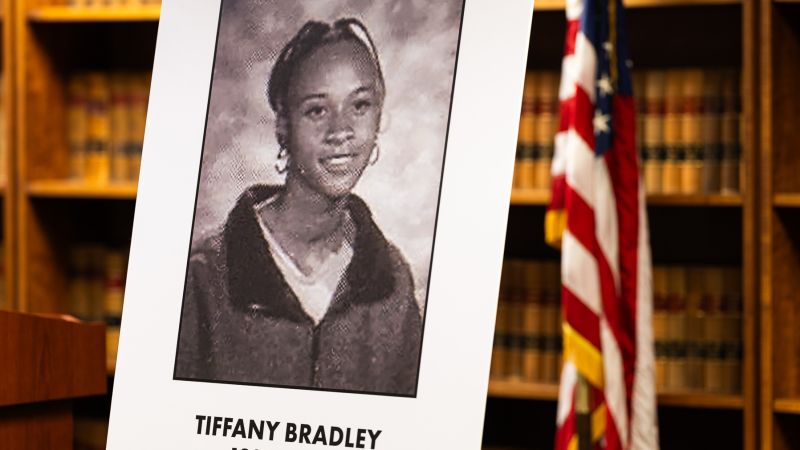
Qwenews.com – After nearly 26 years, “Chelsea Jane Doe” was finally identified by her name this summer: Tiffany Bradley. The breakthrough closed a decades-long search, bringing a long-awaited resolution to a mystery that had languished unsolved. The case was cracked using investigative genetic genealogy, a combination of DNA analysis and paper trail research that has been used over the past decade to reverse engineer a person’s identity. For Bradley’s family, this outcome truly represents a miracle.
From Jane Doe to Tiffany Bradley
While the technique has typically been used to search for suspects, the same method is providing a voice to the hundreds of unnamed Jane and John Does nationwide like Bradley. “The fact that we are here today is a miracle,” Bradley’s niece Shakirah Wiggins said. “It is totally amazing that after 26 years, people care enough to give her a name and return her to her family.” Bradley, 16, was a joyful child with a radiant smile, her family said.
She vanished in November 2000, the FBI said. Meanwhile, for decades in Chelsea, Massachusetts, roughly 300 miles away, investigators had only grim fragments of a case — the mutilated remains of a teenage girl discovered in a parking lot, just across the river from Boston, and a killer who admitted to strangling and dismembering her. The culprit was behind bars, but the victim’s identity remained out of reach, according to Chelsea police.
The first clue in the case came decades later. Three years ago, a private forensic science company called Othram built a DNA profile for the murdered girl, but because of the condition her body parts were discovered in, the DNA was in “horrible condition,” David Mittelman, Othram founder and CEO, said. In a missing persons case, the first step is to identify viable DNA.
Without that vital information, the case can’t be worked. Investigators combed through the DNA and paper trail genealogy research to fill gaps in Bradley’s family tree, from newspaper and social media records to genetic analysis. The FBI used the profile to put together a family tree.
They matched Bradley with her brother, confirming the identity of the athletic, girly girl and giving her back her real name. The mystery of “Chelsea Jane Doe” couldn’t have been solved until recently, thanks to advancements in technology and the growing number of people who are uploading DNA into public databases. For centuries, genealogists have used paper records to build family trees.
A couple decades ago, genealogists began using DNA analysis to knock down “genealogical brick walls,” where paper trails stop, said CeCe Moore, co-founder of DNA Justice, a nonprofit organization that allows anyone to upload their genetic profile to their DNA database, serving as resource for law enforcement genetic genealogists. The identification of the Golden State Killer in 2018 was the first time a major public case had been solved through genetic genealogy, according to Moore. “That really changed everything,” Moore said.
A prosecutor reveals new details about the capture of one of America’s most notorious serial killers The FBI subsequently created an investigative genetic genealogy team after realizing they could solve more cases with those techniques, Moore said. This led to Bradley’s identification, along with dozens of others. The remains of a 10-week pregnant young woman were identified last month as 15-year-old Cheryl Lynn Edwards, who went missing about 50 years earlier, according to nonprofit DNA Doe Project.
In 1975, her body was found in the Mississippi River near Clinton County, Iowa. She had been killed by a gunshot wound to the head, an autopsy found. Naming her “Jane Clinton Doe,” the Iowa Department of Public Safety took the case to the DNA Doe Project, a group of volunteer genetic genealogists.
A team of 16 genealogists put their heads together to work the case over a weekend. Within hours, they identified a couple from Louisiana as the girl’s grandparents, the nonprofit said. They focused their research on the grandparents’ children, soon discovering their eldest son had a daughter who “vanished from the records in the 1970s,” Trish Bird, a volunteer genetic genealogist who worked on the case, told the DNA Doe Project.
Iowa DPS made contact with a relative of Edwards and confirmed she had gone missing, according to the nonprofit. As part of the last step to cracking the cold case, direct DNA testing confirmed Edwards’ identity. In both Jane Doe cases, investigators relied on public DNA databases to reveal the true identities of the teenagers.
When searching DNA samples, the FBI traditionally uses its Combined DNA Index System, or CODIS, which compares a DNA sample against all known offenders. In missing persons cases though, investigators can often hit a dead end. “Unless you have a suspect in mind, or you got a guess as to who the person is, or you get a lucky match in the database, these cases are unsolvable,” Othram founder Mittelman said.
“So look at what we’ve accomplished,” Moore added. “This is a miracle for families who have waited decades for answers.”
For Bradley’s family, this miracle means closure after more than two decades of uncertainty. The power of genetic genealogy continues to grow, offering hope to countless families still searching for their missing loved ones.