
How to Costume an Uber-Rich Family: A ‘Dress Up Party’ in ‘Rosebush Pruning’
The Family’s Fashion Obsession
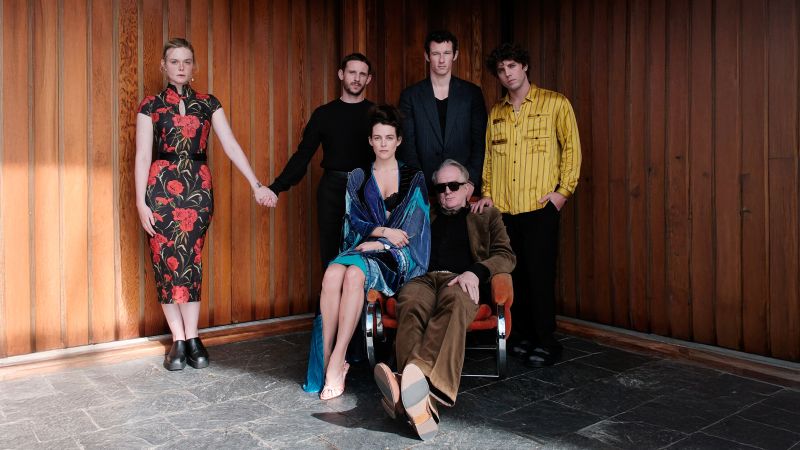
Qwenews.com – Karim Aïnouz’s latest film, *Rosebush Pruning*, explores the complexities of an American family defined by blood ties, emotional entanglements, and an unrelenting fixation on high-end fashion. The narrative is driven by the arrival of an outsider—Elle Fanning’s Martha, the girlfriend of eldest son Jack (Jamie Bell)—whose presence disrupts the family’s carefully curated image. Martha’s initial outfit, a black-and-red floral dress, is swiftly dismissed by her sister Anna (Riley Keough) as “high street garb,” sparking a debate that highlights the family’s exaggerated standards. Costume designer Bina Daigeler, who sourced the piece from a Barcelona vintage store, explains how the dress becomes a symbol of Martha’s struggle to fit into a world that values excess and appearance over authenticity.
A Visual Narrative of Dysfunction
“It’s obviously not Zara,” Daigeler said during a video call. “You can’t see who made it, which made it easier for Anna to say, ‘oh, it’s probably a Zara dress.’”
The film’s visual style amplifies the family’s dysfunction, with their clothing serving as a mirror to their inner conflicts. After Anna criticizes Martha’s outfit, their widowed father (Tracy Letts), who is blind since his wife’s death, asks Martha to describe every detail of her look—dress, handbag, hair, bosom. This moment underscores the family’s performative nature, as Anna’s harsh critique reveals her deep-seated envy of Jack, whose affections are lavishly given. The costumes, meticulously crafted, become a language of power and insecurity, shaping the characters’ interactions and emotional stakes.
Living in a modernist home in Catalonia’s countryside, the four siblings—Anna, Jack, Ed (Callum Turner), and Robert (Lukas Gage)—are adults yet remain bound by their family’s legacy of wealth and style. Their lavish lifestyle allows them to indulge in fashion as a form of self-expression, a theme that permeates every scene. The film opens with Ed engaging in a spirited debate about Ann Demeulemeester with a Greek friend, later correcting him for confusing Bottega Veneta loafers with Sebago. These details, woven into the dialogue, emphasize the family’s obsession with sartorial perfection and their inability to escape its influence.
Loosely inspired by Marco Bellocchio’s 1965 film *Fists in the Pocket*, *Rosebush Pruning* is Aïnouz’s second English-language project, co-written with Efthimis Filippou. The film blends the surreal atmosphere of Yorgos Lanthimos’s *Dogtooth* with the satirical edge of Emerald Fennell’s *Saltburn*, creating a narrative that is as visually striking as it is emotionally charged. The family’s chaotic relationships and twisted desires are heightened by their extreme focus on appearance, which becomes a metaphor for their inability to confront deeper truths about themselves and their bonds.
Daigeler’s approach to costume design is described as a “dress up party,” a concept that aligns with the family’s fashion-centric culture. She drew inspiration from Spanish painter Joaquín Sorolla, whose vibrant brushstrokes and emotional depth reflect the film’s aesthetic. “We were in Barcelona, near the sea, in the mountains with the family—all these emotions are somehow reflected in Sorolla’s paintings,” she shared. This philosophy is evident in the costumes, which blend elegance with a sense of impermanence, mirroring the family’s unstable dynamics. The use of color, texture, and silhouette becomes a narrative device, reinforcing the characters’ personalities and the film’s central themes.
Each sibling’s style reflects their unique relationship with the family’s wealth and their own inner conflicts. Robert, the youngest, is drawn to Versace’s silk shirts and knits, an infatuation that borders on obsession. His dream of Donatella and ownership of a gun similar to the one that killed Gianni suggest a deeper connection to fashion as both a muse and a symbol of loss. Ed, meanwhile, gravitates toward textured fabrics and muted tones, while Jack’s understated choices—plain tees and shirts—contrast with his rare sartorial highlight: a pistachio green suit worn during a house viewing. These visual cues not only define the characters but also underscore the film’s exploration of identity and familial hierarchy.
The film’s biggest twist—a revelation that the mother (Pamela Anderson) is alive and living with her girlfriend Emma (Elena Anaya)—provides Daigeler with a new opportunity to express the family’s evolving relationships through costume. The looser silhouettes for Anderson and the symbolic matching boilersuits for the couple highlight their newfound freedom and the complexity of their bond. This development, combined with the film’s visual style, creates a narrative that is as much about transformation as it is about the lingering effects of dysfunction. By blending fashion with emotional depth, *Rosebush Pruning* challenges viewers to reconsider how appearance shapes perception and relationships within a family defined by excess and secrecy.