
Avant-garde Gardens, Singular Debuts and Vampire Brides: A Dispatch from Paris Haute Couture Week
Qwenews.com – Paris has always been a city where art and fashion intersect seamlessly. This week, as I attended the high-profile haute couture presentations, I found myself drawn not only to the collections but also to the creative expressions embedded in the city’s cultural fabric. From gallery spaces to avant-garde installations, the luxury world is increasingly using art as a bridge to connect with its audience in an economy marked by uncertainty.
The Fusion of Craft and Concept
At Chanel, the brand’s latest collection by Matthieu Blazy seemed to blur the lines between storytelling and sartorial innovation. While the show’s visual narrative revolved around fairy tales, the presence of artist Joël Blanc in the front row added a dynamic layer. His live painting captured the essence of the presentation, turning the runway into a living canvas. The design featured sweeping vines evoking “Jack and the Beanstalk,” alongside whimsical details like magic beans and golden eggs, creating a fairy-tale atmosphere through precise tailoring.
“Couture isn’t only about the dress. It’s about the mindset.”
Pierpaolo Piccioli, creative director at Balenciaga, offered a different perspective. Though his collection lacked overt art references, it was undeniably artful. His work, rooted in emotional resonance, aims to evoke feelings akin to those stirred by a memorable song or a striking piece of visual art. “It’s about the mindset,” he remarked backstage, underscoring the deeper philosophy behind the designs.
Artistic Inspirations in the Collections
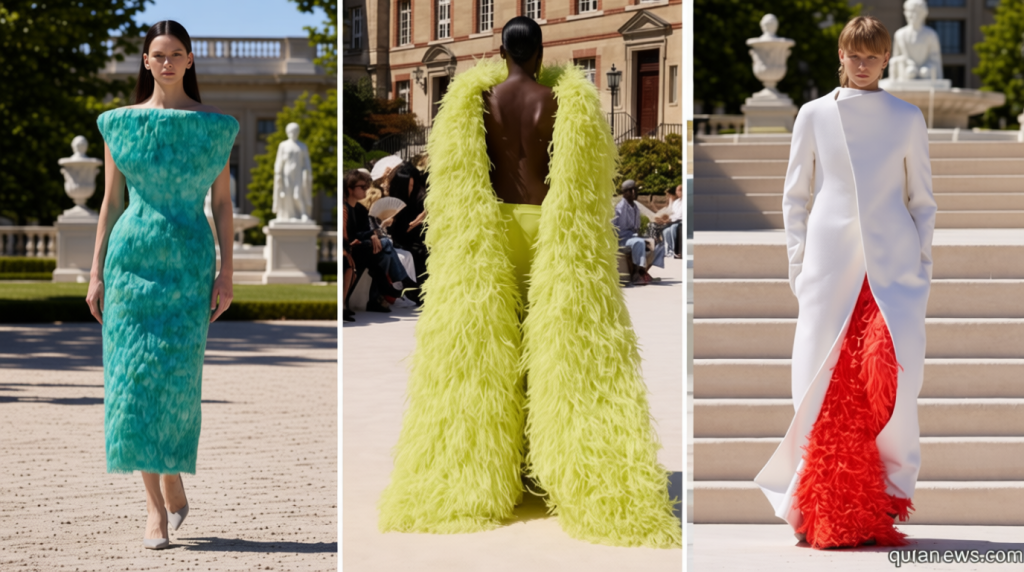
Jonathan Anderson’s second haute couture collection, staged at the Musée Rodin, brought a modern twist to the gallery’s historic setting. Drawing from the work of sculptor Lynda Benglis, Anderson’s designs reflected the chaotic beauty of her mixed-media pieces. The American artist’s use of latex and glitter, once controversial, found new life in the collection’s textures and colors. These elements echoed the stark contrasts between Santa Fe’s arid landscapes and Ahmedabad’s vibrant cultural tapestry, creating a dialogue between distant worlds.
Anderson, a lifelong advocate for art, continues a tradition at Dior. The house’s history is steeped in artistic influence, from Christian Dior’s early gallery ownership to the current generation of designers inspired by contemporary movements. The Musée Rodin setting was no accident — it amplified the collection’s theme of transformation, with garments that shifted from the solemn to the surreal.
A Pilgrimage to the Past
Between the shows, I visited the Azzedine Alaïa Foundation, a sanctuary for fashion purists. The space houses an extensive archive of the late designer’s work, alongside books and art that shaped his vision. His studio, preserved behind a glass enclosure, remains untouched since his passing. Carla Sozzani, a guiding force in the fashion world, played a pivotal role in maintaining this legacy.
“Integrity,” Sozzani said simply, “is something hard-fought in the business of fashion.”
Meanwhile, Michael Stewart’s debut at Paris Couture Week sparked a quiet ripple. The Irish brand Standing Ground, known for its innovative approach to eveningwear, showcased a collection that defied convention. Stewart’s designs, crafted with a distinct voice, emphasized technique and individuality over trend-driven uniformity. His work reminded us that fashion can transcend commerce when it is rooted in a clear artistic vision.
From the grandeur of the Grand Palais to the intimate spaces of Rodin’s garden, this week’s haute couture events revealed a deeper truth: luxury is not just about aesthetics, but about creating moments that linger long after the final curtain falls.