
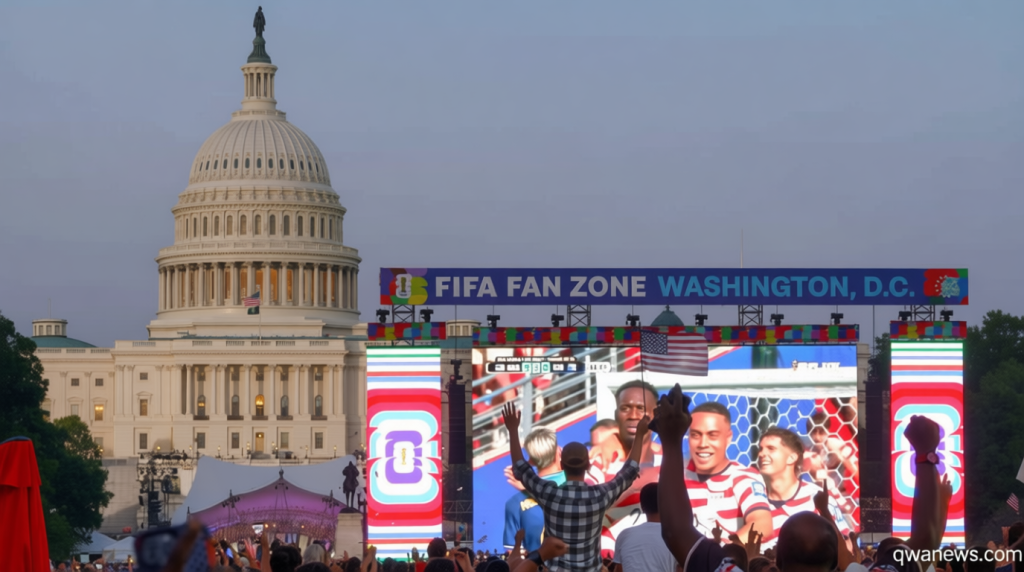
America Held a Big Birthday Party — and a Soccer Extravaganza Broke Out
A Unifying Force Amid Division
Qwenews.com – As the world celebrates football, the United States is discovering a reflection of its own identity on its 250th anniversary. The World Cup has become a rare moment of collective joy, offering respite from the nation’s ideological fractures and the lingering effects of economic downturns caused by the pandemic. This international event, featuring a mix of European and South American stars alongside emerging teams from Africa and Asia, has highlighted America’s diverse cultural fabric and its ongoing experiment with immigration.
Diversity on the Field and Beyond
The tournament’s energy has spilled into communities, with fans from multiple nationalities gathering in cities that have seen a decline in vibrancy due to shifting economic trends and remote work. These scenes, where people of Mexican, Brazilian, Colombian, and European descent celebrate their heritage, underscore the idea of a shared American identity. Yet, this unity feels especially significant in a time when immigrants face scrutiny and uncertainty from political rhetoric.
“We can see, well, actually this other person from this other part of the world, he’s not so bad or she’s not so bad as described, right?”
Team USA’s success, managed by an Argentinian coach, symbolizes the country’s blend of tradition and transformation. Players like Antonee Robinson, raised in the north of England, speak with accents shaped by their upbringing. Malik Tillman, a son of an American serviceman and a German mother, grew up in Germany’s youth soccer system. Folarin Balogun, born in Brooklyn to Nigerian parents, owes his U.S. citizenship to the nation’s birthright policy—a principle recently reaffirmed by the Supreme Court the day before his goal in the tournament.
FIFA’s Vision and the Political Landscape
FIFA’s leader, Gianni Infantino, has faced criticism for aligning with authoritarian regimes and awarding Trump a peace prize. However, his comments in Los Angeles last year hinted at a broader hope: football’s ability to bridge divides. “You have a celebration — we organize a party,” he said, envisioning the 2026 World Cup as a catalyst for national pride. Despite political tensions, the event has proven to be a rare common ground where partisan factions can coexist.
While sports like ice hockey have sometimes fallen prey to cultural debates—such as when Olympic gold was overshadowed by politics—soccer’s global appeal offers a different path. The US team’s blend of homegrown talent and international recruits, including players from Europe and South America, reflects a soccer culture that thrives on inclusivity. As fans in red, white, and blue fill streets and bars, the summer of 2026 has become a testament to the country’s resilience and adaptability.