
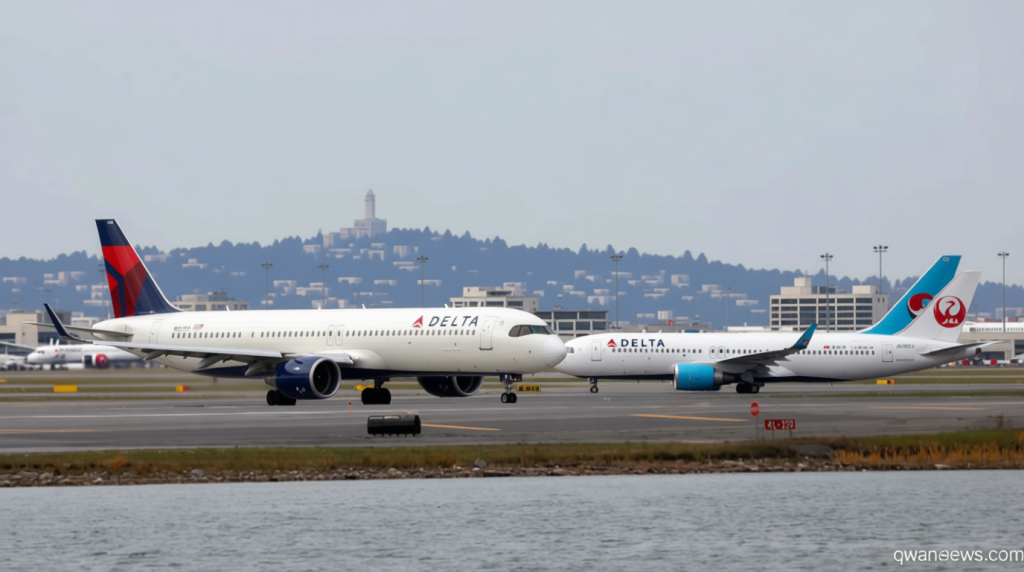
FAA investigates close call between two aircraft at Boston Logan International Airport
Qwenews.com – The Federal Aviation Administration (FAA) is conducting a thorough investigation into a near-miss incident between two commercial aircraft at Boston Logan International Airport. The event, which occurred on Saturday, involved Delta Air Lines Flight 2351 and American Airlines Flight 3161 as they navigated intersecting runways. According to Flightradar24 data, the two planes came dangerously close to colliding during a routine operation, prompting Delta’s pilots to execute a rapid climb to avoid the situation. The Airbus A319 landed safely, and passengers disembarked without any reported issues, as confirmed by a Delta spokesperson.
Initial reports suggest that the incident unfolded during a period of high traffic at Logan Airport, a critical hub in the northeastern U.S. Flight tracking records show that American Airlines Flight 3161 was in the process of accelerating for takeoff when Delta Flight 2351, which had been landing, veered off its approach path. The FAA is analyzing the sequence of events to determine whether procedural lapses, communication errors, or equipment malfunctions contributed to the close call. The agency’s spokesperson emphasized that the incident is under review to ensure all safety protocols are upheld.
Details of the Near-Miss Incident
The FAA has released preliminary details of the incident, highlighting the complexity of managing intersecting runways at Boston Logan. Runway 16L and 16R, which cross at a 150-degree angle, are particularly challenging for air traffic controllers due to the proximity of the two paths. According to ATC.com audio recordings, the air traffic controller confirmed the departure clearance for American Airlines Flight 3161 just moments before Delta Flight 2351 initiated its climb. The Delta pilot described the situation as “unexpected but managed effectively,” adding that the crew’s quick response averted a potential disaster.
The incident has raised questions about the coordination between air traffic control and pilots during high-stress scenarios. Experts warn that even minor misjudgments at intersections can lead to severe consequences. FAA officials have stated that the investigation will include a review of radar data, pilot communications, and the airport’s operational procedures. “This type of close call is a wake-up call for all stakeholders involved in aviation safety,” said one FAA investigator, underscoring the need for continuous vigilance.
FAA investigates close call between aircraft: Broader Implications
While Boston Logan’s incident is isolated, it adds to a growing list of close calls and safety concerns in U.S. aviation. In recent months, the FAA has been scrutinized for its handling of runway incursions and air traffic control errors. This incident has reignited debates about the adequacy of current safety measures, particularly in airports with complex runway configurations. The FAA’s focus on these issues aligns with its broader mandate to monitor and improve aviation safety across the nation.
Logan Airport, one of the busiest in the country, has faced criticism in the past for runway management challenges. The FAA’s investigation into this specific near-miss will likely examine whether additional training or technological upgrades are needed to prevent similar incidents. The agency has also been working on modernizing its systems to incorporate real-time data analytics and predictive modeling. These efforts aim to reduce human error and enhance situational awareness for both pilots and controllers, which is crucial in preventing aviation accidents.
Aviation experts stress that such incidents, while alarming, are common in high-volume airports. “Runway intersections are inherently high-risk areas, and even with advanced technology, human judgment remains essential,” noted Michael McCormick, a former FAA air traffic manager. He added that the FAA’s proactive approach in investigating these events is a positive step toward improving safety standards. The agency’s ability to quickly respond to incidents and implement corrective measures has been a key factor in maintaining public confidence in air travel.