
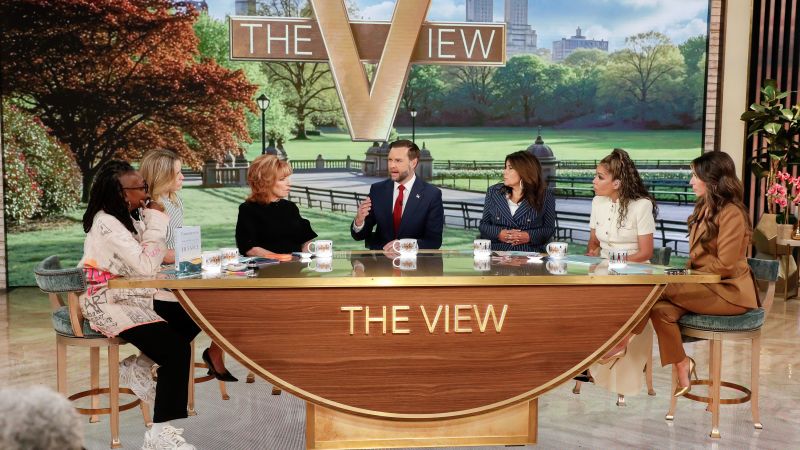
Trump’s ‘I Love the Inflation’ Remark Sparks Debate
Qwenews.com – During a recent press event, President Donald Trump’s cryptic comment, “I love the inflation,” became a flashpoint in political discussion, drawing sharp reactions from JD Vance and Whoopi Goldberg during their appearance on The View. The phrase, delivered in a fragmented speech style, led to immediate questions about its meaning and intent. While some interpreted it as a critique of rising prices, others saw it as a strategic pivot toward a broader economic narrative. The debate surrounding Trump’s words highlights the nuances of political communication and the power of language to shape perception.
Clarifying the Context of the Statement
Vance, who defended Trump’s remarks during the segment, argued that the president was emphasizing the potential for inflation to decrease following a military conflict. “What he said is that he loves the fact that the inflation is going to come down when this war is over,” Vance explained, trying to frame Trump’s statement as a forward-looking economic assessment. However, Whoopi Goldberg quickly challenged this interpretation, noting that the president had not explicitly linked the current inflation numbers to a post-war decline in the full transcript of his remarks.
“You know what I really love? I love the inflation. You know why?” Trump asked, before delving into an explanation. “Because as soon as this war is over – you know, I can say it now, something you didn’t know. Do you know we’ve been taking out millions of barrels of oil. Nobody knows it. You know who doesn’t know about it: Iran, until right now. We took out – that’s why oil is $85 a barrel.”
The president’s response, part of his signature “the weave” speaking style, showcased his tendency to shift topics rapidly. While the initial question focused on inflation, Trump seamlessly transitioned to discussing the impact of military actions on oil prices and economic conditions. This rhetorical strategy has often been used to obscure or redirect the focus of his statements, leaving room for varied interpretations.
Trump’s Economic Claims and the War Angle
During the interview, Trump elaborated on the economic backdrop, highlighting the stock market’s performance and 401(k) values as indicators of a strong economy. He framed his military strikes as essential to securing economic stability, claiming that the destruction of Iranian assets had directly influenced oil prices. This narrative was bolstered by references to Venezuela’s post-strike situation, which Trump used to underscore the global reach of U.S. military interventions.
Despite his assertions, the transcript of the full remarks did not include a direct connection between the current inflation figures and a future decline. Instead, Trump’s comments centered on the immediate effects of the conflict, suggesting that the war had already begun to shape economic outcomes. This raised questions about whether the phrase “I love the inflation” was a standalone endorsement or a misstatement within a larger argument.
The debate also revealed broader tensions between political figures and media outlets. Goldberg’s immediate pushback emphasized the importance of contextual accuracy, while Vance’s defense highlighted the interpretive flexibility of spoken language. Both perspectives underscore the challenge of distilling complex messages from spoken words, especially when they are delivered in a style that prioritizes brevity and punch over clarity.
As the discussion unfolded, the focus shifted to the potential consequences of Trump’s economic rhetoric. Critics argued that his praise for inflation could be seen as a downplay of its negative impacts on households, particularly in the context of rising living costs. Supporters, however, viewed the remark as a reflection of his belief in market-driven solutions and the idea that inflation might naturally ease once geopolitical tensions were resolved. This duality in interpretation continues to fuel the debate over Trump’s message and its implications for economic policy.