
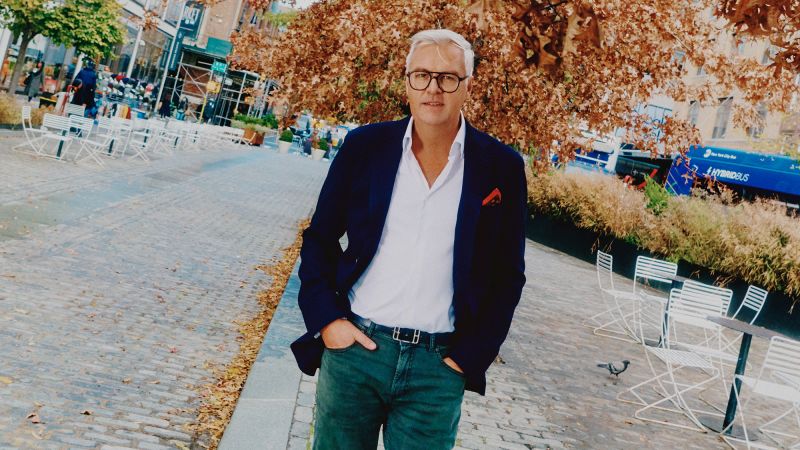
Frank Voelkl’s Nose Has Helped Define a Generation of Fragrance
Qwenews.com – Frank Voelkl may blend easily into the weekday rush in Manhattan: a sharply dressed German man moving through the city without attracting much notice. Yet the fragrances he has created have become difficult to miss. They may be sitting on a bathroom shelf, lingering on a scarf, or familiar from a former partner’s jacket. Over the past 20 years, anyone who has regularly worn perfume has a good chance of encountering his work.
Voelkl is behind several of the era’s most recognizable scents, including Le Labo’s Santal 33, Glossier’s You and Phlur’s Father Figure. His portfolio also includes fragrances connected with Ariana Grande and Jennifer Lopez, as well as projects for Dolce & Gabbana, Calvin Klein and other major brands. As a master perfumer at DSM-Firmenich, he occupies an unusually rare position: only the 16th person to receive that designation in the company’s more than 100-year history.
The title carries unusual weight in an industry where a small number of people shape what consumers will eventually encounter in stores. There are more registered astronauts than master perfumers. The role includes participation in councils that assess which fragrance materials should be developed and pursued, decisions that can influence scent trends years before a product reaches the public.
“I would say we’re the ultimate experts,” Voelkl says.
A recognizable modern signature
Voelkl’s fragrances often share a particular kind of clarity. They can feel freshly laundered without becoming antiseptic, woody without heaviness, and contemporary without the chill of a laboratory. His work has been especially influential in the rise of the “skin scent,” a category built around the intimate impression of clean skin made softer, warmer and more nostalgic.
Glossier’s You and Phlur’s Father Figure are closely associated with that effect. A bottle of You sells every 40 seconds, Glossier has said. Santal 33, meanwhile, transformed sandalwood into something creamy, mineral-like and airborne. At the height of its popularity, its trail was so distinctive that it seemed to drift through entire stretches of Manhattan.
Not every fragrance Voelkl creates reflects what he would choose to wear himself. His personal preferences lean toward smoky and leathery elements, though he tends to use them in minute, almost imperceptible amounts when composing for a broad audience. In larger doses, he believes those materials can suggest more unsettling ideas.
“Very, very small, subliminal” doses can work, he says. Beyond that, people may interpret them as “fire, danger, shadow.”
Creation is a collective process
Perfume is sometimes presented as the product of a singular artistic genius, but Voelkl describes a more collaborative reality. A finished scent is shaped through exchanges among managers, evaluators, marketing and sales teams, and the brand client. Each participant can help identify whether a fragrance is moving too far away from its intended audience.
“As a perfumer, we work with managers, evaluators, sales, marketing, the clients themselves. Our work is being edited. I see the evaluators as editors.”
Evaluators may flag a composition as overly green or too smoky for commercial release. Voelkl takes in those responses, but the final creative decision remains his. The challenge is to absorb informed criticism without losing sight of the fragrance’s purpose and direction.
“I listen to everybody and absorb the comments.”
He frequently returns to guidance a colleague offers trainees: “Don’t take the bus until you know where you’re going.” For Voelkl, that principle means establishing a clear destination while remaining willing to discover unfamiliar territory and work alongside collaborators. Intuition matters, but so does knowing when the moment has come to make the decisive call alone.
“In the end, you’re alone. You’re alone as a creator, and you have to make that call.”
Why favorite fragrances can change
The raw materials available to perfumers are constantly changing. New molecules and technologies enter the field, while established natural ingredients can become harder to find or vanish from regular use. This instability is one reason many longtime fragrances have recently appeared in reformulated or rereleased versions.
Those changes are rarely quick. A new material can require years of research, beginning with chemical exploration and continuing through a perfumer’s experiments with formula and performance. The process can involve millions of dollars before consumers notice anything different on a counter or in a bottle.
“You have to be five, ten years ahead — easily — in your thinking and in your strategy,” Voelkl says.
Part of his work as a senior and master perfumer is helping guide research into preserving particular olfactory effects when their original components become threatened. Natural ingredients are increasingly vulnerable to disruptions in cultivation and production, including severe weather.
Bay oil offers a stark example. Dominica once produced 70% of the world supply, but Tropical Storm Erika and Hurricane Maria devastated the island’s distillery network. Voelkl says the material was almost entirely lost from the palette after those events.
“Since then, we don’t have bay oil anymore,” Voelkl says.
It is the material he misses most, not simply because of its scarcity but because of its unusual character. For him, bay oil carried a metallic quality unlike any other ingredient he had available.
“It smells like metal,” he says.
That search for a lost sensory detail captures the unusual time scale of perfumery. The scents people recognize instantly may be the result of decisions made years earlier, of materials protected before they disappear, and of a creator balancing personal instinct with an entire workshop’s knowledge. Voelkl’s work demonstrates how a fragrance can feel effortless in daily life while containing an extraordinary amount of planning, revision and imagination.
Related Reading
Frequently Asked Questions
What is The man behind some of your?
The man behind some of your is the main topic of this guide. The article explains the context, practical details, and next steps readers should understand.
Why does The man behind some of your matter?
The man behind some of your matters because readers are looking for a useful answer, not just a short summary. Good content should match search intent and help them decide what to do next.