
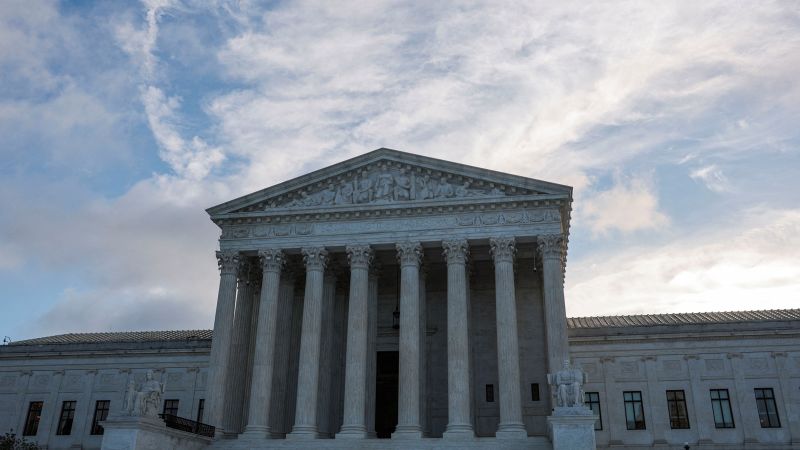
Supreme Court Lets New Hampshire Enforce Limits on Student IDs at the Polls
Qwenews.com – New Hampshire election officials may proceed with restrictions on the use of student identification cards by voters seeking ballots, after the Supreme Court stepped in shortly before the November election.
The unsigned order, issued Thursday, permits the state to enforce its reading of a voting law passed by the Legislature this spring. The dispute centered on whether a student ID can be considered alongside other evidence when a voter is attempting to establish identity at the polls.
The decision favors Republican Secretary of State David Scanlan and the Republican National Committee, which supported the state in the legal fight. The court did not disclose how individual justices voted, but cited the need for caution when courts alter election procedures close to an election.
A Dispute Over Identification Rules
Under the new New Hampshire law, a student ID alone is no longer sufficient to verify a voter’s identity for purposes of receiving a ballot. Lower federal courts had allowed the state to retain that central feature of the statute.
However, the law also contains what has been described as a safety valve. It gives voters an opportunity to demonstrate their identity through additional means when they do not have the required identification. The legal question was narrower: whether student identification could still be one piece of supporting evidence in that process.
State officials took the position that the legislation barred the use of student IDs even as part of a larger collection of materials offered to establish a voter’s identity. Coalition for Open Democracy, a voting-rights organization, challenged that interpretation in court.
On October 2, a federal district court blocked New Hampshire from enforcing that interpretation. The Supreme Court’s latest order temporarily clears the way for the state to apply the restriction as officials understand it while the broader litigation continues.
Election Timing Drives the Court’s Decision
The court relied on the principle commonly known as the Purcell doctrine, which advises federal courts to avoid making late changes that could disrupt election administration or confuse voters and poll workers. The doctrine takes its name from an earlier Supreme Court case involving election rules.
In practical terms, the justices concluded that the district court’s order came too near Election Day. New Hampshire voters will choose a successor to retiring Democratic Sen. Jeanne Shaheen in November, adding political significance to the state’s voting procedures during a closely watched election season.
The Supreme Court has addressed several notable election-related disputes ahead of next month’s midterms. In mid-September, the court rejected President Donald Trump’s proposal to change the system for sending mail ballots to voters nationwide.
Election cases that reach the court in the final weeks before voting often raise competing concerns. Courts must weigh the need to protect voting rights and ensure lawful procedures against the potential complications created when rules change after election officials have already prepared their operations.
Justice Jackson Questions the Rationale
Justice Ketanji Brown Jackson was the lone justice identified as dissenting. She questioned whether the Purcell doctrine properly applied to this particular dispute, emphasizing that the lower court had not rewritten New Hampshire’s law.
Instead, Jackson said, the lower court had addressed the state’s interpretation of the law. In her view, there is an important distinction between a court changing an election rule and a court preventing officials from enforcing an interpretation that may be inconsistent with the statute.
“This so-called ‘Purcell principle’ arose in a particular context, and this court has yet to fully define its limits,” Jackson wrote.
Her dissent echoed a broader criticism of the doctrine: that its boundaries remain unclear even though it is frequently invoked in election litigation. Jackson argued that proximity to an election should not automatically prevent a court from intervening when it believes voters need accurate information about the rules that govern participation.
“I respectfully dissent because – even, and perhaps especially, when an election is looming – I would not disturb a clearly justifiable federal-court order issued to ensure that the public receives accurate information about a state’s electoral processes,” Jackson wrote.
What the Ruling Means for Voters
The order does not resolve every legal issue surrounding New Hampshire’s identification law. It determines what rules may be used for the upcoming election while the challenge proceeds through the courts.
For voters, the immediate effect is that a student ID cannot be used by itself to establish identity, and state officials may also refuse to treat it as a supporting factor when someone attempts to verify identity through other available evidence. Voters who rely on student identification should be especially attentive to the state’s current requirements before going to the polls.
The issue may carry particular relevance for younger voters. A recent poll found that Democrats held a 31-percentage-point advantage among younger adults over Republicans. Although voter-identification rules apply regardless of political affiliation, debates over acceptable identification often focus on their possible effects on groups that may be more likely to possess certain forms of ID than others.
New Hampshire’s Senate race and other contests will now take place under the state’s preferred interpretation of the new law. The Supreme Court’s intervention leaves open the possibility of a more complete ruling later, after the immediate pressure of the election calendar has passed.
Related Reading
Frequently Asked Questions
What is Supreme Court says New Hampshire can limit?
Supreme Court says New Hampshire can limit is the main topic of this guide. The article explains the context, practical details, and next steps readers should understand.
Why does Supreme Court says New Hampshire can limit matter?
Supreme Court says New Hampshire can limit matters because readers are looking for a useful answer, not just a short summary. Good content should match search intent and help them decide what to do next.